par 


Bienvenue dans cette analyse détaillée de Emblème avant-couvercle de pare-chocs avant système pour le FAW Jiefang CA3250P66K2L1T1E 6×4 tombereau. Ce groupe de composants est le “affronter” du véhicule, un élément essentiel de son identité de marque. Ce guide déconstruira le 2 pièces clés qui créent cet assemblage.
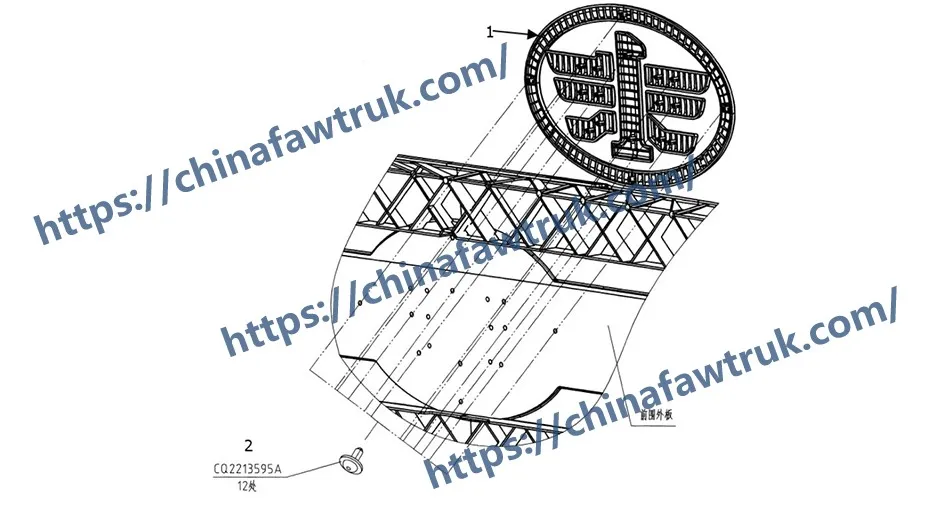
Le Emblème avant-couvercle de pare-chocs avant est la principale caractéristique d'identification du FAW J6P. C'est plus qu'un simple logo; c'est un ingénierie, assemblage multi-pièces conçu pour résister aux environnements difficiles tout en conservant une qualité supérieure, aspect impeccable. C'est la pièce maîtresse du panneau extérieur avant de la cabine..
Ce démontage analysera l'emblème avant (5302801-B26) et son matériel de montage spécialisé (CQ2213595A). Nous explorerons le processus de fabrication complexe de l'emblème, de son substrat ABS à son chromage multicouche, et le rôle critique de ses fixations à vis combinées.
Pour un technicien ou un propriétaire de flotte, le Emblème avant-couvercle de pare-chocs avant représente le professionnalisme du camion. Un endommagé, peeling, ou un emblème manquant dégrade considérablement l’apparence du véhicule. Comprendre son système de montage robuste est essentiel pour le remplacer correctement, assurer une sécurité, ajustement sans vibrations qui dure.
Ce composant est le “bijoux” de la Emblème avant-couvercle de pare-chocs avant système. C'est un complexe, composant multicouche conçu pour une durabilité et un impact visuel élevé.
1. Composant: « Emblème avant’ (5302801-B26) – Quantité 1
Ce (Marque 1) est l'emblème avant complet. Ce n'est pas un simple autocollant ou un seul morceau de plastique. Il s'agit d'un assemblage sophistiqué fabriqué selon les normes automobiles les plus élevées..
La logique du substrat: La base de l'emblème est un substrat moulé par injection fabriqué à partir de matériaux de haute qualité., ABS vierge (Acrylonitrile Butadiène Styrène). Ce matériau est choisi pour son excellente stabilité dimensionnelle (il ne se déformera pas au soleil), sa qualité de surface supérieure, et sa capacité à adhérer parfaitement aux couches électrolytiques.
La logique de la galvanoplastie: Le brillant “chrome” la finition n'est pas de la peinture. C'est un complexe, processus de galvanoplastie en plusieurs étapes. Le substrat ABS est d'abord gravé, puis trempé dans une série de bains pour appliquer une couche de nickel (pour l'adhérence et la résistance à la corrosion), suivi d'une couche de cuivre (pour une douceur, surface brillante), et enfin la couche supérieure de chrome (pour la brillance bleu-blanc et la dureté de la surface).
Ce processus est ce qui donne au Emblème avant-couvercle de pare-chocs avant son véritable éclat métallique et sa résistance aux éclats de pierre et aux retombées environnementales.
La logique de protection UV: Après galvanoplastie, l'ensemble de l'emblème avant est recouvert d'un fini, laque transparente de qualité automobile. Cette couche transparente constitue la principale défense de l’emblème contre les éléments.. Il contient des niveaux élevés d'inhibiteurs UV pour empêcher le soleil de “jaunissement” ou “buée” le substrat chromé et plastique au fil du temps. Il fournit également un “aspect mouillé” et rend l'emblème plus facile à nettoyer.
La logique du patron de montage: Le revers de l'emblème comporte plusieurs (dans ce cas, 10) moulé “les patrons” ou “goujons.” Ce sont des cylindres creux en plastique qui remplissent deux fonctions: 1. Ils agissent comme des broches d'alignement, S'insère dans les trous pré-percés sur le couvercle du pare-chocs pour garantir que l'emblème est *parfaitement* de niveau et centré.. 2. Ils agissent comme “femelle” filetages pour les vis taraudeuses (Cœur 2).
La logique de service: L'emblème avant est une unité non réparable. Si le chrome s'écaille, fissuré par un éclat de pierre, ou endommagé par des produits chimiques agressifs, toute la pièce 5302801-B26 doit être remplacée. Le remplacement est un élément clé de la réparation d’une collision pour restaurer l’état du véhicule. “comme neuf” apparence.
Cette logique décrit le “Couverture de pare-chocs avant” lui-même, qui est le “Panneau extérieur avant” (Peau du front) référencé dans le titre du schéma. Ce panel est l'hôte de l'ensemble Emblème avant-couvercle de pare-chocs avant système.
La logique matérielle: Le couvercle du pare-chocs est très grand, moulage complexe, généralement constitué d'un flexible, polymère résistant aux chocs comme le TPO (Oléfine thermoplastique) ou un PC/PBT (Polycarbonate/polybutylène téréphtalate) mélange. Ce matériau est choisi pour son “impacter la mémoire.”
La logique de la mémoire d’impact: Le TPO est utilisé sur les camions à benne basculante car il peut se déformer considérablement sous un impact à faible vitesse (Par exemple, heurter un tas de gravier) puis reprend sa forme originale. Cette flexibilité évite les fissures et les éclats coûteux associés aux plastiques plus rigides., sauver le panneau des impacts mineurs.
Le “Classe A” Logique de surface: L'extérieur du panneau est un “Classe A” finition. Il s'agit d'un terme de fabrication automobile désignant une surface parfaitement lisse., exempt de toute trace de moisissure, coule, ou des imperfections, et est prêt à accepter une qualité, finition peinture couleur carrosserie. Le Emblème avant-couvercle de pare-chocs avant s'appuie sur cette surface parfaite pour son ajustement haut de gamme.
La logique de précision: Cette coque de pare-chocs avant n'est pas seulement une peau cosmétique.. Il s'agit d'un composant conçu avec des centaines de fonctionnalités intégrées. Il comporte des points de montage moulés pour la barre de renfort en acier, les phares, la grille principale, et, le plus important, le Emblème avant.
Les moules d'usine 10 trous pilotes de précision dans le panneau. Ces trous correspondent parfaitement au 10 bossages de montage au dos de l'emblème (Cœur 1). Cette ingénierie de précision garantit que l'emblème est installé parfaitement droit., centré, et de niveau sur chaque camion qui quitte l'usine.
Ce sont les attaches critiques qui lient physiquement l'emblème (Cœur 1) au couvercle du pare-chocs (Cœur 2), complétant le Emblème avant-couvercle de pare-chocs avant assemblée.
1. Composant: « Ensemble vis taraudeuse à tête cylindrique à empreinte cruciforme et rondelle plate’ (CQ2213595A) – Quantité 10
Ce (Marque 2) est l'ensemble complet de 10 attaches identiques. Le numéro de pièce désigne un “combinaison” ou “Sems” vis.
La logique de combinaison: Le terme “assemblée” (Assemblée) est la clé. Il ne s'agit pas d'une vis et d'une rondelle séparées. Il s'agit d'un composant pré-assemblé où la rondelle plate est “captif” sous la tête de vis et ne peut pas tomber.
Cette conception est essentielle pour faciliter la fabrication. Un technicien (ou un robot) sur la chaîne de montage, travailler derrière le couvercle du pare-chocs, peut facilement installer la vis sans avoir à tâtonner avec un autre, petite rondelle. Il réalise l'assemblage du Emblème avant-couvercle de pare-chocs avant plus rapide et plus fiable.
La logique de répartition de la charge: Le “rondelle simple” (Rondelle plate) est un élément d'ingénierie essentiel. Son rôle est de répartir la force de serrage de la vis sur une surface plus large.. Sans cette rondelle, la petite tête de vis concentrerait toute sa force sur un anneau étroit, ce qui créerait un point de tension et fissurerait le bossage de fixation en plastique de l'emblème. La laveuse empêche cela, assurer une sécurité, ajustement durable.
Le “Vis taraudeuse” Logique: Ce sont “autotaraudeuse” (Vis autotaraudeuses). Les vis ont des filetages durcis conçus pour être enfoncés directement dans le plastique plus souple des bossages de montage de l'emblème. (Cœur 1). Ils coupent leurs propres fils au fur et à mesure de leur installation, créant un environnement extrêmement serré, précis, et connexion résistante aux vibrations.
La logique quantitative: Dix attaches pour un seul emblème peuvent paraître excessives, mais c'est intentionnel. Le Emblème avant est grand et plat, l'exposant à un vent important à vitesse d'autoroute. En utilisant 10 les points de fixation garantissent que l'emblème est parfaitement maintenu contre le couvercle du pare-chocs, sans “levage” ou “fléchissement” sur les bords. Cela évite le bruit du vent, hochets, et l'humidité/la glace provenant de l'emblème.
La logique de service: Ces fixations sont la clé pour remplacer un Emblème avant. Un technicien doit accéder à l'*arrière* du Emblème avant-couvercle de pare-chocs avant pour les supprimer 10 vis. Lors de l'installation du nouvel emblème, ces vis doivent être serrées soigneusement à la main. L’utilisation d’un outil électrique peut facilement les serrer trop fort, enlever les nouveaux bossages en plastique et détruire le tout nouvel emblème.
Le tableau suivant fournit l'intégralité, ventilation détaillée de tous 2 types de composants spécifiés pour le Emblème avant-couvercle de pare-chocs avant système sur le FAW Jiefang CA3250P66K2L1T1E 6×4 tombereau.
| Marque | Partie no. | Nom de la pièce | Quantité |
|---|---|---|---|
| 1 | 5302801-B26 | Emblème avant | 1 |
| 2 | CQ2213595A | Ensemble vis taraudeuse à tête cylindrique à empreinte cruciforme et rondelle plate | 10 |
Les spécifications pour le Emblème avant-couvercle de pare-chocs avant se définissent par son rôle de prime, durable, et élément de marque esthétique.
| Demande de véhicule | FAW Jiefang CA3250P66K2L1T1E 6×4 Tombereau |
| Groupe système | Emblème avant-couvercle de pare-chocs avant |
| Composant principal | « Emblème avant’ (5302801-B26) |
| Substrat d'emblème | Plastique ABS moulé par injection |
| Finition de l'emblème | Chrome électrolytique multicouche (Nickel, Cuivre, Chrome) |
| Protection de l'emblème | Couche de finition laquée transparente résistante aux UV |
| Matériel de montage | « Ensemble vis taraudeuse à tête cylindrique à empreinte cruciforme et rondelle plate’ |
| Numéro de pièce du matériel. | CQ2213595A |
| Type de matériel | Vis Sems (Laveuse captive) / Autotaraudeuse |
| Quantité de matériel | 10 |
| Panneau hôte | Couverture de pare-chocs avant / Panneau extérieur avant |
Pièces FAW, y compris l'ensemble bloc-cylindres, sont emballés avec soin pour garantir une livraison en toute sécurité. Chaque composant est sécurisé dans des matériaux de protection pour éviter tout dommage pendant le transport. Le réseau logistique garantit des expéditions ponctuelles dans le monde entier, soutenir des opérations de maintenance efficaces. Vous trouverez ci-dessous une image illustrant l'emballage standard des pièces de camion FAW., mettant en valeur l’attention portée aux détails dans la manipulation et le stockage.
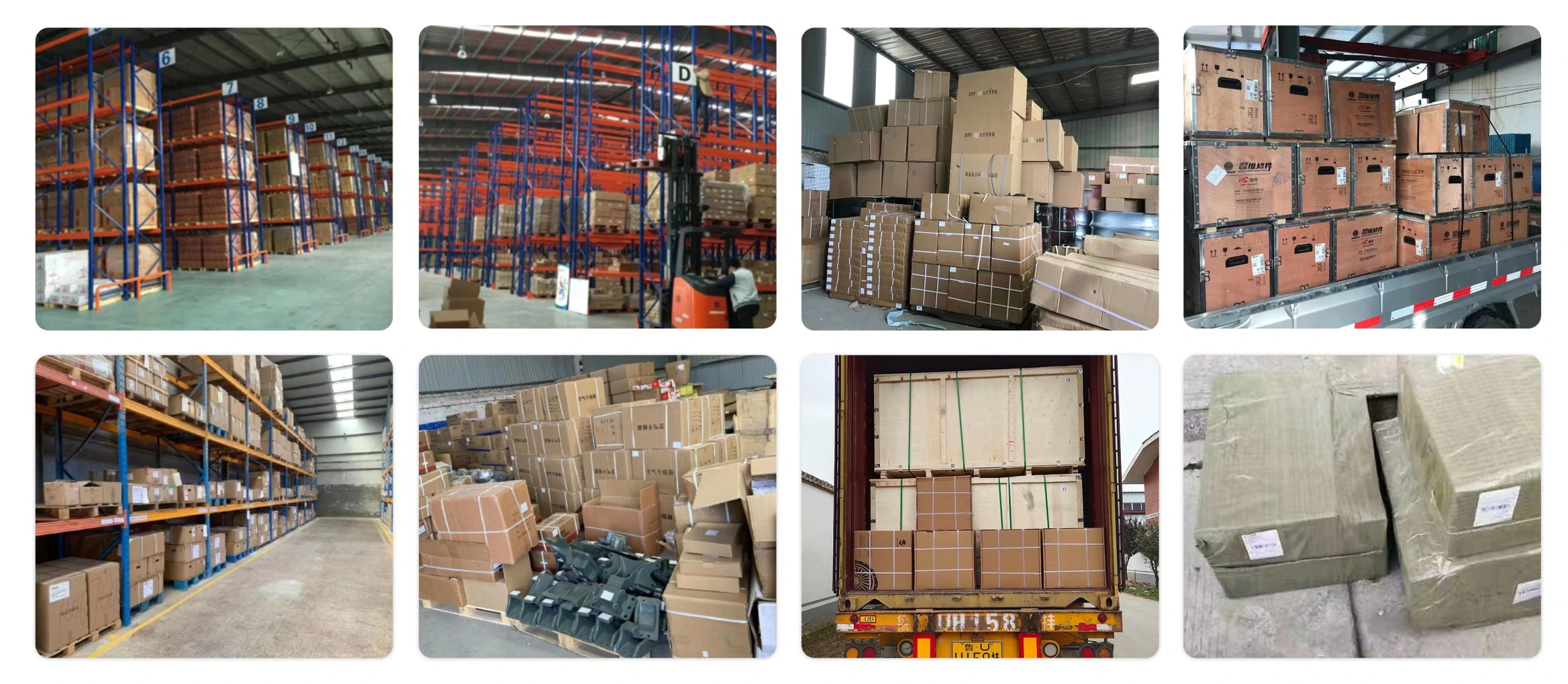
Cette approche d'emballage minimise le risque de corrosion ou de dommages causés par les chocs., s'assurer que les pièces comme l'ensemble bloc-cylindres FAW arrivent en parfait état. Les clients peuvent compter sur la logistique de FAW pour une qualité et une fiabilité constantes.