par 


Bienvenue dans ce guide essentiel sur le Tuyaux de chauffage FAW J6P Pour le FAW Jiefang CA3250P66K2L1T1E 6×4 tombereau. Ce ne sont pas que des tubes; ce sont les artères critiques du système climatique de la cabine, essentiel pour la sécurité et le confort du conducteur par temps froid. Ce guide détaille les 4 pièces critiques qui garantissent un circuit de chauffage étanche.
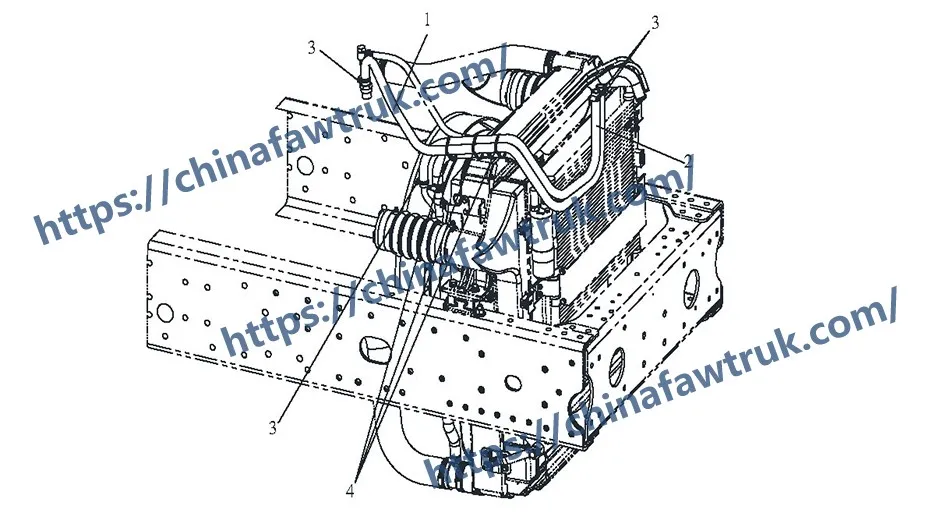
Le Tuyaux de chauffage FAW J6P Le système remplit un double objectif essentiel au fonctionnement d'un camion-benne lourd. Sa fonction la plus évidente est le confort du conducteur, fournir de la chaleur à la cabine dans des conditions inférieures à zéro. Plus important encore, c'est un système de sécurité critique, car il fournit le liquide de refroidissement chaud nécessaire au fonctionnement de l'unité CVC. “décongeler” et “désembuage” le pare-brise massif.
Ce démontage analysera l'ensemble complet des composants, y compris les tuyaux EPDM haute température, les colliers à vis sans fin en inox, et la sangle de protection. Le Tuyaux de chauffage FAW J6P doit transporter de manière fiable sous pression, liquide de refroidissement moteur haute température (un mélange de glycol et d'eau) du bloc moteur, à travers le pare-feu, au radiateur de chauffage de la cabine, et retour au moteur.
Une panne dans ce système est un événement de service critique. Une fuite dans le Tuyaux de chauffage FAW J6P peut vider chaud, liquide de refroidissement sous pression, potentiellement embuer la cabine ou provoquer une surchauffe du moteur si le niveau de liquide de refroidissement descend trop bas. Pour un technicien, comprendre ce système est essentiel pour diagnostiquer les fuites, “pas de chaleur” plaintes, et assurer une sécurité, réparation durable.
Ces deux composants sont les artères primaires du Tuyaux de chauffage FAW J6P système. Ce sont les conduits flexibles qui déplacent la chaleur du moteur vers la cabine..
1. Composant: « Tuyau d'arrivée’ (8116711-14B) – Quantité 1
Ce (Marque 1) est le “pression” ou “entrée” tuyau. Il transporte le liquide de refroidissement le plus chaud (jusqu'à 100°C / 212° F) *depuis* un port sur le bloc moteur *vers* l'entrée du radiateur de chauffage, qui est situé à l’intérieur de l’unité CVC de la cabine.
La logique matérielle (EPDM): Ce n'est pas un simple tube. Il s'agit d'un tuyau de haute spécification en EPDM (Monomère d'éthylène propylène diène) caoutchouc. L'EPDM est la norme industrielle pour les systèmes de refroidissement car il a une tolérance de température extrêmement élevée et est chimiquement inerte vis-à-vis de l'éthylène glycol. (antigel) et additifs anticorrosion.
La logique de renforcement: Le Tuyaux de chauffage FAW J6P le système est pressurisé à 15-20 psi. Pour éviter que le tuyau ne gonfle, “montgolfière,” ou éclater, il est renforcé intérieurement par une tresse textile, souvent constitué de fibres d'aramide ou de polyester à haute résistance. Ce squelette interne contient la pression, tandis que l'EPDM contient le fluide.
2. Composant: « Tuyau de sortie’ (8116712-14B) – Quantité 1
Ce (Marque 2) est le “retour” ou “sortie” tuyau. Il complète le circuit, transporter le liquide de refroidissement maintenant légèrement plus froid *de* la sortie du radiateur de chauffage *retour* au moteur, se connectant généralement à la pompe à eau à recirculer.
Le “Pré-moulé” Logique: Ces deux-là Tuyaux de chauffage FAW J6P sont “pré-moulé” ou “formé” tuyaux. Ils sont fabriqués avec des, virages et courbes complexes. Il s'agit d'une caractéristique de conception essentielle. Un technicien ne peut pas les remplacer par un tuyau droit. La forme prémoulée est essentielle pour acheminer parfaitement les flexibles à travers le pare-feu et autour des zones chaudes., composants du moteur vibrants sans “se tordre.”
Le “Torsion” Logique d'échec: Un coude dans un tuyau est un 100% blocage du flux. Si un bon marché, un tuyau droit est utilisé et il se plie au niveau du pare-feu, aucun liquide de refroidissement n'atteindra le radiateur de chauffage. Le conducteur se plaindra “pas de chaleur,” et le système semblera avoir échoué, alors qu'en fait la mauvaise pièce a été utilisée. Seulement le bon pré-moulé Tuyaux de chauffage FAW J6P fonctionnera.
La logique de service (Tuyaux): Les tuyaux sont des objets d'usure. Pendant de nombreuses années, l'EPDM “durcir” des cycles de chaleur, perdre sa flexibilité. Cela provoque la formation de fissures, surtout aux points de connexion, conduisant à des fuites lentes. Alternativement, le renfort interne peut se briser, ce qui donne l'impression que le tuyau “spongieux” ou “détrempé.” Un tuyau bombé est le signe d’une panne imminente et doit être remplacé immédiatement.
Ce sont sans doute les éléments les plus critiques du Tuyaux de chauffage FAW J6P système. Un tuyau de haute qualité est inutile si le collier tombe en panne.
1. Composant: « Collier de serrage à vis sans fin, type B’ (CQ67627B) – Quantité 4
Ce (Marque 3) est un ensemble de quatre « Worm-drive’ pinces, deux pour chaque tuyau (un côté moteur, un du côté du radiateur de chauffage).
La logique de serrage: La seule fonction de la pince est de fournir une vue à 360 degrés, à haute pression, joint à l'épreuve des fuites. Il comprime le tuyau flexible EPDM (Cœur 1) contre le tuyau métallique rigide (ou “mamelon”) du moteur et du radiateur de chauffage.
Le “Entraînement à vis sans fin” Logique: Ce mécanisme fournit une force de serrage élevée à partir d'un faible couple d'entrée. UN “ver” (la vis) s'engage dans les fentes du groupe. Alors que la vis est tournée, ça serre le groupe. Ce “Tapez B” la conception spécifie un “non perforé” ou “bord roulé” groupe. C'est supérieur au bon marché, pinces à fente, car la bande intérieure lisse offre une étanchéité uniforme et ne coupe pas le tuyau en caoutchouc.
La logique matérielle (Inoxydable): Ces pinces ne sont pas en acier ordinaire. Pour une application sur camion lourd, ce sont généralement “W4” ou “W5” grade, c'est à dire le groupe, logement, et les vis sont toutes en acier inoxydable de haute qualité. Ceci est obligatoire pour un composant qui vit dans une température élevée, environnement très humide et est constamment éclaboussé de sel de déneigement et d'eau. Les pinces en acier ordinaire rouilleraient, affaiblir, et échouer, ce qui fait exploser le tuyau.
La logique de service (Pinces): UN “pleurer” ou “goutte” du liquide de refroidissement est le #1 symptôme d'un échec Tuyaux de chauffage FAW J6P système. Il s’agit presque toujours d’une défaillance du couple de serrage, pas le tuyau lui-même. Comme le tuyau durcit avec l'âge, il “compresse,” et la pince perd sa tension.
La première étape d’un technicien consiste à resserrer les colliers. Cependant, un serrage excessif est une erreur courante et coûteuse. Un technicien doit utiliser un tourne-écrou, ce n'est pas un outil électrique à couple élevé, car il est très facile de dénuder les filetages du collier ou de casser le tuyau d'entrée/sortie en plastique du noyau chauffant, ce qui nécessite une suppression complète du tableau de bord.
Ce single, un composant simple est un élément crucial du Tuyaux de chauffage FAW J6P système, conçu pour prévenir un type spécifique de défaillance.
1. Composant: « Sangle en plastique’ (T67437676) – Quantité 1
Ce (Marque 4) est un serre-câble de qualité automobile, communément appelé zip-tie. Son numéro de pièce le désigne comme une taille spécifique et, le plus important, un matériau spécifique.
Le “Anti-frottement” Logique: La fonction principale de cette sangle est de sécuriser les deux Tuyaux de chauffage FAW J6P (Entrée et sortie) *ensemble*, ou pour les fixer sur un support fixe sur le châssis ou le moteur.
C'est un point critique “anti-vibration” ou “anti-frottement” mesure. Sans cette sangle, les deux tuyaux vibreraient indépendamment, frottant constamment les uns contre les autres ou contre un bord métallique tranchant du châssis. Sur des milliers de kilomètres, cette constante, haute fréquence “sciage” l'action frottera le caoutchouc extérieur et le renfort intérieur, provoquant l'éclatement d'un tuyau.
Le “Routage” Logique: Cette sangle garantit également que les tuyaux suivent leur destination, chemin sûr, les éloigner des composants mobiles (comme la courroie du ventilateur) ou des composants extrêmement chauds (comme le collecteur d'échappement ou le turbocompresseur).
La logique matérielle (Nylon 6/6): Ce n'est pas un bracelet en plastique standard. Il s'agit d'une cravate de qualité automobile fabriquée à partir de “Nylon 6/6 avec stabilisateur de chaleur.” Ce matériau spécifique est choisi pour son point de fusion élevé et sa résistance à “le dessèchement.” Il peut résister à la chaleur radiante élevée du compartiment moteur (100°C+) pendant des années sans devenir cassant et cassant, ce qu'une attache zippée commune dans une quincaillerie ferait.
La logique de service (Sangle): Il est courant que les techniciens coupent cette sangle (T67437676) pour y accéder lors du remplacement de l'un des Tuyaux de chauffage FAW J6P. Il est *obligatoire* qu'un nouveau, une sangle haute température équivalente est installée. Le fait de ne pas sécuriser à nouveau les tuyaux garantit une défaillance prématurée des nouvelles pièces en raison du frottement.
Le tableau suivant fournit l'intégralité, ventilation détaillée de tous 4 types de composants spécifiés pour le Tuyaux de chauffage FAW J6P système sur le FAW Jiefang CA3250P66K2L1T1E 6×4 tombereau.
| Marque | Partie no. | Nom de la pièce | Quantité |
|---|---|---|---|
| 1 | 8116711-14B | Tuyau d'arrivée | 1 |
| 2 | 8116712-14B | Tuyau de sortie | 1 |
| 3 | CQ67627B | Collier de serrage à vis sans fin, type B | 4 |
| 4 | T67437676 | Sangle en plastique | 1 |
Les spécifications pour le Tuyaux de chauffage FAW J6P sont définis par leur rôle de haute température, système de transport de fluide à haute pression pour la climatisation de la cabine.
| Demande de véhicule | FAW Jiefang CA3250P66K2L1T1E 6×4 Tombereau |
| Groupe système | Tuyaux de chauffage FAW J6P (Alimentation du noyau de chauffage) |
| Tuyau d'arrivée | « Tuyau d'arrivée’ (8116711-14B) |
| Tuyau de sortie | « Tuyau de sortie’ (8116712-14B) |
| Matériau du tuyau | Caoutchouc EPDM (Monomère d'éthylène propylène diène) |
| Renfort de tuyau | Tresse textile aramide ou polyester |
| Conception du tuyau | Pré-moulé (Formé) pour éviter de se tordre |
| Pinces | « Collier de serrage à vis sans fin, type B’ (CQ67627B) |
| Quantité de pince | 4 |
| Matériau de serrage | Acier inoxydable (Catégorie W4/W5) |
| Composant de routage | « Sangle en plastique’ (T67437676) |
| Système associé | Système de refroidissement du moteur, Unité CVC de cabine (Noyau de chauffage) |
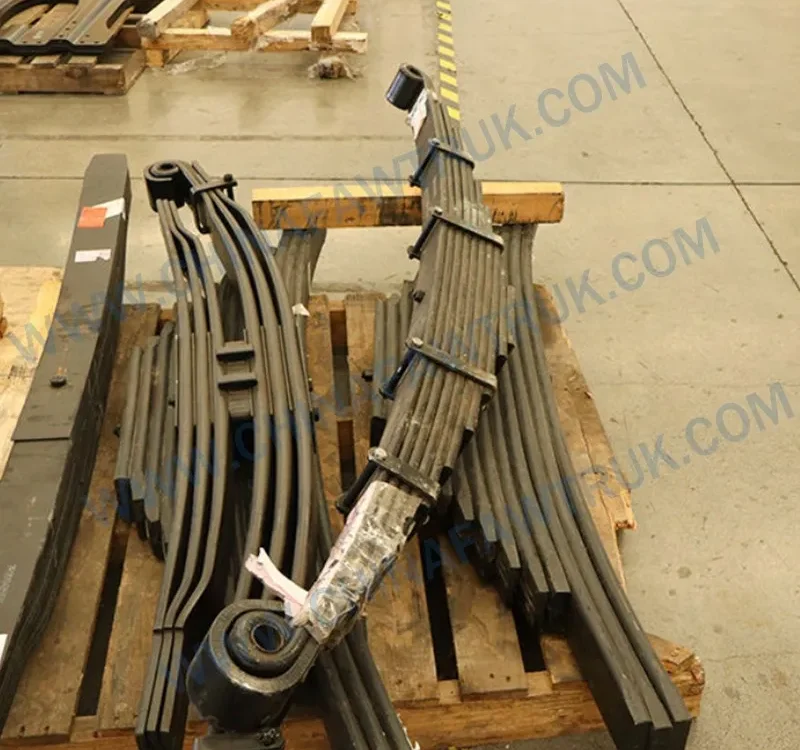
Pièces FAW, y compris l'ensemble bloc-cylindres, sont emballés avec soin pour garantir une livraison en toute sécurité. Chaque composant est sécurisé dans des matériaux de protection pour éviter tout dommage pendant le transport. Le réseau logistique garantit des expéditions ponctuelles dans le monde entier, soutenir des opérations de maintenance efficaces. Vous trouverez ci-dessous une image illustrant l'emballage standard des pièces de camion FAW., mettant en valeur l’attention portée aux détails dans la manipulation et le stockage.
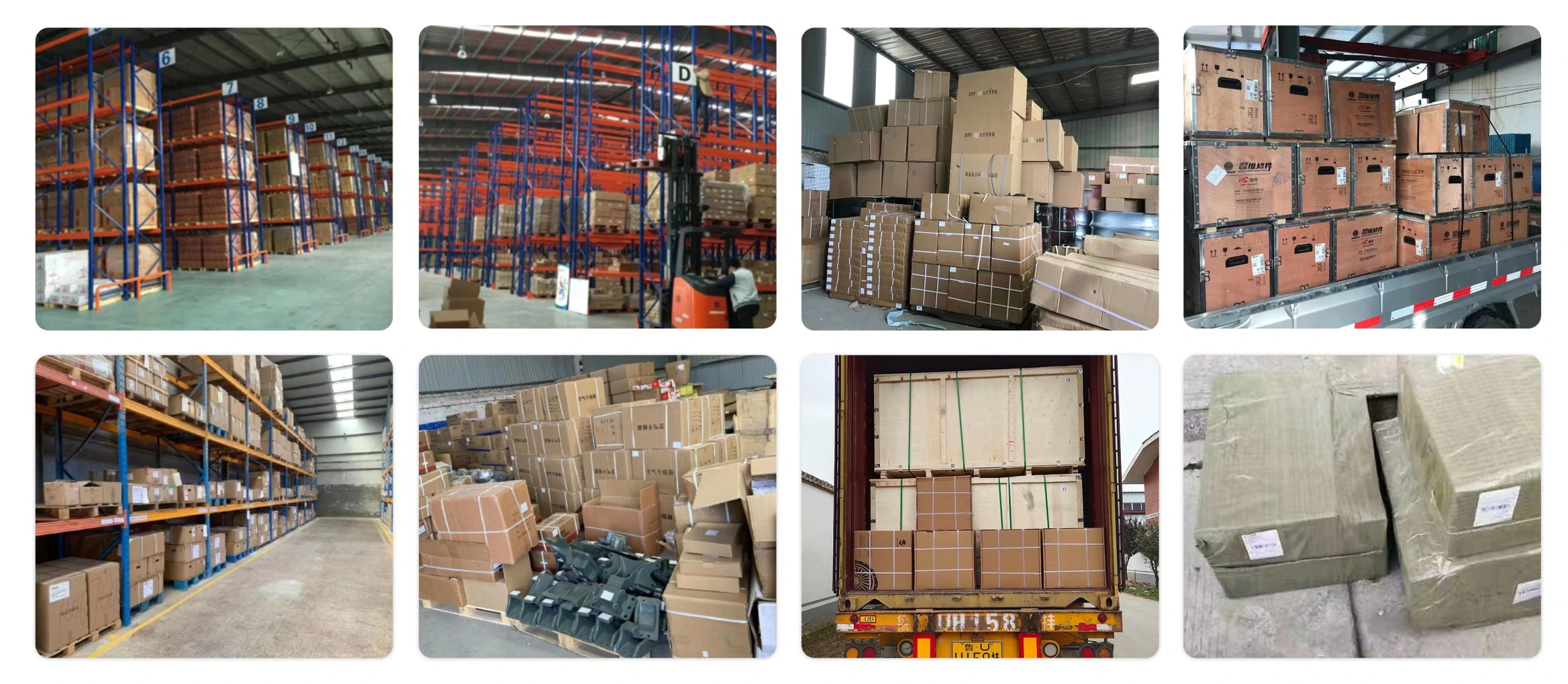
Cette approche d'emballage minimise le risque de corrosion ou de dommages causés par les chocs., s'assurer que les pièces comme l'ensemble bloc-cylindres FAW arrivent en parfait état. Les clients peuvent compter sur la logistique de FAW pour une qualité et une fiabilité constantes.