Vilebrequin russe FAW: 13 Composants critiques pour un couple arctique imparable
Le Vilebrequin russe FAW est l'épine dorsale du groupe motopropulseur CA3250P66K24L1TE5Z, convertir la force du piston en énergie de rotation qui propulse de lourdes charges à travers la toundra russe gelée. Cet assemblage comprend des technologies sophistiquées d'amortissement et d'étanchéité conçues pour résister à une contraction thermique extrême.. Ce guide décortique le volant d'inertie, amortisseur, et les vitesses essentielles au maintien de l'équilibre du moteur dans des conditions inférieures à zéro.
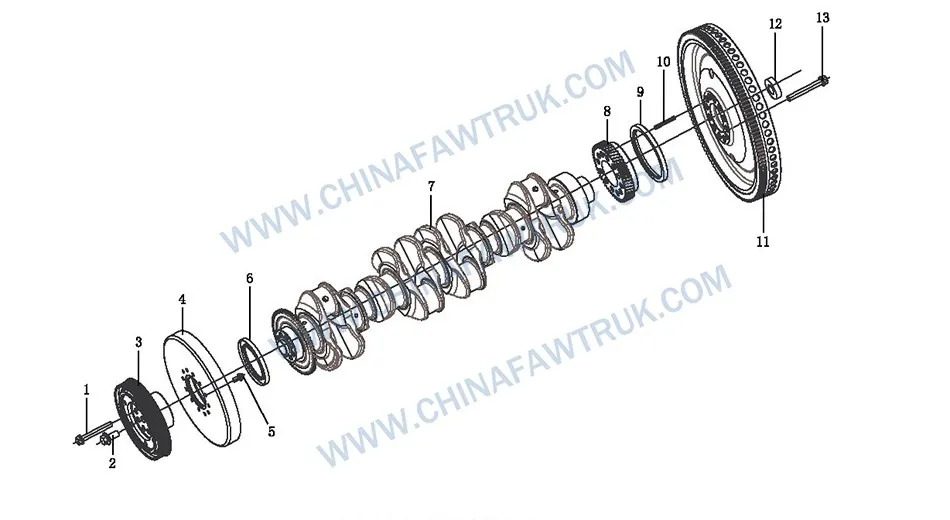
Vilebrequin russe FAW
Contrôle harmonique: L'architecture frontale
La longévité du Vilebrequin russe FAW dépend fortement de sa capacité à gérer les vibrations de torsion. L'élément principal de cette défense est le Ensemble d'amortisseur d'huile de silicone (Partie no. 1005195-81D). Contrairement aux amortisseurs en caoutchouc solide qui peuvent devenir cassants et se fissurer à des températures inférieures à -40°C., cette unité remplie de fluide utilise un fluide silicone à haute viscosité. Ce fluide conserve ses propriétés d'amortissement même par grand froid, absorber les forces de torsion générées par les impulsions d'allumage du moteur six cylindres et empêcher la rupture par fatigue du vilebrequin.
Fixer ce lourd amortisseur au nez du Vilebrequin russe FAW nécessite des attaches à haute résistance. L'assemblage utilise huit Boulons d'amortisseur (Partie no. 1005048-53D). Ces boulons sont soumis à des charges de cisaillement constantes et à une accélération de rotation. En utilisant des boulons de qualité standard, voici une recette pour le désastre; s'ils tondent, l'amortisseur peut se détacher, causant des dommages catastrophiques au radiateur et au carter de distribution avant. L'application correcte du couple sur ces boulons est essentielle pour garantir que l'amortisseur agit comme une masse unifiée avec la manivelle..
Entraîné par le nez du vilebrequin, le Poulie à courroie Poly-V (Partie no. 1005046A81D). Cette poulie alimente le ventilateur, alternateur, et pompe à eau. Dans le Vilebrequin russe FAW assemblée, cette poulie est équilibrée avec précision pour garantir qu'elle n'induit pas de vibrations secondaires. La finition de surface des rainures des poulies est traitée pour résister à la corrosion causée par le sel de déneigement et l'humidité., s'assurer que la courroie ne glisse pas pendant la demande de charge élevée d'un démarrage hivernal froid lorsque l'alternateur fonctionne à sa capacité maximale.
Engrenage de précision: Synchronisation de la distribution et de la pompe à huile
Derrière la couverture, le Vilebrequin russe FAW entraîne les systèmes vitaux du moteur grâce à une série d’engrenages robustes. Le Engrenage de chronométrage du vilebrequin (Partie no. 1005037-81D) est fretté sur le museau du vilebrequin. Cet engrenage est responsable de la synchronisation de l'arbre à cames et de la pompe d'injection. Dans la spécification russe, la métallurgie de cet engrenage est durcie pour résister à l'usure des dents causée par le jeu de couple élevé qui se produit pendant le ralenti à froid. Toute usure ici modifie le calage de l'injection, conduisant à des démarrages difficiles et de la fumée blanche.
Adjacent au pignon de distribution se trouve le Ensemble d'engrenages de pompe à huile de vilebrequin (Partie no. 1005015-81D). Ce composant est sans doute l’entraînement auxiliaire le plus critique de tout le Vilebrequin russe FAW système. Il entraîne la pompe à huile qui lubrifie les roulements principaux. Le profil d'engrenage est conçu pour un fonctionnement silencieux et une zone de contact maximale. Si cet équipement tombe en panne ou glisse, la pression d'huile chute instantanément, conduisant à un moteur grippé. La tolérance d'ajustement par pression de cet engrenage sur le tourillon de vilebrequin est mesurée en microns pour éviter tout glissement sous charge..
L'alignement précis de ces engrenages est maintenu par le Pignon d'entraînement et goupille de volant moteur (Partie no. 1005031-29D). Bien que petit, cette goupille garantit que le pignon de distribution est correctement indexé par rapport au Point Mort Haut (PMH). Dans le Vilebrequin russe FAW assemblée, cette goupille doit résister aux forces de cisaillement lors d'une décélération rapide du moteur. Il sert de point de référence mécanique pour toute la logique de synchronisation du moteur., garantir que les événements de soupape et l'injection de carburant se produisent à la milliseconde précise requise pour la combustion.
Architecture d'étanchéité: Prévenir la perte de pétrole dans le froid arctique
La conservation de l'huile moteur à des températures inférieures à zéro constitue un défi technique important pour le secteur automobile. Vilebrequin russe FAW. L'avant du moteur est scellé par le Ensemble de joint d'huile avant de vilebrequin (Partie no. 1005050-53D). Ce joint comporte un matériau de lèvre spécialisé, souvent PTFE ou Viton, conçu pour rester flexible à -40°C. Les joints en caoutchouc standard durciraient et rainureraient la surface d'étanchéité du vilebrequin, conduisant à des fuites. Cet ensemble comprend une lèvre anti-poussière pour empêcher les graviers de route et la boue de glace de pénétrer dans le moteur et d'endommager la lèvre du joint d'huile primaire..
Du côté de la transmission, le Ensemble de joint d'huile arrière de vilebrequin (Partie no. 1005060-53D) gère une surface d’étanchéité de diamètre beaucoup plus grand. Ce joint est essentiel car son remplacement nécessite de séparer la transmission du moteur, une opération importante.. Le Vilebrequin russe FAW utilise un joint arrière de type cassette dans cette application. Cette conception comprend un manchon d'usure qui tourne avec la manivelle, ce qui signifie que la lèvre d'étanchéité frotte intérieurement contre le manchon plutôt que contre le coûteux tourillon de vilebrequin lui-même, protéger l'arbre des rainures d'usure au fil du temps.
L'intégrité de ces sceaux est vitale pour le Vilebrequin russe FAW environnement. Une fuite du joint principal arrière peut contaminer le disque d'embrayage, provoquant des glissements et des ruptures sur les pentes abruptes et glacées. Donc, la tolérance de fabrication du boîtier de joint et la finition de surface des tourillons de vilebrequin sont inspectées selon des normes rigoureuses. Les opérateurs de flotte en Russie donnent la priorité à l'utilisation de ces véritables, joints résistants au froid pour éviter les temps d'arrêt associés à “mouillé” boîtiers de cloche et manque d'huile.
Inertie et transmission: L'ensemble volant
L'extrémité de sortie du Vilebrequin russe FAW est dominé par le massif Assemblage du volant (Partie no. 1005120-73D). Ce composant en fonte remplit trois fonctions: il porte la couronne dentée du démarreur, fournit une surface de friction pour l'embrayage, et agit comme un réservoir d’énergie pour lisser les impulsions de puissance du moteur. La masse thermique de ce volant est calculée pour absorber la chaleur générée par le patinage de l'embrayage lors de lancements lourds dans la neige profonde sans déformation ni contrôle thermique..
Sécuriser cette lourde masse rotative est 12 haute résistance Boulons du volant (Partie no. 1005071-81D). Il s'agit de fixations à couple de serrage qui doivent être serrées selon un motif en étoile spécifique.. Dans le Vilebrequin russe FAW assemblée, ces boulons subissent d'immenses contraintes de cisaillement à chaque fois que l'embrayage est engagé. La réutilisation d'anciens boulons est strictement interdite car ils s'étirent lors de l'installation initiale.; les boulons réutilisés peuvent se casser, provoquant le détachement du volant - une panne catastrophique qui peut détruire le carter de transmission et le bloc moteur.
Au centre du volant se trouve le Roulement avant de l'arbre d'entrée (Partie no. 60305), souvent appelé roulement pilote. Ce roulement supporte la pointe de l'arbre d'entrée de transmission. Bien que petit, il est crucial pour le Vilebrequin russe FAW système. Un roulement pilote grippé maintiendra l'arbre de transmission en rotation même lorsque l'embrayage est enfoncé., rendant les changements de vitesse impossibles. Le véritable roulement FAW utilise une graisse à basse température qui ne se solidifie pas pendant l'hiver russe, assurer un changement de vitesse en douceur dès un démarrage à froid.
Liste de répartition des composants
Le tableau suivant répertorie les composants spécifiques du Vilebrequin russe FAW et ensemble volant moteur. Une identification correcte de ces pièces est essentielle pour garantir l'équilibre du moteur et l'intégrité de l'étanchéité lors des procédures de révision du CA3250P66K24L1TE5Z..
| Non. |
Numéro de pièce |
Nom de la pièce |
Quantité |
| 1 |
1005048-53D |
Boulon d'amortisseur |
8 |
| 2 |
Q1862040 (HB) |
Boulon de bride hexadécimal – Série élargie |
1 |
| 3 |
1005046A81D |
Poulie à courroie Poly-V |
1 |
| 4 |
1005195-81D |
Ensemble d'amortisseur d'huile de silicone |
1 |
| 5 |
Q1841020 |
Boulon de bride hexadécimal (Queue grossière/standard) |
12 |
| 6 |
1005050-53D |
Ensemble de joint d'huile avant de vilebrequin |
1 |
| 7 |
1005015-81D |
Ensemble d'engrenages de pompe à huile de vilebrequin |
1 |
| 8 |
1005037-81D |
Engrenage de chronométrage du vilebrequin |
1 |
| 9 |
1005060-53D |
Ensemble de joint d'huile arrière de vilebrequin |
1 |
| 10 |
1005031-29D |
Pignon d'entraînement et goupille de volant moteur |
1 |
| 11 |
1005120-73D |
Assemblage du volant |
1 |
| 12 |
60305 |
Roulement avant de l'arbre d'entrée |
1 |
| 13 |
1005071-81D |
Boulon du volant moteur |
12 |
Protocoles de diagnostic pour l'assemblage tournant
Inspecter le Vilebrequin russe FAW l'assemblage nécessite une attention aux détails. Le Ensemble d'amortisseur d'huile de silicone doit être vérifié visuellement pour détecter les fuites. Tout signe de fuite de fluide visqueux du boîtier de l'amortisseur indique une défaillance; un amortisseur compromis permettra des vibrations harmoniques dangereuses qui peuvent casser le vilebrequin. En plus, vérifiez la zone du joint en caoutchouc pour des fissures, bien que le fluide interne soit le principal moyen d'amortissement.
Les fuites d'huile à l'avant ou à l'arrière du moteur indiquent souvent une défaillance du Ensemble de joint d'huile avant de vilebrequin ou joint arrière. Dans les climats froids, vérifier si le système de reniflard est bloqué par la glace, car une pression élevée dans le carter peut forcer l'huile à dépasser même un joint sain. Si les joints sont remplacés, assurez-vous que la surface du tourillon de vilebrequin est polie et exempte de bavures pour éviter d'endommager immédiatement la nouvelle lèvre d'étanchéité.
Enfin, inspecter le Assemblage du volant surface de friction lors du remplacement de l'embrayage. Un contrôle thermique ou des fissures indiquent une surcharge. Assurer le Boulons du volant sont serrés selon les spécifications à l'aide d'une clé calibrée. Des boulons desserrés peuvent provoquer des vibrations qui imitent une défaillance des roulements du moteur. Vérifiez toujours le Roulement avant de l'arbre d'entrée pour une rotation en douceur; une sensation granuleuse nécessite un remplacement pour protéger l'arbre d'entrée de la transmission.
Conclusion: Les fondements de la durée de vie du moteur
Le Vilebrequin russe FAW est l’élément fondamental sur lequel repose la fiabilité de l’ensemble du moteur. Il gère les forces brutales de combustion et les convertit en énergie utilisable. Chaque composant qui y est attaché, de la Ensemble d'amortisseur d'huile de silicone au Assemblage du volant, joue un rôle essentiel dans l’équilibre de ces forces et dans le bon fonctionnement.
Pour les propriétaires de flotte opérant dans l’environnement impitoyable de la Fédération de Russie, utiliser des pièces d'origine FAW est le seul moyen de garantir la longévité. Les joints du marché secondaire peuvent geler et fuir, et les amortisseurs génériques peuvent ne pas réussir à arrêter les vibrations harmoniques. En maintenant le Vilebrequin russe FAW avec composants OEM, vous vous assurez que votre camion benne CA3250P66K24L1TE5Z demeure un atout fiable capable de conquérir les routes hivernales les plus difficiles.
Emballage et logistique
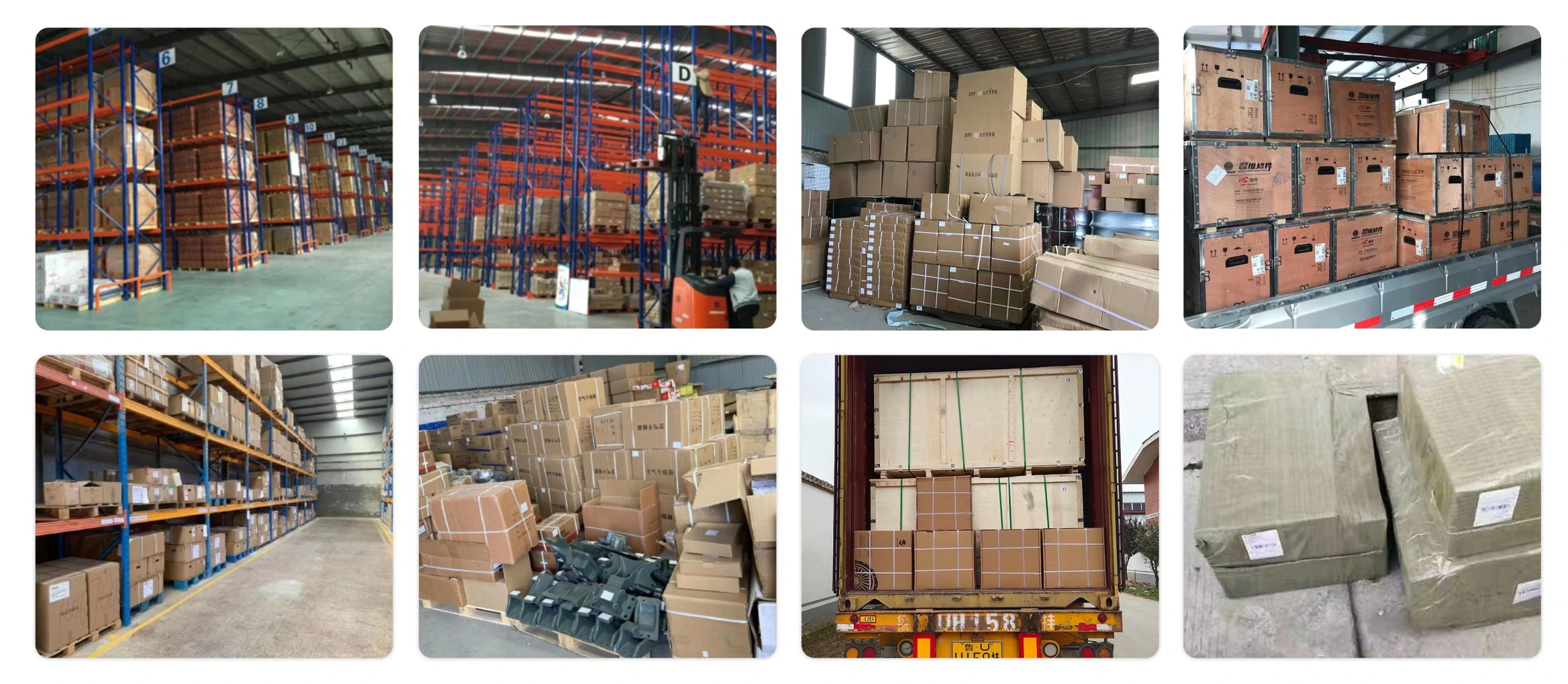
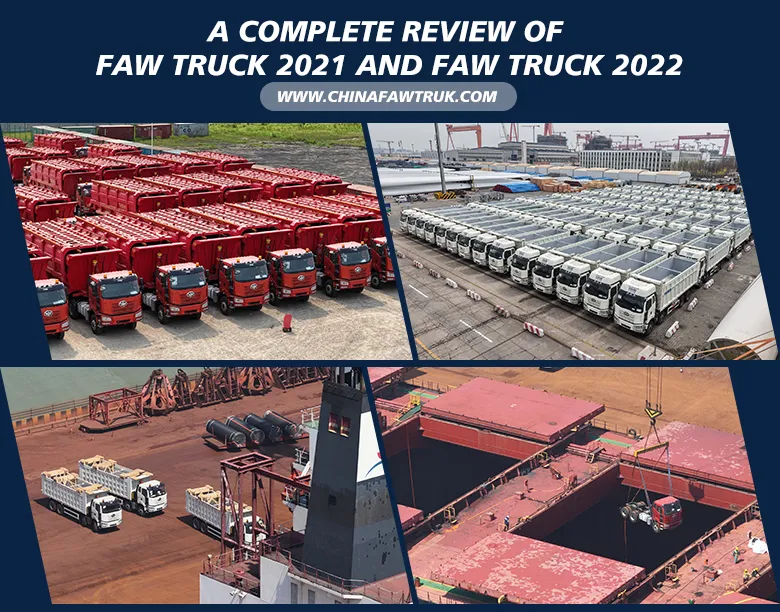
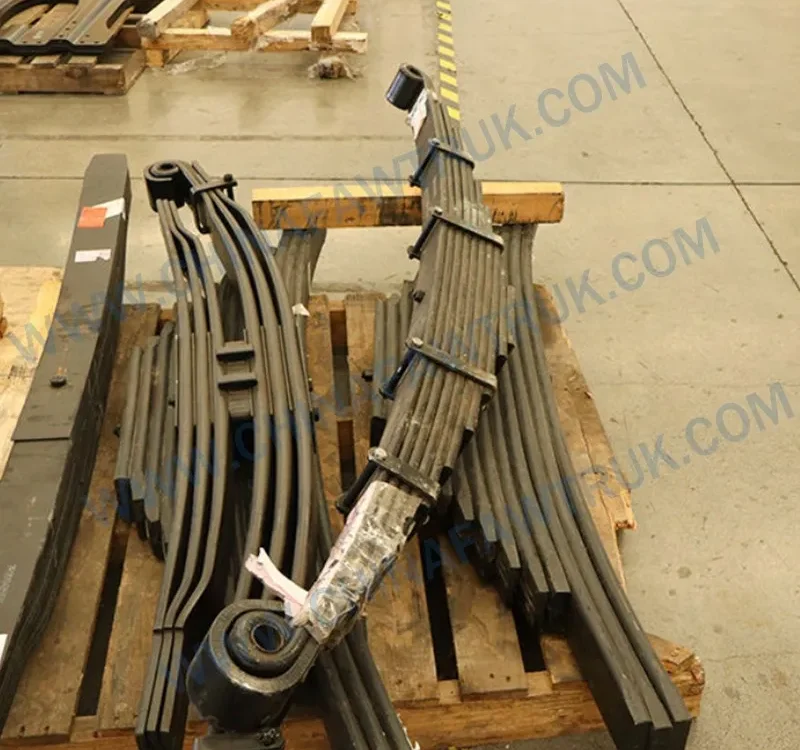
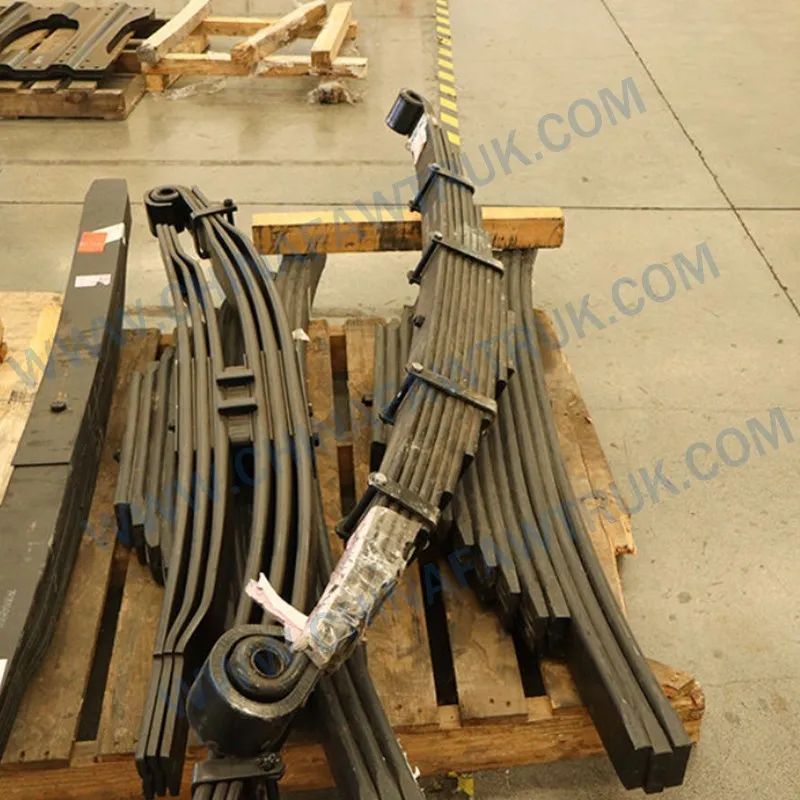
Pièces FAW, y compris l'ensemble bloc-cylindres, sont emballés avec soin pour garantir une livraison en toute sécurité. Chaque composant est sécurisé dans des matériaux de protection pour éviter tout dommage pendant le transport. Le réseau logistique garantit des expéditions ponctuelles dans le monde entier, soutenir des opérations de maintenance efficaces. Vous trouverez ci-dessous une image illustrant l'emballage standard des pièces de camion FAW., mettant en valeur l’attention portée aux détails dans la manipulation et le stockage.
Cette approche d'emballage minimise le risque de corrosion ou de dommages causés par les chocs., s'assurer que les pièces comme l'ensemble bloc-cylindres FAW arrivent en parfait état. Les clients peuvent compter sur la logistique de FAW pour une qualité et une fiabilité constantes.