Mécanisme de commande d'embrayage russe FAW: Maîtriser 12 Composants stratégiques pour un contrôle inflexible de la transmission
Le Mécanisme de commande d'embrayage russe FAW est le centre névralgique hydraulique et pneumatique de la transmission du camion-benne CA3250P66K24L1TE5Z. Combler l'écart entre la pédale du conducteur et le carter de transmission, cet assemblage traduit l'effort humain en un levier mécanique massif. Conçu pour l'étendue gelée de la Fédération de Russie, il assure une douceur, changement de vitesse sans fatigue, même lorsque les fluides hydrauliques s'épaississent dans des conditions de -40°C. Ce guide décortique le 12 composants essentiels définissant ce système.
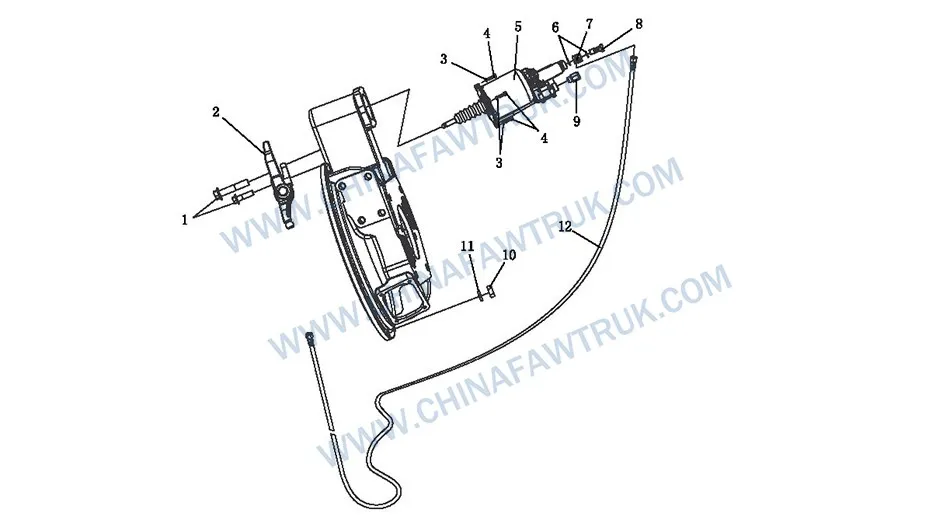
Ensemble logique du mécanisme de commande d'embrayage russe FAW
Dynamique d'actionnement: La pompe de surpression d'embrayage
Au coeur du Mécanisme de commande d'embrayage russe FAW ment le Ensemble de pompe de surpression d'embrayage (Partie no. 1602305A70A). Dans le cadre des poids lourds, l'actionnement manuel du plateau de pression d'embrayage nécessite une force immense, bien au-delà de ce qu'un conducteur peut supporter confortablement pendant un long quart de travail. La pompe de surpression utilise l'air comprimé du système pneumatique du véhicule pour amplifier la pression hydraulique générée par le maître-cylindre.. Ce “servo-assistance” réduit l'effort de pédalage jusqu'à 70%, un facteur essentiel pour la sécurité et la vigilance des conducteurs sur les dangereuses routes minières russes.
L'ingénierie spécifique au Mécanisme de commande d'embrayage russe FAW se concentre sur les joints internes du booster. Par grand froid, les joints en caoutchouc standard durcissent et rétrécissent, entraînant des fuites d'air ou un contournement du fluide hydraulique. Si le côté pneumatique fuit, le conducteur perd l'assistance électrique, rendant la pédale incroyablement lourde. Si le côté hydraulique fuit, l'embrayage ne parvient pas à se désengager complètement. FAW utilise des joints en nitrile ou en polyuréthane basse température conçus pour maintenir la flexibilité à -40°C, assurant une pression de suralimentation constante et une réponse immédiate.
En outre, le boîtier du booster est moulé en alliage résistant à la corrosion pour résister aux attaques externes des sels de déneigement et à l'accumulation d'humidité interne. Le mécanisme à tige de poussée à l'intérieur du Mécanisme de commande d'embrayage russe FAW le booster est usiné avec précision pour éviter le grippage. Toute friction ici entraînerait un “collant” pédale ou engagement incomplet de l’embrayage, entraînant une usure rapide du disque de friction. Ce composant représente l'intersection de la puissance pneumatique et de la précision hydraulique..
Logique mécanique: L'ensemble de fourche de dégagement
Traduire le mouvement linéaire du booster en mouvement de rotation nécessaire pour débrayer l'embrayage est la tâche du Ensemble fourche de dégagement et support (Partie no. 1602420-896). Au sein du Mécanisme de commande d'embrayage russe FAW, ce composant agit comme un levier robuste. Il pivote sur un point d'appui pour pousser la butée de débrayage contre le ressort diaphragme.. L'intégrité structurelle de cette fourche est primordiale; toute flexion ou flexion sous charge entraîne une perte de déplacement, ce qui signifie que l'embrayage peut traîner même lorsque la pédale est complètement enfoncée.
Le Mécanisme de commande d'embrayage russe FAW spécifie une fourche forgée en acier à haute résistance pour résister à la fatigue. Dans le cycle stop-and-go d'un camion-benne, cette fourche subit des millions de cycles de stress. Les points de pivotement sont durcis pour résister à l'usure. Si le pivot s'use, la géométrie du levier change, modifier le point d'engagement de la pédale. Dans le rude environnement russe, où le sable et la poussière sont omniprésents, l'étanchéité de la cloche autour de cette fourche est indispensable pour éviter l'usure abrasive des bagues de pivotement.
L'ensemble de support qui fixe la fourche doit être rigide. Il est fixé avec du matériel spécifique sur le carter de transmission. Tout jeu dans le support se traduit par des vibrations et du bruit dans le Mécanisme de commande d'embrayage russe FAW. La conception garantit que la fourche reste parfaitement alignée avec la butée de débrayage, empêchant les charges hors axe qui pourraient provoquer le grippage du roulement ou la rupture des pointes de fourche, une panne qui immobiliserait instantanément le véhicule.
Logique fluide: Tuyaux, Boulons creux, et rondelles
La pression hydraulique est délivrée via le Assemblage de tuyau d'huile – Embrayage (Partie no. 1602200-75U). Dans le Mécanisme de commande d'embrayage russe FAW, ce n'est pas un tuyau en caoutchouc standard. Il s'agit d'une ligne renforcée à haute pression conçue pour minimiser l'expansion volumétrique. Si le tuyau se dilate sous pression (montgolfière), la force hydraulique est perdue, entraînant une sensation de pédale spongieuse et un débrayage incomplet. Le matériau est également formulé pour résister au froid extrême, empêchant les fissures ou le raidissement qui pourraient transmettre les vibrations du châssis aux lignes dures.
Les points de connexion utilisent une solution intelligente peu encombrante: le Boulon creux (Partie no. 1602243-93C), souvent appelé boulon banjo, jumelé avec le Joint de transition – Tuyau d'huile (Partie no. 1602244-93C). Cette configuration permet à la conduite hydraulique de sortir du booster à un angle de 90 degrés, indispensable dans le châssis encombré du J6P. Le boulon creux doit être serré avec précision pour comprimer le Laveuse de scellage (Partie no. 1602242A70A) sans cisailler la tête du boulon.
Les rondelles d'étanchéité dans le Mécanisme de commande d'embrayage russe FAW sont généralement des rondelles d'écrasement en cuivre ou en aluminium. Ce sont des objets à usage unique. Une fois compressé, ils durcissent et forment une étanchéité parfaite contre le raccord banjo. La réutilisation de ces rondelles est une des principales causes de fuites hydrauliques. Une fuite dans le système d’embrayage introduit de l’air, qui est compressible, contrairement au fluide. Ce “sas” rend l'embrayage inutilisable. Donc, l'intégrité de ces petits composants d'étanchéité est essentielle à la fonctionnalité de l'ensemble Mécanisme de commande d'embrayage russe FAW.
Dynamique de fixation: Boulons à bride et contrôle des vibrations
Sécuriser les composants du Mécanisme de commande d'embrayage russe FAW nécessite un matériel robuste. Le système utilise Boulon à bride à tête hexagonale (Partie no. Q1851690T) et Boulon à tête hexagonale (Partie no. CQ1500825). Le boulon à bride est particulièrement important pour le montage de la pompe de surpression. La bride intégrée répartit la charge de serrage sur une zone plus large du boîtier du booster en aluminium, empêchant les fissures ou les déformations qui pourraient se produire avec une tête de boulon standard.
Pour lutter contre les vibrations intenses du groupe motopropulseur diesel, l'assemblage repose sur une multitude d'attaches de verrouillage: Écrou hexagonal (Partie no. CQ34010) et Rondelle à ressort (Partie no. Q40310). Il y a 12 de chacun dans l'assemblée, mettant en évidence les nombreux points de montage nécessaires pour maintenir les lignes et les supports en sécurité. La rondelle élastique agit comme un tendeur dynamique, maintenir la charge sur l'écrou même en cas de dilatation et de contraction thermiques.
Dans le Mécanisme de commande d'embrayage russe FAW logique, chaque fixation est un point de défaillance critique. Si un boulon de support se desserre, les conduites hydrauliques rigides peuvent vibrer jusqu'à se fatiguer et se casser. Si les boulons de montage du booster se desserrent, l'alignement de la tige de poussée change, provoquant une liaison. Donc, la spécification de haute qualité, fixations résistantes à la corrosion (probablement zingué ou phosphaté) est essentiel pour la fiabilité à long terme du système en milieu salin, conditions humides des routes russes.
Répartition des composants: 101. Mécanisme de commande d'embrayage
| Non. |
Numéro de pièce |
Nom de la pièce |
Quantité |
| 1 |
Q1851690T |
Boulon à bride à tête hexagonale |
2 |
| 2 |
1602420-896 |
Ensemble fourche de dégagement et support |
1 |
| 3 |
Q40308 |
Rondelle à ressort |
4 |
| 4 |
CQ1500825 |
Boulon à tête hexagonale |
4 |
| 5 |
1602305A70A |
Ensemble de pompe de surpression d'embrayage |
1 |
| 6 |
1602242A70A |
Laveuse de scellage |
2 |
| 7 |
1602244-93C |
Joint de transition – Tuyau d'huile |
1 |
| 8 |
1602243-93C |
Boulon creux |
1 |
| 9 |
3533055-55UN |
Assemblage de joint de tuyau droit – Vanne à deux voies |
1 |
| 10 |
CQ34010 |
Écrou hexagonal |
12 |
| 11 | Q40310 |
Rondelle à ressort |
12 |
| 12 |
1602200-75U |
Assemblage de tuyau d'huile – Embrayage |
1 |
Conclusion: L'interface transparente
Le Mécanisme de commande d'embrayage russe FAW est le héros méconnu de la maniabilité des véhicules. C'est l'interface qui permet au conducteur de commander le couple massif du moteur avec précision et facilité.. En amplifiant efficacement la force manuelle et en garantissant une intégrité hydraulique robuste, ce système transforme la tâche épuisante du changement de vitesse dans un camion lourd en un processus gérable, même en plein hiver.
Pour les exploitants de flotte, la maintenance de ce système est essentielle à la fidélisation des conducteurs et à la longévité des véhicules. Un booster défaillant ou un tuyau qui fuit non seulement retarde le camion, mais peut également entraîner une défaillance prématurée de l'embrayage en raison d'un engagement incomplet.. En investissant dans l'authentique Mécanisme de commande d'embrayage russe FAW composants - en particulier le booster par temps froid et la tuyauterie renforcée - les opérateurs s'assurent que leur flotte reste réactive, fiable, et prêt pour les travaux les plus difficiles.
Emballage et logistique
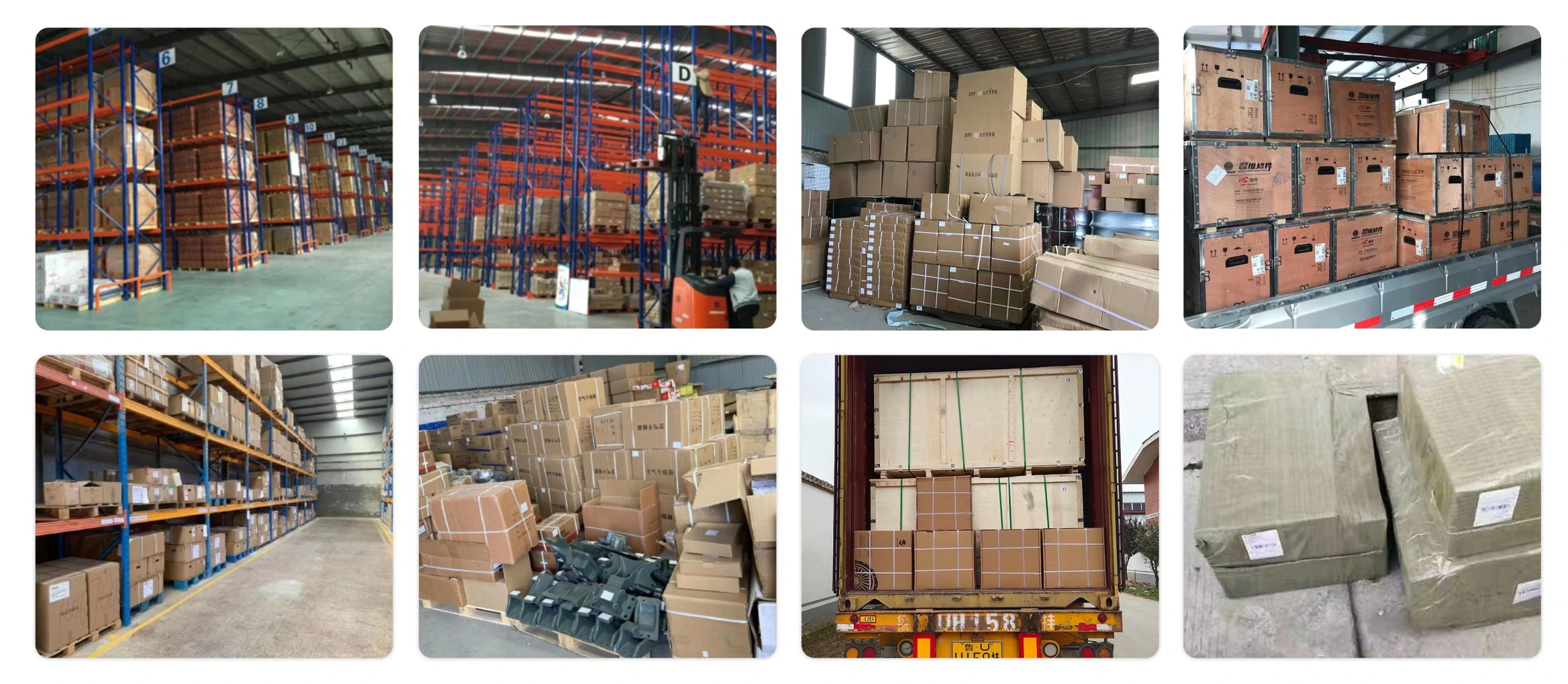
Pièces FAW, y compris l'ensemble bloc-cylindres, sont emballés avec soin pour garantir une livraison en toute sécurité. Chaque composant est sécurisé dans des matériaux de protection pour éviter tout dommage pendant le transport. Le réseau logistique garantit des expéditions ponctuelles dans le monde entier, soutenir des opérations de maintenance efficaces. Vous trouverez ci-dessous une image illustrant l'emballage standard des pièces de camion FAW., mettant en valeur l’attention portée aux détails dans la manipulation et le stockage.
Cette approche d'emballage minimise le risque de corrosion ou de dommages causés par les chocs., s'assurer que les pièces comme l'ensemble bloc-cylindres FAW arrivent en parfait état. Les clients peuvent compter sur la logistique de FAW pour une qualité et une fiabilité constantes.