FAW Russian Fuel Tank Module: 26 Precision Components for Unstoppable Arctic Fuel Delivery
The FAW Russian Fuel Tank Module is the strategic energy reservoir for the CA3250P66K24L1TE5Z dump truck. Engineered to combat diesel gelling and structural fatigue, this assembly ensures consistent fuel supply in temperatures reaching -40°C. This guide dissects the tank architecture, strapping logic, and sensing electronics required for reliable operation in the Russian Federation.

FAW Russian Fuel Tank Module
Reservoir Engineering: The Diesel Tank Assembly
The central component of this system is the Diesel Tank Assembly (Part No. 1101010-55R-C00). For the FAW Russian Fuel Tank Module, the material choice is critical. While traditional steel tanks are durable, they are prone to internal corrosion from condensation, a frequent occurrence in the Russian climate where tanks breathe in freezing moist air.
Therefore, this assembly typically utilizes a high-grade aluminum alloy or specially coated steel. This construction offers a high strength-to-weight ratio and superior resistance to the corrosive sulfur compounds often found in diesel fuel. The internal structure of the Diesel Tank Sub-assembly (Part No. 1101015-63U-C00) includes baffles. These are not merely structural reinforcements; they are hydrodynamic dampers.
When a dump truck navigates rough mining terrain, the fuel load sloshes violently. Without baffles, this movement would create hydraulic hammer effects that could rupture the tank seams or starve the pickup tube. The FAW Russian Fuel Tank Module baffling ensures a calm pool of fuel around the intake, preventing air aeration which causes injector cavitation.
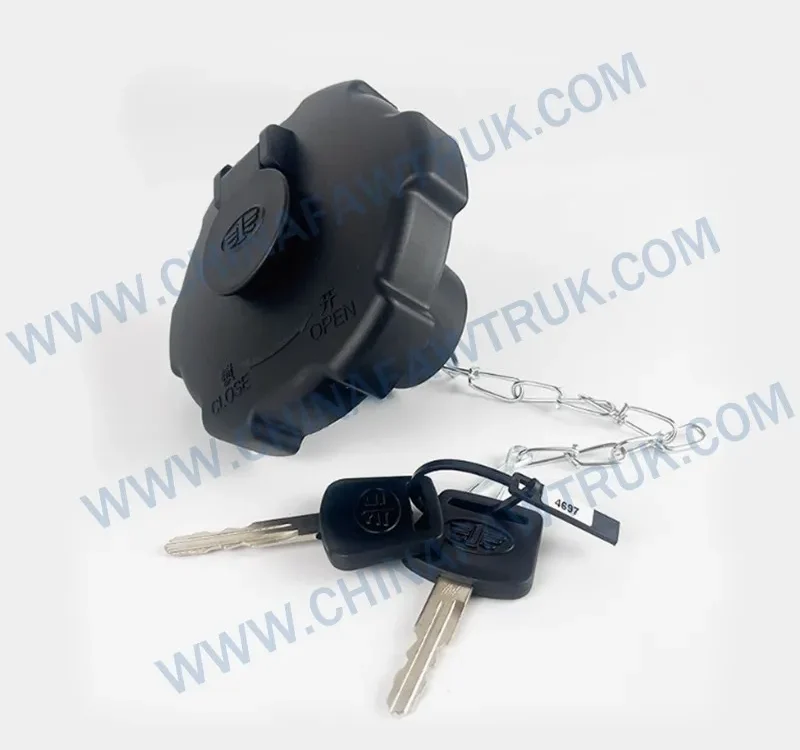
Access to the tank is governed by the Fuel Tank Cap Assembly (Part No. 1103010-59A). This is not a simple lid; it is a pressure-relief valve. As fuel is consumed, a vacuum forms; as the tank heats up, pressure builds. The cap regulates this breathing. In the FAW Russian Fuel Tank Module, the cap’s vents are designed to resist icing, ensuring the tank does not implode under vacuum during a long, cold descent.
Mounting Logic: Straps, Cushions, and Brackets
Securing hundreds of liters of diesel to a vibrating chassis requires a sophisticated mounting system. The FAW Russian Fuel Tank Module employs the Strap Assembly – Fuel Tank (Part No. 1101130C50A/1101135C50A). These steel bands are tensioned to hold the tank firmly against the brackets.
However, metal-on-metal contact is disastrous in a high-vibration environment. To prevent the straps from chafing through the tank walls, the assembly uses the Liner – Strap (Part No. 1101134C50A) and Liner – Bracket (Part No. 1101117C50A). These rubber or polymer cushions provide friction to hold the tank in place while absorbing high-frequency engine vibrations.
In the FAW Russian Fuel Tank Module, these liners must be made of a material that remains flexible at -40°C. Standard rubber would turn brittle and crack, leading to a loose tank. The brackets themselves, specifically the Rear Bracket Assembly – Fuel Tank (Part No. 1101205C50A), act as the load-bearing shelves. They are bolted to the chassis frame using high-tensile Hex Flange Bolts (Part No. Q1841445T/Q1841455T).
The fastening system also includes critical safety pins. The Flat Head Pin (Part No. Q5101485) and Cotter Pin (Part No. Q5004030) are used in the strap tensioning mechanism. The cotter pin prevents the tensioning nut from backing off due to vibration. In the FAW Russian Fuel Tank Module, checking these pins is a vital pre-trip inspection, as a loose strap can lead to the tank detaching from the vehicle.
Fluid Dynamics: Intake and Return Lines
The circulatory system of the FAW Russian Fuel Tank Module consists of various pipe assemblies. The Inlet Pipe Assembly – Filter to Transfer Pump (Part No. 1104130-58H) and Inlet Pipe Assembly – Tank to Prefilter (Part No. 1104120-58H) manage the suction side. These lines must resist collapsing under the vacuum created by the lift pump, especially when the fuel is cold and viscous.
The Return Pipe Assembly – Engine to Changeover Valve (Part No. 1104250-41T) is equally important. In diesel engines, the fuel is also a coolant for the injectors. Warm fuel returning to the tank helps raise the overall temperature of the bulk fuel, preventing waxing (gelling) in winter. The FAW Russian Fuel Tank Module piping layout is optimized to facilitate this thermal recirculation.
Connections are made using the Fuel Banjo Joint (Part No. 1104351A11B) and Hollow Bolt (Part No. 1104061-11B). This banjo-style connection allows for compact routing of fuel lines in tight spaces. Sealing these high-pressure joints are the Sealing Washers (Part No. CQ72318T5).
In the FAW Russian Fuel Tank Module, copper washers are preferred. Copper works hardens when torqued, creating a permanent seal that is impervious to the expansion and contraction caused by extreme temperature swings. Reusing these washers is a common error; they must be replaced every time a line is disconnected to ensure the FAW Russian Fuel Tank Module remains leak-free.
Data Feedback: Sensors and Safety Limits
Accurate fuel level monitoring is essential for logistics planning. The Fuel Sensor Assembly (Part No. 3806040-55R) is the probe that provides this data. In the FAW Russian Fuel Tank Module, this sensor often uses a float arm attached to a rheostat. The mechanism is damped to prevent the gauge needle from fluctuating wildly as fuel sloshes.
To protect this delicate mechanism, the system includes the Fuel Level Sensor Limit Plate (Part No. 3806041-61B). This physical stop prevents the float arm from over-extending and getting stuck against the tank baffles or walls during violent chassis movements. A stuck float would result in a false reading, potentially leaving a driver stranded with an empty tank.
The sensor’s electrical connections are also ruggedized for the FAW Russian Fuel Tank Module environment. The wiring harness is secured with the Plastic Cable Tie Assembly (Part No. 3724015-240). These are not standard nylon ties; they are cold-weather formulated to resist snapping in frost. Loose wires can chafe against the metal tank, leading to short circuits and fire hazards.
Component Breakdown List
The following table provides the complete, unedited breakdown of the FAW Russian Fuel Tank Module. Every washer, pin, and bracket is listed to ensure that maintenance teams can source the exact replacement parts needed to maintain the structural and hydraulic integrity of the fuel system.
| No. |
Part Number |
Part Name |
Qty |
| 1 |
3806041-61B |
Fuel Level Sensor Limit Plate |
1 |
| 2 |
3724015-240 |
Plastic Cable Tie Assembly |
6 |
| 3 |
1104250-41T |
Return Pipe Assembly – Engine to Changeover Valve |
1 |
| 4 |
1104130-58H |
Inlet Pipe Assembly – Filter to Transfer Pump |
1 |
| 5 |
1104301-50A |
Intake/Exhaust Pipe (Breather) |
1 |
| 6 |
1104120-58H |
Inlet Pipe Assembly – Tank to Prefilter |
1 |
| 7 |
CQ34012 |
Hex Nut |
4 |
| 8 |
Q40112 |
Washer |
2 |
| 9 |
Q5101485 |
Flat Head Pin |
2 |
| 10 |
Q40114 |
Washer |
4 |
| 11 |
Q5004030 |
Cotter Pin |
2 |
| 12 |
1101130C50A |
Strap Assembly – Fuel Tank |
1 |
| 13 |
1101135C50A |
Strap Assembly – Fuel Tank |
1 |
| 14 |
1101134C50A |
Liner – Strap |
2 |
| 15 |
1101010-55R-C00 |
Diesel Tank Assembly (with Level Sensor) |
1 |
| 15-1 |
1101015-63U-C00 |
Diesel Tank Sub-assembly |
1 |
| 15-2 |
3806040-55R |
Fuel Sensor Assembly |
1 |
| 15-3 |
1104450-11B |
Fuel Pipe Assembly |
1 |
| 15-4 |
CQ72318T5 |
Sealing Washer |
6 |
| 15-5 |
1104351A11B |
Fuel Banjo Joint |
2 |
| 15-6 |
1104061-11B |
Hollow Bolt |
2 |
| 16 |
1103010-59A |
Fuel Tank Cap Assembly |
1 |
| 17 |
1101117C50A |
Liner – Bracket |
2 |
| 18 |
1101205C50A |
Rear Bracket Assembly – Fuel Tank |
2 |
| 19 |
Q1841445T |
Hex Flange Bolt (Coarse Shank/Standard) |
4 |
| 20 |
Q1841455T |
Hex Flange Bolt |
2 |
Diagnostic Protocols for Tank Integrity
Inspecting the FAW Russian Fuel Tank Module starts with the straps. Check for corrosion on the Strap Assembly where it wraps under the tank. This is where road salt accumulates. Ensure the Liner – Strap is present and not degraded. If the rubber is missing, the steel strap will rub a hole in the aluminum tank wall, leading to a hazardous leak.
Examine the fuel lines for signs of weeping diesel. The Fuel Banjo Joint connections are common leak points if the Sealing Washers are reused or over-torqued. In winter, thermal contraction can loosen these fittings. A wet spot on the top of the tank indicates a leak in the return line or the sending unit seal.
Finally, verify the operation of the Fuel Sensor Assembly. If the gauge reads erratically or shows empty when the tank is full, the float arm may be stuck or the rheostat worn. Checking the ground connection on the tank is a quick first step, as aluminum tanks rely on the straps and brackets for electrical grounding to the chassis.
Conclusion: The Foundation of Range
The FAW Russian Fuel Tank Module is a robust storage solution designed to withstand the physical and environmental abuse of Russian logistics. Its capacity and construction ensure that the CA3250P66K24L1TE5Z can operate for long shifts without refueling, a critical factor in remote mining or construction sites.
From the baffled interior of the Diesel Tank Assembly to the secure locking mechanism of the Strap Assembly, every component works in concert to keep the fuel safe and the engine fed. By using genuine FAW replacement parts, fleet owners ensure that their trucks maintain the safety standards and operational reliability required for the demanding Russian market.
Packaging and Logistics
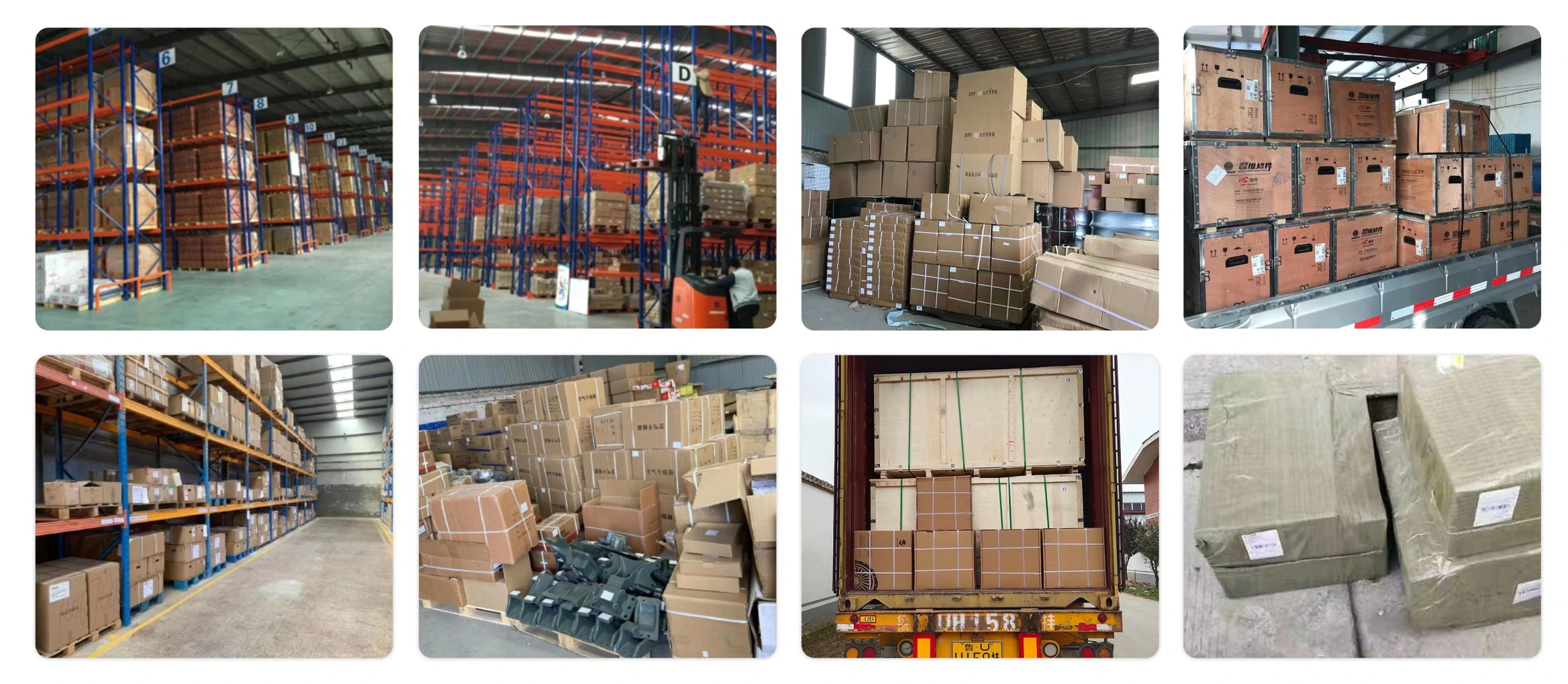
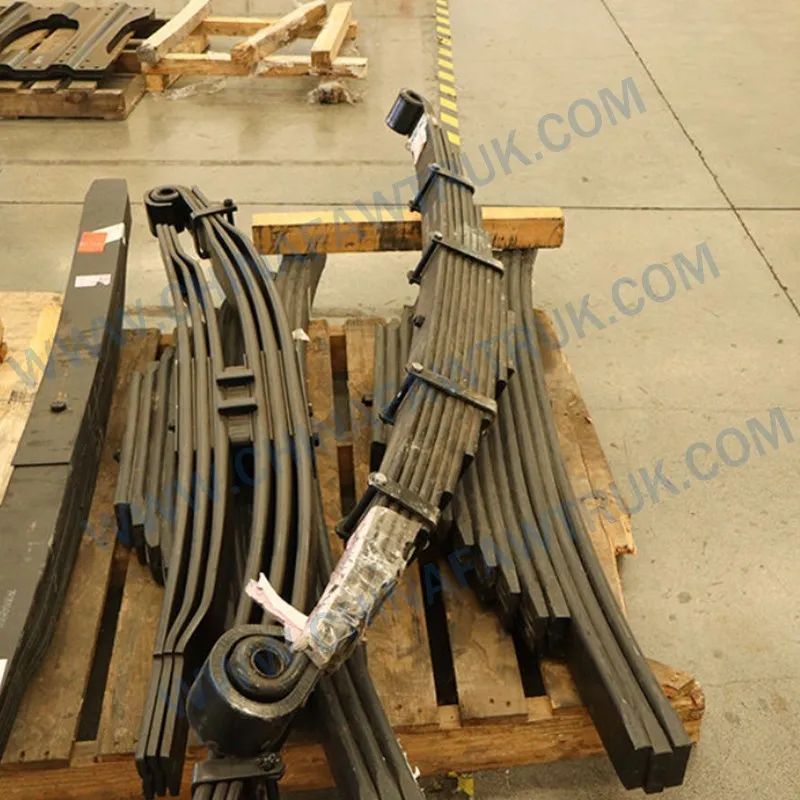
FAW parts, including the Cylinder Block Assembly, are packaged with care to ensure safe delivery. Each component is secured in protective materials to prevent damage during transit. The logistics network guarantees timely shipments worldwide, supporting efficient maintenance operations. Below is an image illustrating the standard packaging for FAW truck parts, showcasing the attention to detail in handling and storage.
This packaging approach minimizes the risk of corrosion or impact damage, ensuring that parts like the FAW Cylinder Block Assembly arrive in perfect condition. Customers can rely on FAW’s logistics for consistent quality and reliability.