by 


Welcome to this critical deconstruction of the FAW J6P Storage Tank for the FAW Jiefang CA3250P66K2L1T1E 6×4 dump truck. This component, also known as the Receiver Drier, is the A/C system’s primary filter and guardian. This guide analyzes the 2 key parts that form this essential assembly.

The FAW J6P Storage Tank (Receiver Drier) is a vital, non-negotiable component in the high-pressure liquid line of the air conditioning system. Its function is far more complex than a simple “tank.” It is a three-in-one device: it stores liquid refrigerant, it filters debris, and (most importantly) it traps catastrophic moisture.
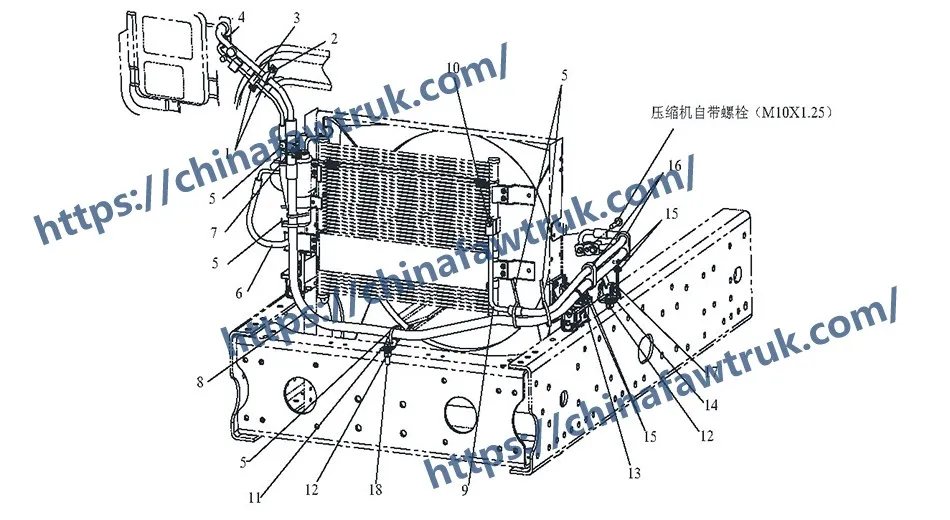
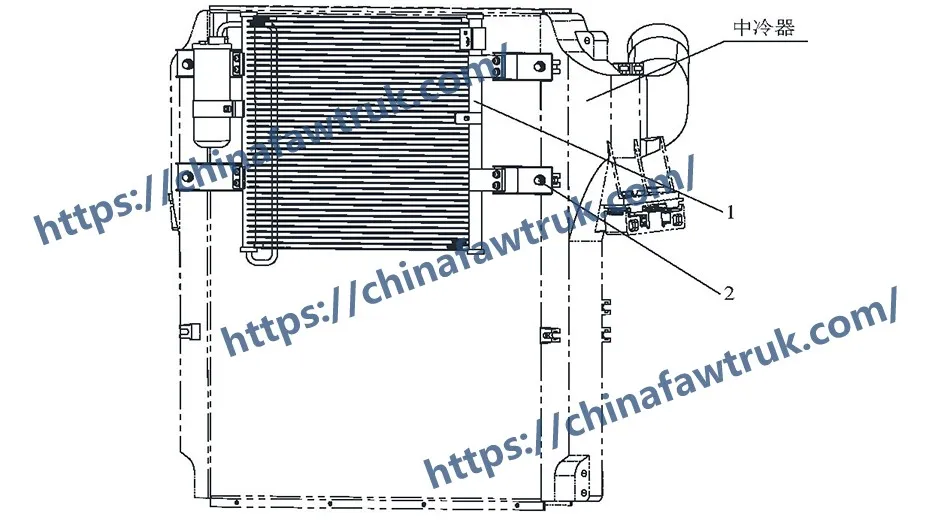
As shown in the parts diagram, the FAW J6P Storage Tank is not available as a separate part. It is integrated into the ‘Condenser with Receiver Drier Assy’ (8105010-70U). This modern, efficient design eliminates extra hoses and leak points. This teardown will analyze the logic of this integrated tank and its mounting system.
For a technician, the FAW J6P Storage Tank is a mandatory replacement item. Any time the A/C system is opened for service (e.g., a hose or compressor replacement), this component *must* be replaced. We will explore why this is critical for the health of the compressor and the expansion valve.
This is the primary assembly that houses the FAW J6P Storage Tank. It is sold as one complete part, which is critical for service.
1. Component: ‘Condenser with Receiver Drier Assy’ (8105010-70U) – Qty 1
This (Mark 1) is the complete assembly. The name (Condenser with Storage Tank Assembly) clearly states it is a Condenser *with* a Storage Tank. The FAW J6P Storage Tank (Receiver Drier) is the aluminum canister permanently attached to the side of the main condenser.
The Integration Logic: This modern design is for reliability. By manufacturing the FAW J6P Storage Tank as part of the condenser, the factory eliminates two high-pressure refrigerant hose connections. This reduces the number of potential leak points by half and simplifies the assembly process.
The Service Logic: This is the most important concept. A technician cannot buy the FAW J6P Storage Tank separately. If the tank’s desiccant is saturated or its internal filter is clogged, the *entire* 8105010-70U assembly must be replaced. This ensures a new, perfectly clean condenser is installed at the same time as the new filter/drier.
The first function of the FAW J6P Storage Tank is to act as a liquid “receiver.”
The “Receiver” Logic: The tank is positioned in the “liquid line” of the A/C system (after the condenser). Its first job is to act as a buffer or reservoir for the liquid refrigerant.
The “Bubble-Free” Logic: The A/C system’s expansion valve (TXV) is a precision device that can only function with a 100%, solid stream of liquid. If refrigerant *gas* (bubbles) hits the valve, it will “starve” the system. The FAW J6P Storage Tank ensures that there is always a reserve of solid liquid ready.
The “Pickup Tube” Logic: To achieve this, the FAW J6P Storage Tank has an internal “pickup tube.” This tube extends from the *outlet* port down to the very *bottom* of the canister. This design ensures that it only ever draws refrigerant from the pool of liquid at the bottom.
This is the most critical function of the FAW J6P Storage Tank. It “dries” the refrigerant.
The Desiccant Logic: Inside the FAW J6P Storage Tank is a porous bag filled with a “desiccant.” This is a material with a high affinity for water (H2O), typically silica gel or zeolite. As refrigerant flows through the tank, it must pass through this desiccant bag.
The “Water” Failure Logic: Moisture is the #1 killer of A/C systems. When moisture meets the TXV, it instantly freezes into an ice crystal, completely blocking the valve and stopping all cooling. This is the most common cause of “A/C stops cooling after 20 minutes.”
The “Acid” Failure Logic: The second moisture-related failure is “hydrolysis.” When H2O mixes with R134a refrigerant and oil, it forms corrosive acids, which will eat the aluminum A/C components from the inside out. The FAW J6P Storage Tank prevents this.
The “Replacement” Logic: The desiccant bag can only hold a fixed amount of water. It is *mandatory* to replace the FAW J6P Storage Tank (the entire 8105010-70U assembly) *any time* the system is opened for more than a few minutes. Failure to do so guarantees the new compressor or hose will fail prematurely.
The third and final function of the FAW J6P Storage Tank is to act as the system’s main debris filter.
The “Compressor Failure” Logic: When an A/C compressor fails, it often “grenades,” sending thousands of tiny metal shavings (shrapnel) into the system. This debris is pushed into the condenser.
The “Filter” Logic: The FAW J6P Storage Tank contains one or more fine-mesh filter screens. Its job is to trap all of this circulating debris *before* it can travel to the next component: the Thermal Expansion Valve (TXV).
The “TXV” Logic: The TXV is a precision valve with an opening (orifice) as small as a human hair. A single piece of compressor shrapnel will instantly and permanently clog this orifice, blocking all refrigerant flow. The filter in the FAW J6P Storage Tank is the last line of defense.
The “Black Death” Logic: A clogged FAW J6P Storage Tank is a clear sign of “black death” (a compressor failure). In this scenario, the entire system is contaminated. A technician *must* replace the compressor, the FAW J6P Storage Tank assembly (8105010-70U), and the TXV, and then flush all remaining hoses.
This hardware is all that holds the integrated condenser (which contains the FAW J6P Storage Tank) in place.
1. Component: ‘Combination Bolt’ (CQ1460820) – Qty 4
This (Mark 2) is a set of four identical M8 bolts. They are the structural fasteners for the 8105010-70U assembly.
The “Combination Bolt” Logic: The name “Combination Bolt” means each bolt has a pre-installed, captive washer. This is a vibration-resistance and assembly-speed feature. The washer (likely a spring lock washer) prevents the bolt from backing out under the constant vibration of the diesel engine.
The Isolation Logic: These bolts are almost always used with (unlisted) rubber bushings or grommets. These rubber isolators absorb vibration, preventing it from fatiguing the condenser’s delicate aluminum tubes and the FAW J6P Storage Tank‘s welded joints.
The Service Logic: A loose condenser assembly will vibrate, which will quickly lead to a stress-fracture leak. A technician must ensure these four bolts are present and properly torqued.
The following table provides the complete, detailed breakdown of all 2 component types specified for the FAW J6P Storage Tank system on the FAW Jiefang CA3250P66K2L1T1E 6×4 dump truck.
| Mark | Part No. | Part Name | Quantity |
|---|---|---|---|
| 1 | 8105010-70U | Condenser with Receiver Drier Assy | 1 |
| 2 | CQ1460820 | Combination Bolt | 4 |
The specifications for the FAW J6P Storage Tank are defined by its integrated, multi-function role as the A/C system’s filter/drier.
| Vehicle Application | FAW Jiefang CA3250P66K2L1T1E 6×4 Dump Truck |
| System Group | A/C System / FAW J6P Storage Tank |
| Technical Name | Receiver Drier / Accumulator |
| Host Assembly | ‘Condenser with Receiver Drier Assy’ (8105010-70U) |
| Serviceability | Non-serviceable (Integrated with Condenser) |
| Function 1 | Stores liquid refrigerant (Receiver) |
| Function 2 | Removes moisture/water (Drier) |
| Function 3 | Filters solid debris (Filter) |
| Desiccant Material | Silica Gel or Zeolite |
| Mounting Hardware | ‘Combination Bolt’ (CQ1460820) – Qty 4 |
| Service Note | Mandatory replacement whenever A/C system is opened. |
FAW parts, including the Cylinder Block Assembly, are packaged with care to ensure safe delivery. Each component is secured in protective materials to prevent damage during transit. The logistics network guarantees timely shipments worldwide, supporting efficient maintenance operations. Below is an image illustrating the standard packaging for FAW truck parts, showcasing the attention to detail in handling and storage.
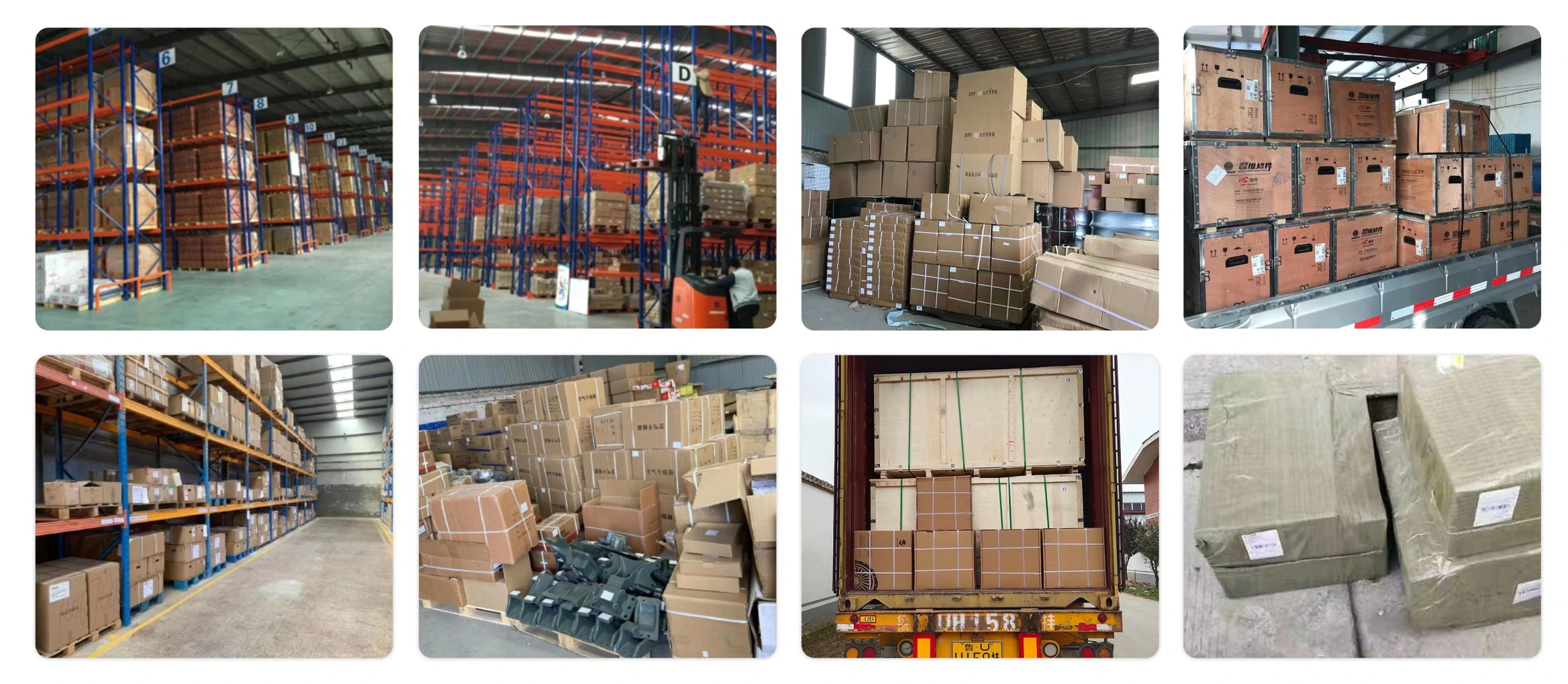
This packaging approach minimizes the risk of corrosion or impact damage, ensuring that parts like the FAW Cylinder Block Assembly arrive in perfect condition. Customers can rely on FAW’s logistics for consistent quality and reliability.