Sous-couche d'isolation de sol russe FAW: Une barrière thermique à trois segments conçue pour un contrôle climatique extrême
Le Sous-couche d'isolation de sol russe FAW L'ensemble est le principal système de défense thermique pour le plancher de la cabine du camion-benne CA3250P66K24L1TE5Z.. Sur le théâtre opérationnel sévère de la Fédération de Russie, le plancher en métal agit comme un pont thermique massif, conduire les températures ambiantes glaciales du châssis directement dans l’espace de travail du conducteur. Simultanément, il doit protéger l'intérieur de la chaleur radiante intense générée par les systèmes de transmission et d'échappement situés immédiatement en dessous. Ce spécialisé Sous-couche d'isolation de sol russe FAW utilise une conception segmentée en trois parties pour fournir une couverture complète, s'assurer que la cabine maintient une stabilité, température habitable quel que soit l’environnement extérieur.
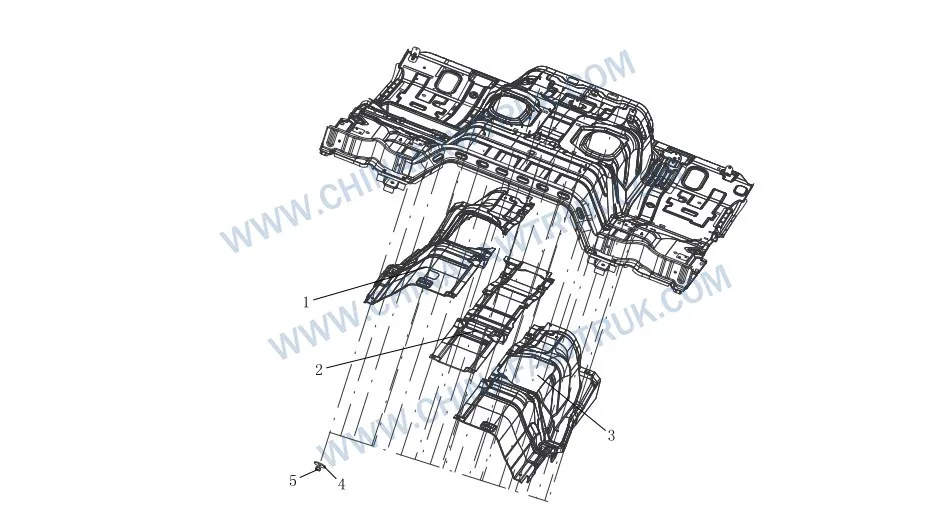
Sous-couche d'isolation de sol russe FAW
| Non. |
Numéro de pièce |
Nom de la pièce |
Quantité |
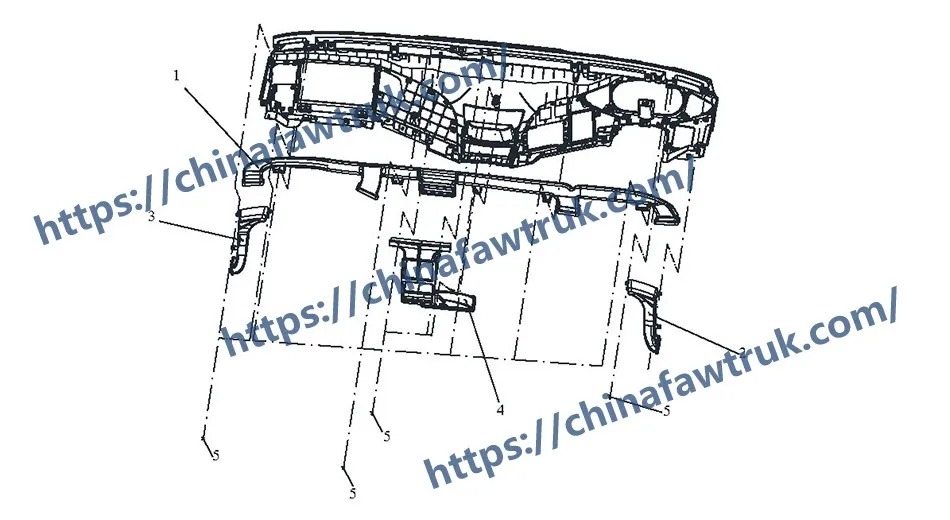
| 1 | 5109311-B35 | Coussin d'isolation thermique au sol gauche | 1 |
| 2 | 5109313-B35 | Coussin d'isolation thermique au sol au milieu | 1 |
| 3 | 5109312-B35 | Coussin d'isolation thermique au sol droit | 1 |
| 4 | 5109318-A01 | Machine à laver – Coussin d'isolation thermique au sol | 25 |
| 5 | CQ34006 | Écrou hexagonal | 25 |
Efficacité thermodynamique et logique climatique de l'habitacle
La philosophie de conception derrière le Sous-couche d'isolation de sol russe FAW donne la priorité à la création d'un “coupure thermique” entre la coque métallique extérieure et l'espace intérieur de la cabine. Aux latitudes extrêmes du nord de la Russie, la différence de température entre l'intérieur de la cabine (chauffé à +20°C) et le châssis extérieur (descendre jusqu'à -40°C) crée un dégradé massif. Sans le Sous-couche d'isolation de sol russe FAW, le plancher en acier fait office de dissipateur thermique, évacuant rapidement la précieuse chaleur de l'habitacle vers l'atmosphère. Cela oblige non seulement les chauffages d'appoint à fonctionner en continu, consommer du carburant en excès, mais crée également des courants d’air froids inconfortables autour des pieds du conducteur, ce qui peut entraîner une réduction des temps de réaction et de l'inconfort pendant les longs quarts de travail.
Le Sous-couche d'isolation de sol russe FAW l'assemblage utilise une haute densité, matériau composite multicouche. La couche centrale est généralement constituée d'une mousse à cellules fermées ou d'une laine fibreuse qui emprisonne l'air mort., l'isolant naturel le plus efficace. Cette structure empêche la perte de chaleur conductrice. En outre, le matériau utilisé dans le Sous-couche d'isolation de sol russe FAW présente des propriétés réfléchissant la chaleur sur sa face inférieure. Ceci est crucial pour gérer la chaleur rayonnante générée par le carter de transmission et le tuyau de descente d'échappement., qui passent directement sous le tunnel de sol. En réfléchissant cette chaleur, la sous-couche empêche le tunnel de sol de devenir trop chaud lors de fortes montées, maintenir un climat intérieur équilibré.
Le “B35” suffixe dans les numéros de pièces pour le Sous-couche d'isolation de sol russe FAW Les composants indiquent une spécification adaptée à la géométrie spécifique du plancher de la cabine J6P dans la configuration de zone froide. Cet ajustement sur mesure garantit qu'il n'y a aucun espace où des fuites thermiques peuvent se produire. Le Sous-couche d'isolation de sol russe FAW est moulé pour épouser étroitement le tunnel de la boîte de vitesses, rehausseurs de siège, et pédalier. Tout espace dans cette barrière isolante agirait comme un “cheminée thermique,” aspirer l'air chaud et aspirer l'air glacial. Le moulage de précision des composants FAW élimine ces points faibles, garantissant une efficacité thermique maximale.
L'avantage architectural à trois segments
Une caractéristique clé du Sous-couche d'isolation de sol russe FAW est sa segmentation en trois parties distinctes: le Coussin d'isolation thermique au sol gauche (Partie no. 5109311-B35), le Coussin d'isolation thermique au sol au milieu (Partie no. 5109313-B35), et le Coussin d'isolation thermique au sol droit (Partie no. 5109312-B35). Cette conception modulaire n'est pas arbitraire; c'est un choix d'ingénierie stratégique pour la facilité d'entretien. Le coussin du milieu, couvrant le tunnel de transmission, est le plus susceptible de nécessiter un retrait pour accéder à la boîte de vitesses ou pour l'entretien de la tringlerie de changement de vitesse.. En le séparant des coussinets latéraux, le Sous-couche d'isolation de sol russe FAW permet aux mécaniciens d'exposer la plaque d'accès au tunnel sans démonter tout le revêtement de sol côté conducteur ou passager.
Le Coussin d'isolation thermique au sol gauche est conçu pour accueillir la colonne de direction, pédalier, et supports de siège conducteur. Cette section du Sous-couche d'isolation de sol russe FAW supporte le plus l'usure des talons du conducteur. Sa ségrégation signifie que si le coussinet du côté conducteur est usé ou endommagé par de lourdes bottes d'hiver, il peut être remplacé individuellement, économiser le coût d'un remplacement complet du sol. De la même manière, le Coussin d'isolation thermique au sol droit est profilé pour le plancher du passager et les bouches d'aération du chauffage auxiliaire. Cette modularité réduit les coûts de possession à long terme et simplifie la logistique pour les départements de pièces détachées de flotte..
L'interface entre ces trois sections du Sous-couche d'isolation de sol russe FAW est conçu avec des zones de chevauchement. Une fois installé, le coussin du milieu chevauche généralement les bords des coussinets gauche et droit (ou vice versa, en fonction de la séquence de superposition spécifique), créer une barrière continue. Cette conception en bardeaux empêche les liquides, tels que la neige fondue des bottes ou les boissons renversées, de s'infiltrer entre les coussinets et d'atteindre le sol métallique., où cela pourrait provoquer une corrosion invisible. Le Sous-couche d'isolation de sol russe FAW agit ainsi comme une barrière secondaire contre l'humidité, protéger l'intégrité structurelle du plancher de la cabine.
Fixation haute densité pour le contrôle NVH
L'installation du Sous-couche d'isolation de sol russe FAW est sécurisé par un nombre remarquablement élevé de fixations, spécifiquement 25 unités du Machine à laver – Coussin d'isolation thermique au sol (Partie no. 5109318-A01) et 25 unités du Écrou hexagonal (Partie no. CQ34006). Cette haute densité de points de fixation est critique pour le bruit, Vibration, et la dureté (Nvh) contrôle. Un coussin isolant lâche sur le plancher vibrant d'un camion diesel agit comme une peau de tambour, amplifiant potentiellement le bruit du châssis plutôt que de l'atténuer. En épinglant le Sous-couche d'isolation de sol russe FAW fermement au plancher en plusieurs points, l'assemblage ajoute efficacement de la masse et de l'amortissement aux panneaux en acier, réduire la résonance structurelle.
La laveuse spécialisée, Machine à laver – Coussin d'isolation thermique au sol, est conçu avec une large surface. Ceci est essentiel pour répartir la force de serrage de l'écrou sur la surface molle., matériau compressible du Sous-couche d'isolation de sol russe FAW. Une petite rondelle standard s'enfoncerait simplement dans l'isolation, déchirer le matériau et ne pas assurer un maintien sûr. La rondelle spécialisée garantit que la sous-couche est comprimée uniformément, maintenir sa position et l'empêcher de se regrouper ou d'interférer avec les pédales - une considération de sécurité essentielle.
En outre, la fixation sûre du Sous-couche d'isolation de sol russe FAW l'empêche de frotter contre le sol métallique. Dans un environnement à fortes vibrations, tout mouvement entre l'isolant et le métal peint peut poncer la peinture, menant à la rouille. En fixant rigidement les patins avec le 25 combinaisons écrou et rondelle, le Sous-couche d'isolation de sol russe FAW devient partie intégrante de la structure du sol, protéger la peinture située en dessous de l'abrasion tout en remplissant ses fonctions thermiques.
Entretien, Inspection, et remplacement
Alors que le Sous-couche d'isolation de sol russe FAW est un composant passif, il nécessite une inspection pour garantir la santé à long terme du véhicule. Le principal ennemi de l’isolation des sols est la saturation en humidité. Si les joints de porte fuient ou si la liaison du pare-brise échoue, l'eau peut s'accumuler dans la sous-couche. Un mouillé Sous-couche d'isolation de sol russe FAW perd ses propriétés thermiques et devient un terrain fertile pour la moisissure et la rouille. Lors de l'entretien annuel, les mécaniciens doivent soulever le bord des tapis pour vérifier l'humidité. Si la sous-couche est imbibée d'eau, huile, ou du gasoil, il doit être remplacé immédiatement pour éviter les risques d'incendie et de corrosion.
Remplacement du Sous-couche d'isolation de sol russe FAW est un processus simple mais qui demande beaucoup de travail, nécessitant généralement le retrait des sièges et des garnitures intérieures inférieures. Parce que l'assemblage repose sur des boulons soudés sur le plancher, des précautions doivent être prises lors du retrait du 25 Écrou hexagonal attaches. Si un écrou est grippé à cause de la corrosion, pour casser le goujon, il faut en souder un nouveau au sol, compliquant considérablement la réparation. L'utilisation d'huile pénétrante sur ces écrous avant leur retrait est une pratique recommandée lors de l'entretien du Sous-couche d'isolation de sol russe FAW.
Les gestionnaires de flotte doivent s'assurer que seules des pièces d'origine FAW sont utilisées pour le remplacement.. Les matériaux d'isolation en vrac génériques ne disposent pas d'un moulage précis, les emplacements découpés pour les boulons de selle, et le support réfléchissant la chaleur du véritable Sous-couche d'isolation de sol russe FAW. Une isolation de rechange mal ajustée peut interférer avec les pédales d'accélérateur ou de frein., créant un risque sérieux pour la sécurité. Les véritables coussinets se mettent parfaitement en place, s'assurer que la cabine reste le coffre-fort, chaud, et un environnement calme, il a été conçu pour être.
Conclusion: Le fondement de la capacité de survie dans l’Arctique
Le Sous-couche d'isolation de sol russe FAW l’assemblage est un élément essentiel de l’arsenal du camion-benne CA3250 contre les éléments. Comprenant 5 parties principales et 50 morceaux de matériel de fixation, il forme une barrière complète qui gère la chaleur, son, et vibrations. Sa conception segmentée permet un entretien pratique, tandis que son ingénierie matérielle garantit que le conducteur reste isolé de la dure réalité de l'hiver russe..
Pour les exploitants de flotte, l'état du Sous-couche d'isolation de sol russe FAW est un indicateur direct de l’intégrité de la cabine. Un sec, une sous-couche bien sécurisée protège la structure du véhicule et améliore l'efficacité de l'opérateur. En privilégiant l'entretien de ce bouclier thermique, les opérateurs veillent à ce que leur personnel puisse travailler en toute sécurité et confortablement, maximiser la productivité de la flotte même dans les conditions les plus extrêmes.
Emballage et logistique
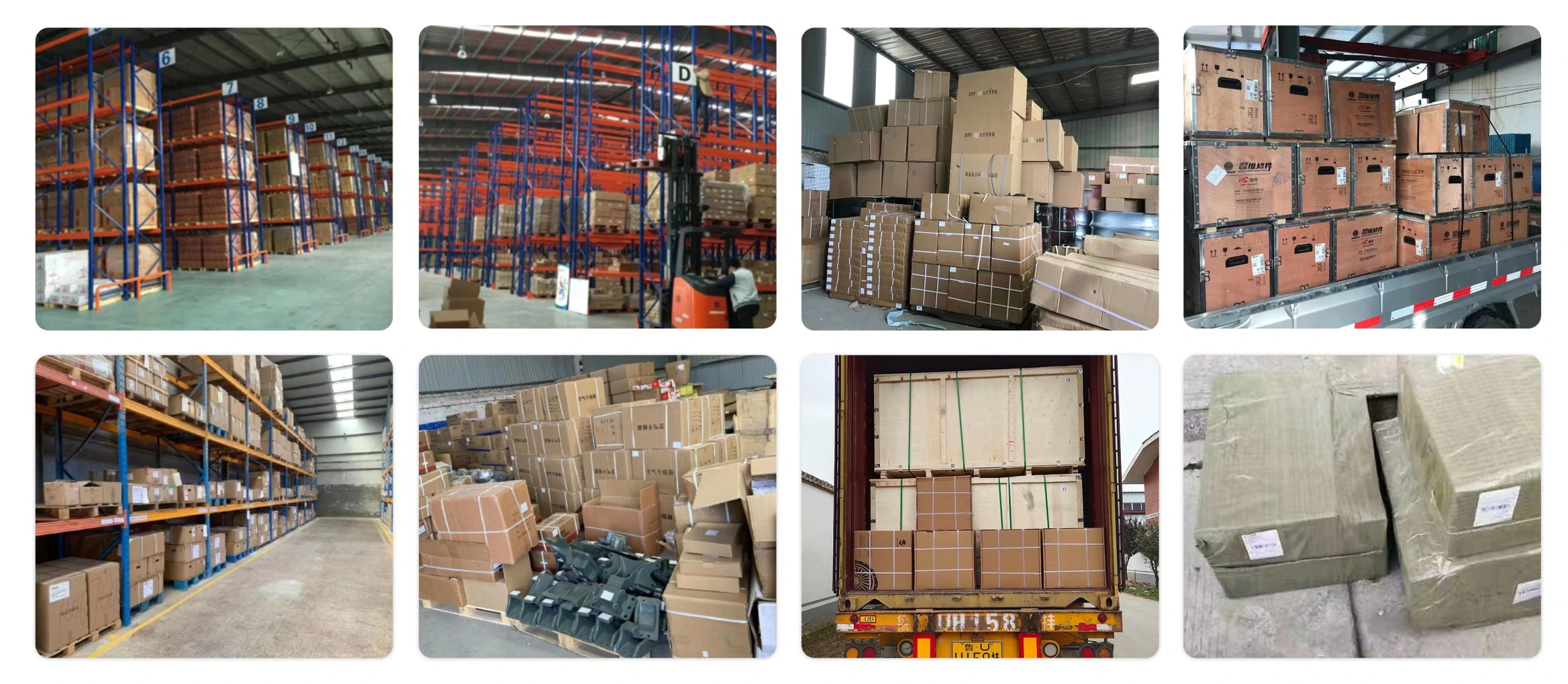
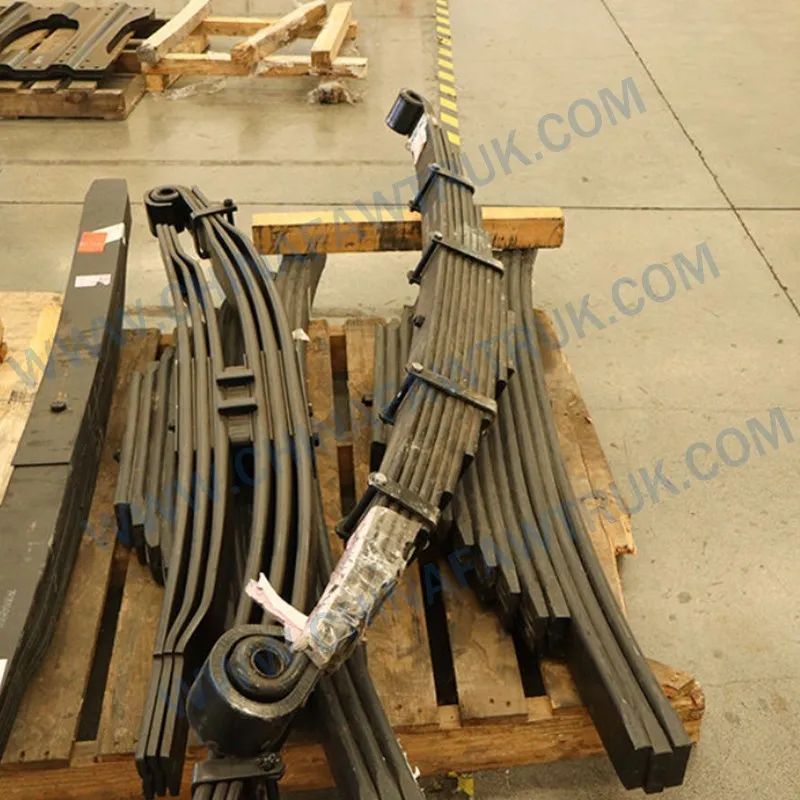
Pièces FAW, y compris l'ensemble bloc-cylindres, sont emballés avec soin pour garantir une livraison en toute sécurité. Chaque composant est sécurisé dans des matériaux de protection pour éviter tout dommage pendant le transport. Le réseau logistique garantit des expéditions ponctuelles dans le monde entier, soutenir des opérations de maintenance efficaces. Vous trouverez ci-dessous une image illustrant l'emballage standard des pièces de camion FAW., mettant en valeur l’attention portée aux détails dans la manipulation et le stockage.
Cette approche d'emballage minimise le risque de corrosion ou de dommages causés par les chocs., s'assurer que les pièces comme l'ensemble bloc-cylindres FAW arrivent en parfait état. Les clients peuvent compter sur la logistique de FAW pour une qualité et une fiabilité constantes.