por 


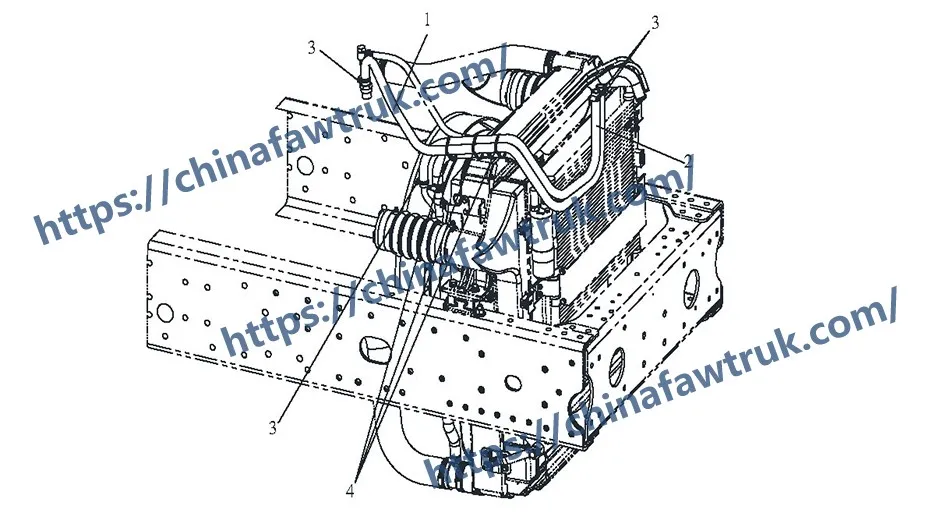
Esta es una deconstrucción técnica experta de la Protector del ventilador FAW J6P (también conocida como "cubierta del ventilador", compensación 2) y su conjunto de montaje de 45 piezas del Capítulo 37. Este sistema es fundamental para la gestión térmica del FAW Jiefang CA3250P66K2L1T1E 6×4 camión volcado. Este componente no es un simple “guardia”; es un “Lógica aerodinámica” herramienta.

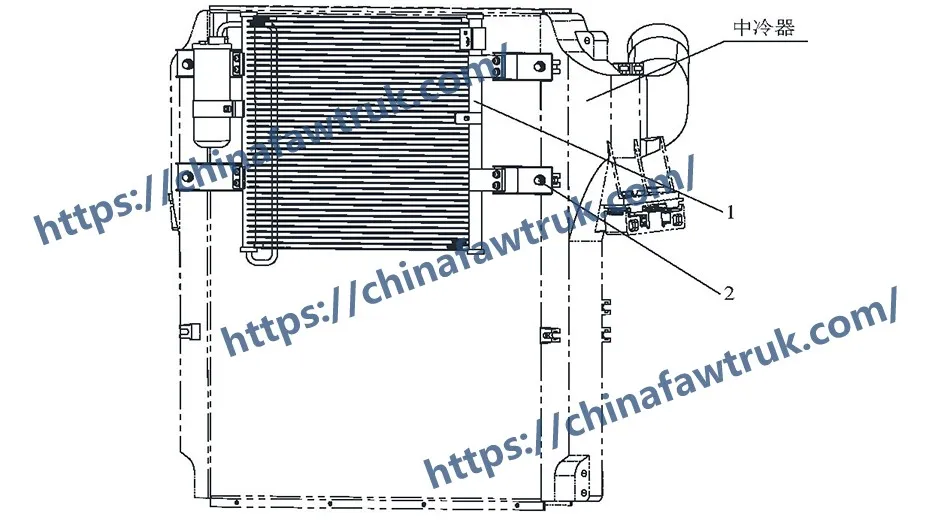
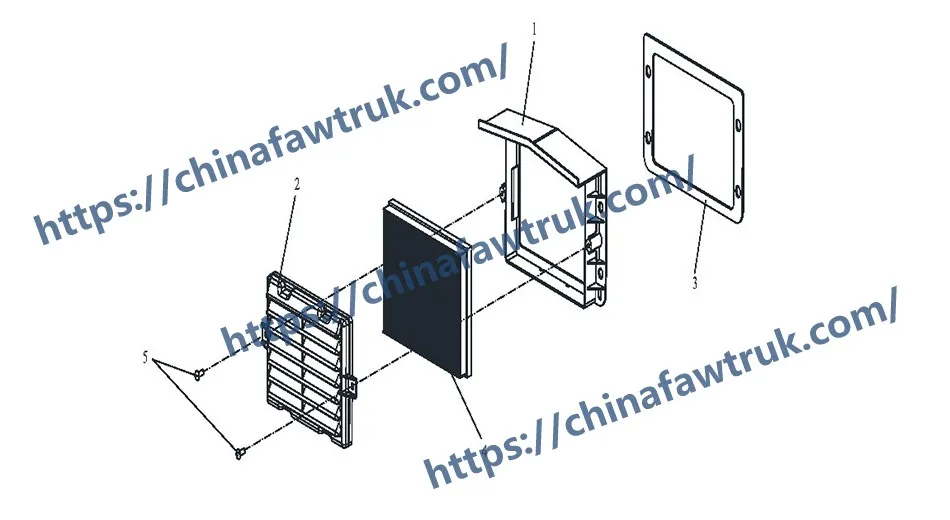
El Protector del ventilador FAW J6P crea un “túnel de vacío,” forzando el ventilador del motor (ver capítulo 20) tirar 100% de su aire *a través* del 'conjunto del radiador’ (compensación 1). Sin este sudario, un ventilador es extremadamente ineficiente, sacando aire del “camino de menor resistencia” (los lados) y “estancamiento.” Este “Lógica del embudo de flujo de aire” es la diferencia entre un enfriamiento máximo y un sobrecalentamiento catastrófico.
Esta guía es esencial para técnicos de flotas y especialistas en repuestos.. El Protector del ventilador FAW J6P está hecho de un polímero compuesto, y su #1 El enemigo es la vibración., que provoca grietas por fatiga. Deconstruiremos todo el sistema de 46 partes., centrándose en el “Lógica del flujo de aire” (la guardia misma), el “Contexto del intercambio de calor” (el radiador al que sirve), y el “Lógica antivibración” (la compleja red de corchetes, tirantes, y sujetadores que lo protegen).
Este componente es el “héroe” de esta asamblea. Todos los demás 45 Las piezas están en servicio para la función de este componente..
1. Componente: 'Cubierta del ventilador’ (1309010-14B)
Este (compensación 2) *es* el Protector del ventilador FAW J6P. Es “Lógica aerodinámica” es más complejo de lo que parece. no es un simple “caja” o “guardia.” es un ingenieria “sudario” o “túnel” Diseñado para optimizar el flujo de aire..
El “Lógica de liquidación de puntas” es el elemento de diseño más crítico. Esto se refiere al *pequeño, espacio preciso* entre los extremos de las aspas del ventilador y el interior “túnel” del Protector del ventilador FAW J6P. Si esta brecha es demasiado grande, aire “recircula” desde el lado de alta presión hacia el lado de baja presión, “estancamiento” el ventilador y destruyendo su eficiencia.
Este “Lógica del vacío” es todo su propósito. El Protector del ventilador FAW J6P crea un “sellado” ambiente, obligando al ventilador a tirar “vacío” *en toda la superficie* del 'Conjunto del radiador’ (compensación 1) aletas. Esto asegura un enfriamiento uniforme y evita “puntos calientes.”
“Lógica de materiales” también es clave. Esta pieza está hecha de un “polímero reforzado con vidrio” (un compuesto). debe ser liviano, pero también lo suficientemente rígido como para no “doblar” o “urdimbre” del calor de más de 100°C que irradia el motor. También debe absorber constante, vibración de alta frecuencia.
El “Lógica del modo de falla” es “agrietamiento por fatiga.” El chasis de un camión pesado se flexiona constantemente. Esta vibración es la #1 enemigo de la Protector del ventilador FAW J6P. una pequeña grieta, a partir de un perno de montaje, voluntad “araña” a través del sudario, rompiendo el “sello de vacío” y provocando una inmediata, pérdida drástica en el rendimiento de refrigeración.
El Protector del ventilador FAW J6P es inútil sin el componente para el que está diseñado “atender”: el 'conjunto del radiador'.
1. Componente: 'Conjunto de radiador’ (1301010-14B)
Este (compensación 1) es el “Lógica del intercambio de calor.” es un grande, pasivo “disipador de calor” tanto para el refrigerante del motor como para el del turbocompresor. “cargar aire” (a través del intercooler). como un “pasivo” dispositivo, se basa 100% en *flujo de aire* para disipar el calor.
El “Lógica simbiótica” es que el Protector del ventilador FAW J6P (compensación 2) está *montado directamente* al marco del 'Conjunto del radiador’ (compensación 1). Su diseño “sellos” contra los bordes del radiador. Este “Lógica de conjunto coincidente” garantiza que el aire aspirado por el ventilador *debe* pasar primero *a través* de las aletas del radiador.
La supervivencia de la Protector del ventilador FAW J6P es por lo tanto directamente “atado” a la supervivencia del radiador. El radiador proporciona la “cara de montaje” y “soporte estructural” para la cubierta del ventilador.
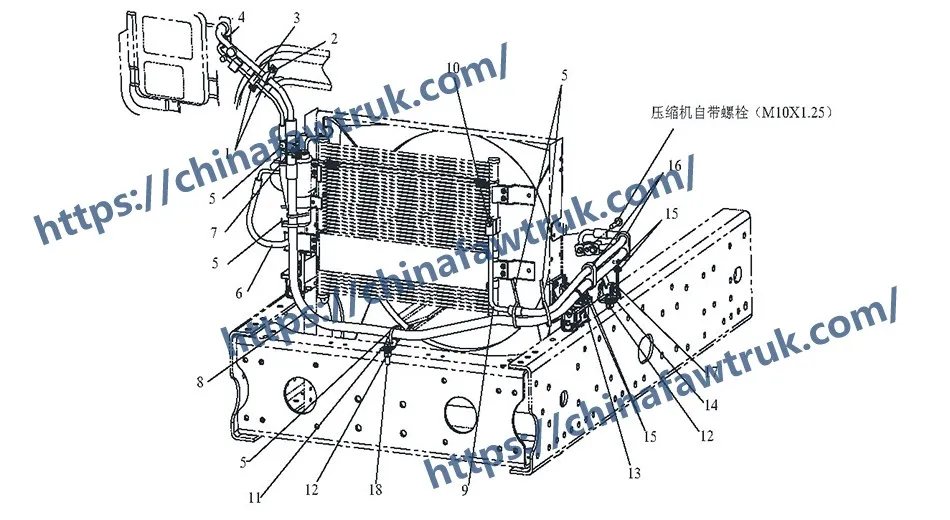
Este grupo representa el complejo “Lógica de aislamiento de vibraciones.” desde el Protector del ventilador FAW J6P es (frágil) compuesto y el chasis/motor (vibrando) es acero, este sistema es el que evita que Protector del ventilador FAW J6P de “sacudida” en pedazos.
1. El “Lógica de aislamiento” (Componentes 11, 12, 13)
Todo el conjunto del radiador’ (que sostiene la guarda del ventilador) se sienta en un 'Conjunto del travesaño inferior del radiador’ (1302030-61B). Este “estante” está en manos del 'Soporte izquierdo radiador’ (1302027-70Ud.) y 'Soporte derecho radiador’ (1302028-70Ud.). Estos “apoya” usar goma grande “aislador” casquillos (ver capítulo 38) a “húmedo” la cruda vibración del marco.
2. El “Lógica anti-oscilación” (Componentes 18, 19)
Este es el “Lógica de la fuerza cortante” protección. El 'Conjunto de barra de acoplamiento’ (1302050-01) y 'Soporte superior tirante’ (1302041-14B) son estabilizadores diagonales. Cuando el camión choca contra un bache, el chasis “se flexiona.” Estos tirantes evitan que el radiador y los accesorios adjuntos Protector del ventilador FAW J6P de ser “retorcido” o “balanceado,” lo que provocaría un instante “grieta por fatiga.”
3. El “Lógica de marco” (Componentes 8, 22, 26, 33, 35)
Este “web” de acero («Placa de conexión del radiador’ (1301020-61B), «Placa de soporte del radiador’ (1302040-14B), etc.) es el “Lógica estructural.” Crea un “jaula rígida” alrededor del “aislado” radiador, proporcionando los puntos de montaje seguros para el Protector del ventilador FAW J6P.
Este grupo final incluye todos “Unidades reparables más pequeñas” (SSU) y el “Plomería” que debe coexistir con el Protector del ventilador FAW J6P.
1. El “Lógica de sujetadores” (Pernos, Nueces, Lavadoras)
Esto incluye todos “Lógica de hardware,” como «Perno de brida hexagonal’ (Q1840816, Q1841230, etc.), «Perno combinado’ (CQ1460820), y «Tuercas hexagonales’ (CQ34010, CQ34008, etc.). Estos son los “Lógica a prueba de vibraciones” sujetadores.
Un solo perno suelto (P.EJ., compensación 7, que sostiene el Protector del ventilador FAW J6Pplaca de soporte) creará un “punto caliente de vibración” y “martillo” la cubierta compuesta hasta que se agriete. Esta es la razón por la que la alta resistencia, “bridado” (autobloqueante) el hardware es esencial.
2. El “Lógica de fontanería” (Manguera & Abrazaderas)
Este grupo incluye todas las mangueras. ('Manguera de entrada del radiador’ (1303011-14B), 'Manguera de salida del radiador’ (1303021-14B), etc.) y su alto par 'Abrazaderas de manguera tipo banjo’ (CQ67670B, etc.).
El “Lógica de enrutamiento” de esta plomería está diseñada *alrededor* del Protector del ventilador FAW J6P. Las mangueras deben ser “flexible” para absorber la vibración entre “motor” y el “radiador” asamblea. Se encaminan para limpiar la cubierta y, más importante, el “hilado” admirador (Capítulo 20) *dentro* del sudario.
La siguiente tabla proporciona la información completa, desglose detallado de todos 46 tipos de componentes en el Protector del ventilador FAW J6P y conjunto de montaje del radiador (Capítulo 37) Para FAW Jiefang CA3250P66K2L1T1E 6×4 camión volcado.
| Marca | Número de pieza. | Nombre de la pieza | Cantidad |
|---|---|---|---|
| 1 | 1301010-14B | Conjunto de radiador | 1 |
| 2 | 1309010-14B | Cubierta del ventilador | 1 |
| 3 | CQ67670B | Abrazadera tipo banjo modelo B | 2 |
| 4 | 1303011-14B | Manguera de entrada del radiador | 1 |
| 5 | CQ67680B | Abrazadera tipo banjo modelo B | 2 |
| 6 | 1303021-14B | Manguera de salida del radiador | 1 |
| 7 | CQ1460820 | Perno combinado | 8 |
| 8 | 1301020-61B | Conjunto de placa de conexión del radiador | 2 |
| 9 | Q1840816 | Perno de brida hexagonal | 14 |
| 10 | Q1841230 | Perno de brida hexagonal | 4 |
| 11 | 1302030-61B | Conjunto de travesaño inferior del radiador | 2 |
| 12 | 1302027-70Ud. | Soporte izquierdo del radiador | 1 |
| 13 | 1302028-70Ud. | Soporte derecho radiador | 1 |
| 14 | Q1840825 | Perno de brida hexagonal | 8 |
| 15 | CQ1461025 | Perno combinado | 4 |
| 16 | CQ1501050 | Perno de cabeza hexágono | 2 |
| 17 | 1302052-01 | Depósito | 2 |
| 18 | 1302050-01 | Conjunto de barra de acoplamiento | 2 |
| 19 | 1302041-14B | Soporte superior del tirante | 2 |
| 20 | CQ34010 | Tuerca hexagonal | 2 |
| 21 | Q40310 | arandela de resorte | 2 |
| 22 | 1302040-14B | Placa de soporte del radiador | 2 |
| 23 | Q1840820 | Perno de brida hexagonal | 2 |
| 24 | Q1841230 | Perno de brida hexagonal | 4 |
| 25 | CQ34008 | Tuerca hexagonal | 2 |
| 26 | 1302043-14B | Placa de soporte | 2 |
| 27 | CQ32612 | Tuerca hexagonal | 4 |
| 28 | 1311034-50A | Manguera de conexión del intercooler | 1 |
| 29 | CQ67635B | Abrazadera tipo banjo modelo B | 3 |
| 30 | 1311062-14B | Tuberia de retorno de agua | 1 |
| 31 | 1311035-61B | Conjunto de tubería de acero de conexión | 1 |
| 32 | CQ1460816 | Perno combinado | 1 |
| 33 | 1311045-61B | Conjunto de soporte | 1 |
| 34 | Q1840816 | Perno de brida hexagonal | 4 |
| 35 | 1301023-50A | Placa de conexión superior del radiador | 2 |
| 36 | Q1841020 | Perno de brida hexagonal | 2 |
| 37 | 1311034-61B | Tubería de agua de retorno frontal | 1 |
| 38 | CQ67640B | Abrazadera tipo banjo modelo B | 1 |
| 39 | 1311069-76A | Tubo desgasificador trasero del radiador | 1 |
| 40 | 1311063-61B | Tubo desgasificador del radiador | 1 |
| 41 | 1311025-61B | Conjunto de tubo de conexión | 1 |
| 42 | Q1840816 | Perno de brida hexagonal | 2 |
| 43 | CQ67622B | Abrazadera tipo banjo modelo B | 4 |
| 44 | CQ2314T5 | Ojal | 2 |
| 45 | 1311024-249 | Perno de purga de aire degas | 1 |
| 46 | 1311025-138 | Conjunto de tubo de desgasificación del motor | 1 |
Las especificaciones para el Protector del ventilador FAW J6P El sistema se define por su función como unidad de control del flujo de aire primario para el conjunto del radiador..
| Solicitud de vehículo | FAW Jiefang CA3250P66K2L1T1E 6×4 Camión de la basura |
| Grupo de sistema | Protector del ventilador FAW J6P & Conjunto de montaje del radiador |
| Lógica primaria | Canalización del flujo de aire & Generación de vacío para refrigeración |
| Lógica secundaria | Aislamiento de vibraciones & Montaje estructural |
| Componente central | 'Cubierta del ventilador’ (1309010-14B) |
| Componente asociado | 'Conjunto de radiador’ (1301010-14B) |
| Sistema estabilizador | 'Conjunto de barra de acoplamiento’ (1302050-01), 'Soporte superior tirante’ (1302041-14B) |
| Sistema de montaje | 'Travesaño inferior’ (1302030-61B), 'Soportes’ (1302027-70Ud., 1302028-70Ud.) |
| Material (Guardia del ventilador) | Alta temperatura, Compuesto de polímero reforzado con vidrio |
| Componentes totales | 46 Tipos de componentes |
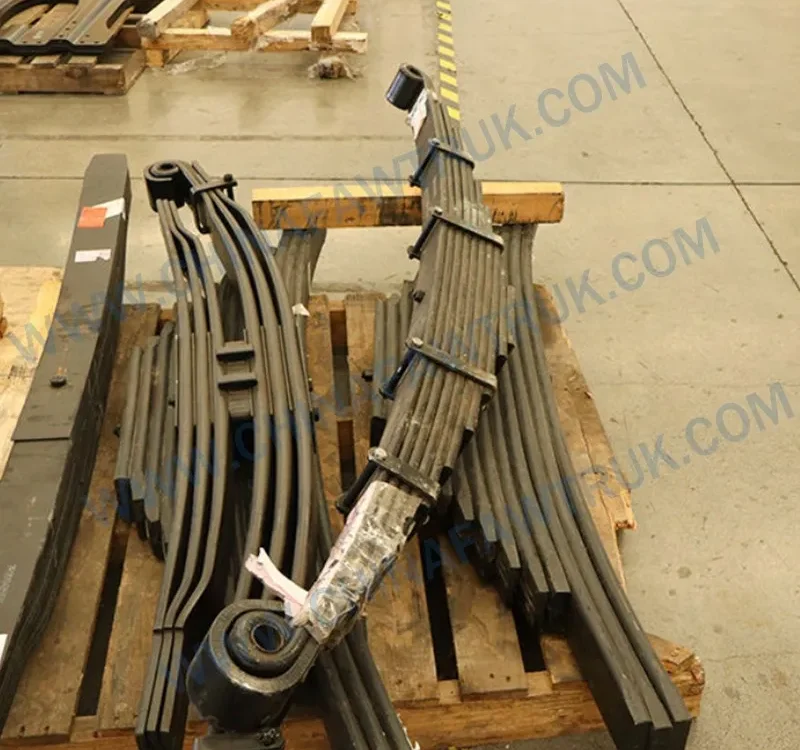
piezas FAW, incluido el conjunto del bloque de cilindros, Se empaquetan con cuidado para garantizar una entrega segura.. Cada componente está asegurado con materiales protectores para evitar daños durante el transporte.. La red logística garantiza envíos puntuales en todo el mundo., apoyando operaciones de mantenimiento eficientes. A continuación se muestra una imagen que ilustra el embalaje estándar de las piezas de camiones FAW., mostrando la atención al detalle en el manejo y almacenamiento.
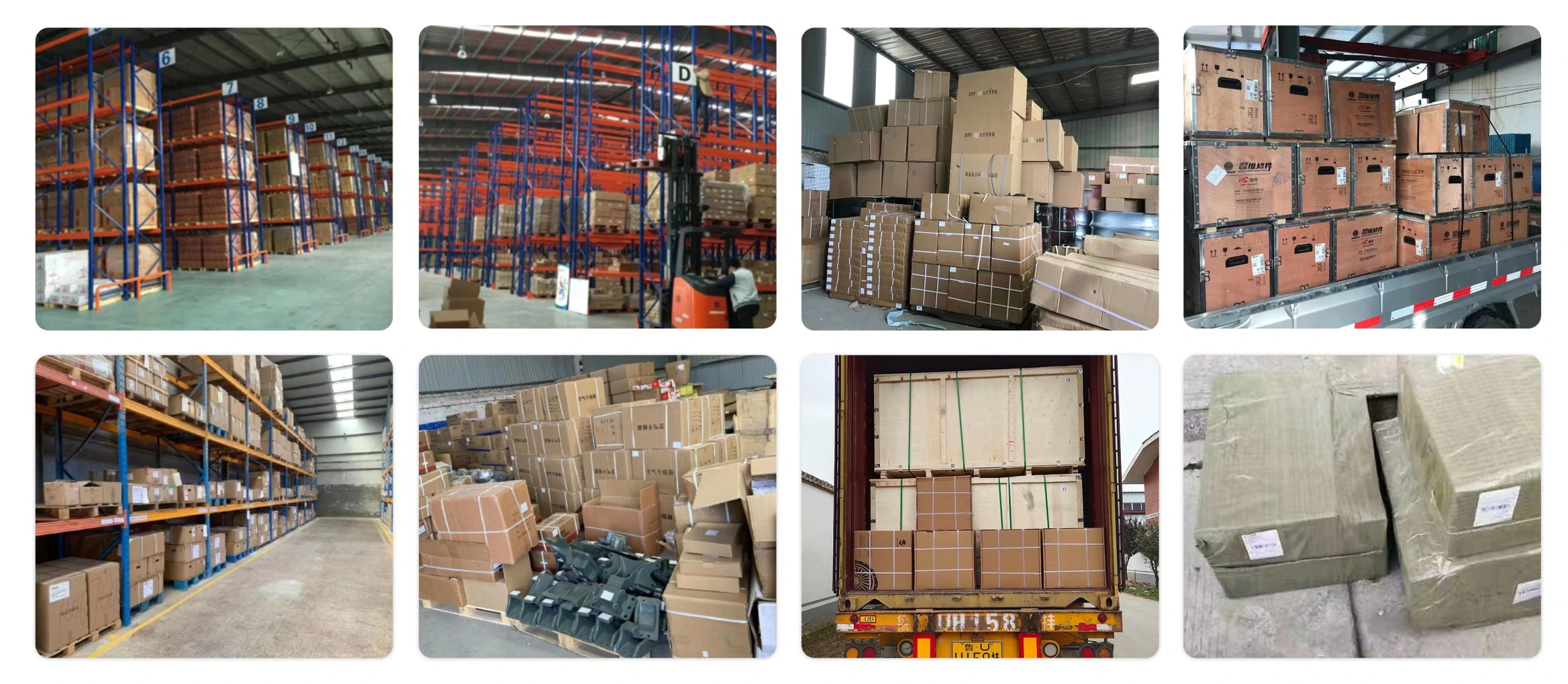
Este enfoque de embalaje minimiza el riesgo de corrosión o daños por impacto., asegurando que piezas como el conjunto de bloque de cilindros FAW lleguen en perfectas condiciones. Los clientes pueden confiar en la logística de FAW para obtener calidad y confiabilidad constantes.