por 


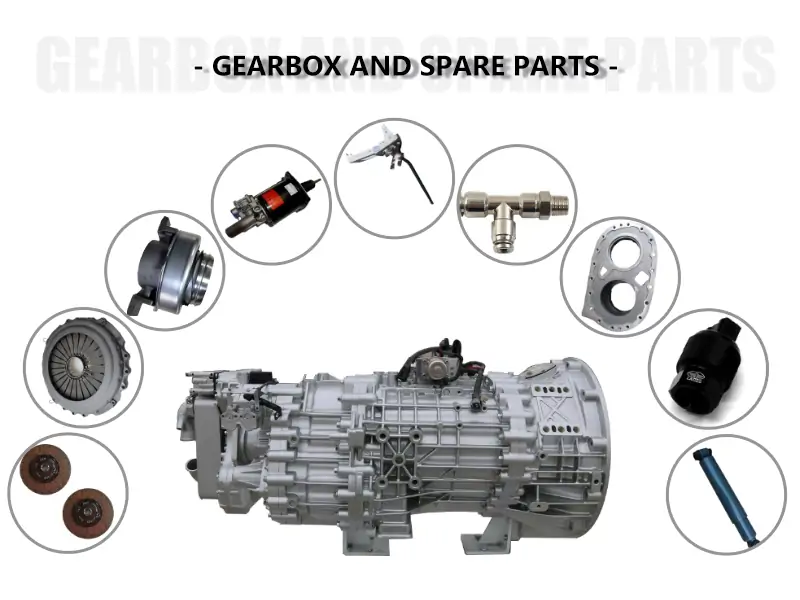
O Eixo de transmissão um FAW atua como interface de torque crítico para a caixa de câmbio 6G55, transmitindo a potência bruta do motor diretamente para o trem de engrenagens interno. Como eixo de entrada primário, sua integridade estrutural determina a suavidade de cada transição de marcha. Este componente lida com imensas forças rotacionais, servindo como eixo fundamental que garante sincronização precisa e fornecimento eficiente de energia em todo o sistema de transmissão do veículo.
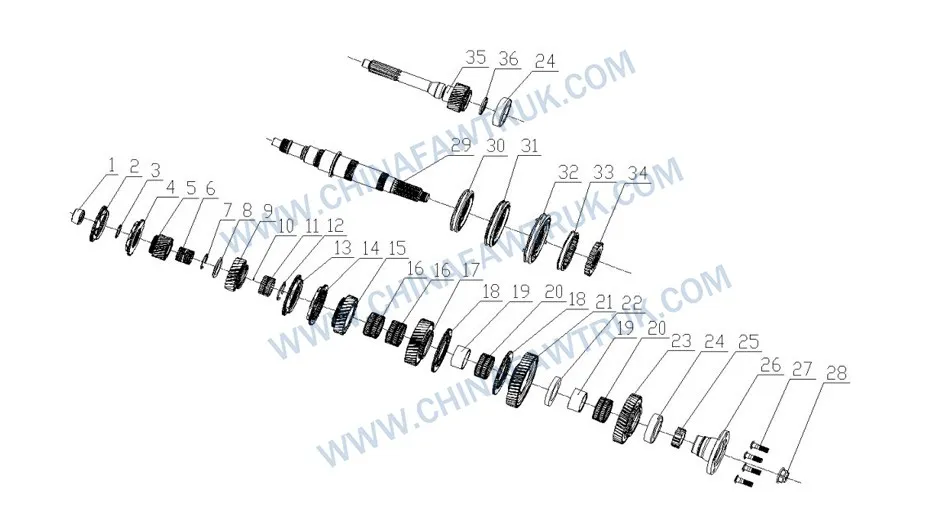
Eixo de transmissão um FAW
No ambiente cansativo da logística pesada, o Eixo de transmissão um FAW está sujeito a estresse térmico e mecânico implacável. Funciona não apenas como uma haste rotativa, mas como um instrumento calibrado de conversão de torque. Após o engate da embreagem, este eixo aceita o total, carga absoluta da produção do motor diesel. A extremidade dianteira estriada deve travar positivamente com o disco da embreagem, enquanto os dentes da engrenagem traseira acionam o contraeixo, iniciando o impulso do veículo.
A interação é contínua e implacável. O Eixo de transmissão um FAW deve manter concentricidade absoluta em altas RPMs. Mesmo desvios microscópicos podem gerar vibrações destrutivas. Esses tremores podem degradar rapidamente o Consequência (Parte não. 6G55-3099) ou o delicado Agulha rolamentos (como Parte Não. WBK40X45X43-6G60) situado mais abaixo na linha de energia, levando a uma falha catastrófica.
Estrategicamente, este componente é o eixo da sincronização de engrenagens. Ele fornece a inércia rotacional inicial que os conjuntos sincronizadores, como o 5/6 Sincronizador (Parte não. 6G60-3560), deve corresponder. Se o eixo piloto apresentar excentricidade excessiva ou irregularidades de superfície, os anéis sincronizadores não conseguem frear ou acelerar efetivamente as velocidades das marchas. Esta falha em combinar as velocidades resulta no ruído de trituração frequentemente ouvido em transmissões desgastadas.
Portanto, a precisão dimensional do Eixo de transmissão um FAW influencia diretamente o ciclo de vida total de cada componente downstream. Do Eixo de saída (Parte não. 6G60-3011) para o diferencial, o bom funcionamento de todo o sistema de transmissão depende da estabilidade deste único ponto de entrada. Os operadores de frota devem compreender que “problemas de caixa de câmbio” são frequentemente sintomas de desgaste do eixo de entrada.
A metalurgia por trás do Eixo de transmissão um FAW (Parte não. 6GT60-1011) é um estudo em ciência dos materiais. É forjado em liga de aço de alta resistência, que passa por um rigoroso processo de cementação. Esse “endurecimento de case” técnica cria uma superfície externa dura como rocha, capaz de resistir à corrosão, enquanto mantém um duro, núcleo dúctil para absorver cargas de choque.
Este equilíbrio é fundamental para navegar em declives acentuados. Quando um caminhão sobe, picos de torque são transmitidos instantaneamente através do eixo. Um núcleo frágil quebraria, enquanto uma superfície macia se deformaria. Os dentes da engrenagem integrados são retificados com precisão para minimizar o ruído e maximizar a eficiência da transferência de potência para as engrenagens do contraeixo, garantindo que cada gota de combustível seja convertida em movimento.
Apoiando o Eixo de transmissão um FAW é uma rede complexa de componentes redutores de atrito. O Consequência (Parte não. 28580/28521) fornece um ponto de ancoragem robusto na parte traseira, gerenciando as intensas forças de impulso geradas pelo projeto da engrenagem helicoidal. Simultaneamente, múltiplo Agulha rolamentos (Parte não. WBK67X75X40-6G55) permitir a rotação independente das engrenagens no eixo principal em relação à velocidade de entrada.
Esses rolamentos dependem de uma constante, filme pressurizado de óleo. O Eixo de transmissão um FAW atua como primer primário da bomba neste circuito de lubrificação. Enquanto gira, ele espirra óleo nas engrenagens superiores e direciona o fluido para os canais perfurados. Sem esta lubrificação ativa, componentes como o Máquina de lavar (Parte não. 6G60-3835) sofreria fricção térmica e emperraria em poucos minutos de operação.
Além disso, a montagem inclui soluções de vedação especializadas. O Arruela de feltro (Parte não. 42X54X4.7DC01-6G) é projetado especificamente para o Eixo de transmissão um FAW ambiente. Ao contrário das vedações de borracha padrão que endurecem sob o calor, o material de feltro permanece flexível e saturado de óleo. Forma uma barreira dinâmica que retém o pó abrasivo da embraiagem, evitando que contamine o interior da caixa de engrenagens e preservando as superfícies polidas do eixo.
A tabela a seguir detalha o detalhamento completo do Eixo de transmissão um FAW montagem e seus componentes de interação dentro da transmissão 6G55. Esta lista inclui rolamentos críticos, engrenagens, sincronizadores, e hardware necessário para uma reconstrução abrangente.
| Não. | Código (Número da peça) | Nome | Número (Quantidade) |
|---|---|---|---|
| 1 | 6G55-3099 | Consequência | 1 |
| 2 | 6G60-3561 | 5o engajamento de velocidade | 1 |
| 3 | 6G55-3525 | Anel (5/6 Sincronizador) | 1 |
| 4 | 6G60-3661 | 6o engajamento de velocidade | 1 |
| 5 | 6GT60-3611 | 6a engrenagem de velocidade | 1 |
| 6 | WBK40X45X43-6G60 | Agulha | 1 |
| 7 | WB43345X2 | Anel | 1 |
| 8 | 6G60-3435 | Máquina de lavar | 1 |
| 9 | 6GT60-3411 | 4a engrenagem de velocidade | 1 |
| 10 | Q966040 | Esfera de aço | 1 |
| 11 | WBK54X60X31-6G60 | Agulha | 1 |
| 12 | 6G55-3325 | Anel (3/4 Sincronizador) | 1 |
| 13 | 6G60-3461 | 4o engajamento de velocidade | 1 |
| 14 | 6G60-3361 | 3Engajamento de terceira velocidade | 1 |
| 15 | 6GT60-3311 | 3engrenagem de terceira velocidade | 1 |
| 16 | WBK67X75X40-6G55 | Agulha | 2 |
| 17 | 6GT60-3211 | 3engrenagem de terceira velocidade (2segundo eixo) | 1 |
| 18 | 6G60-3161 | Conjunto (1ponto/2º) | 2 |
| 19 | 6G55-3824 | Agulha | 2 |
| 20 | WBK67X75X36-6G55 | Agulha | 2 |
| 21 | 6GT60-3111 | 1engrenagem de velocidade máxima | 1 |
| 22 | 6G60-3835 | Máquina de lavar | 1 |
| 23 | 6GT60-3811 | Engrenagem traseira | 1 |
| 24 | 28580/28521 | Consequência | 2 |
| 25 | 6G55-3911 | Engrenagem do velocímetro | 1 |
| 26 | 646-3921A2 | Flange | 1 |
| 27 | Q08-173 | Parafuso de flange | 4 |
| 28 | 530-816B | Flange mantém (Noz) | 1 |
| 29 | 6G60-3011 | Eixo de saída (Segundo eixo) | 1 |
| 30 | 6G60-3560 | 5/6 Sincronizador | 1 |
| 31 | 6G60-3360 | 3/4 Sincronizador | 1 |
| 32 | 6G60-3160 | 1/2 Sincronizador | 1 |
| 33 | 6G60-3864 | Engrenagem deslizante | 1 |
| 34 | 6G55-3863 | Assento de engrenagem deslizante | 1 |
| 35 | 6GT60-1011 | Eixo de transmissão um FAW (Flange) | 1 |
| 36 | 42X54X4.7DC01-6G | Arruela de feltro | 1 |
Analisando o Eixo de transmissão um FAW revela sua interdependência com o resto do conjunto de engrenagens. Pegar, por exemplo, o Engrenagem do velocímetro (Parte não. 6G55-3911). Enquanto localizado no eixo de saída, sua leitura precisa depende do fornecimento consistente de energia do Eixo Um. Se o eixo piloto sofrer arrasto do rolamento devido a uma falha Consequência (Parte não. 6G55-3099), toda a velocidade de transmissão flutua, levando a leituras erráticas do velocímetro e potencialmente confundindo a unidade de controle eletrônico do veículo (ECU).
Isso destaca como uma falha mecânica no Eixo de transmissão um FAW pode se manifestar como um sintoma eletrônico. O processo de diagnóstico deve, portanto, olhar além do próprio sensor e considerar a estabilidade mecânica da entrada do inversor. Uma simples oscilação no eixo pode simular uma falha no sensor, levando a diagnósticos incorretos e reparos elétricos desnecessários.
Os conjuntos sincronizadores, especificamente o 1/2 Sincronizador (Parte não. 6G60-3160) e 3/4 Sincronizador (Parte não. 6G60-3360), são os componentes mais sensíveis às irregularidades do eixo de entrada. O Eixo de transmissão um FAW deve parar de girar quase instantaneamente quando a embreagem é pressionada para permitir que esses sincronizadores correspondam às velocidades. Se o arrasto do rolamento piloto mantiver o eixo girando, o sincronizador toca, como Anel (Parte não. 6G55-3325), são forçados a atuar como freios de fricção contra a inércia total do motor.
Este atrito não intencional causa desgaste rápido nos anéis de travamento de bronze. Ao longo do tempo, isso resulta no clássico “crise” ao mudar para a primeira ou para a ré. A causa raiz não é o próprio sincronizador, mas a incapacidade do Eixo de transmissão um FAW para desacoplar de forma limpa da rotação do motor. Para resolver isso, é necessário inspecionar a ponta do eixo de entrada quanto a marcas ou manchas azuis, o que indica calor excessivo e fricção.
O Engrenagem deslizante (Parte não. 6G60-3864) e seu acasalamento Assento de engrenagem deslizante (Parte não. 6G55-3863) representam o mecanismo físico de seleção de marcha. Esses componentes suportam cargas de alto impacto durante cada turno. O Eixo de transmissão um FAW contribui para sua longevidade, garantindo que a entrega de torque seja suave e linear. A vibração originada de um eixo de entrada ligeiramente torto fará com que essas engrenagens deslizantes chacoalhem contra os garfos de mudança.
Este barulho cria lascas de metal microscópicas que circulam através do óleo. Essas partículas abrasivas então se incorporam em componentes mais macios, como o Agulha rolamentos (Parte não. WBK54X60X31-6G60), criando um ciclo destrutivo de desgaste. Este ciclo começa com o eixo de entrada, mas termina com uma travamento total da transmissão. Por isso, a limpeza do óleo e a retidão do eixo estão inextricavelmente ligadas.
Mantendo o Eixo de transmissão um FAW requer uma estratégia proativa focada na análise de lubrificação e verificações de folga. A tarefa de manutenção mais crítica é monitorar a qualidade do fluido de transmissão. Partículas de metal são liberadas do 5o engajamento de velocidade (Parte não. 6G60-3561) ou o Engrenagem traseira (Parte não. 6GT60-3811) vai suspender no óleo. Essas partículas atuam como um composto líquido de lapidação, retificando lentamente as superfícies de precisão dos rolamentos do eixo piloto.
Recomendamos respeitar rigorosamente os intervalos de troca de óleo e usar bujões de drenagem magnéticos. Inspecionando o plugue para ferrosos “penugem” pode revelar os estágios iniciais do desgaste do rolamento do eixo piloto antes que se torne audível. Se forem encontrados chips grandes, muitas vezes indica que o Esfera de aço (Parte não. Q966040) ou os mecanismos de retenção estão falhando, necessitando de uma desmontagem imediata.
Durante as substituições da embreagem, é imperativo inspecionar a interface do rolamento piloto no Eixo de transmissão um FAW. Esta é uma etapa comumente esquecida. Se a ponta da haste apresentar sinais de descoloração, corrosão, ou pontuação, o rolamento piloto provavelmente apreendeu no passado. Instalar um novo kit de embreagem em um eixo piloto danificado resultará em vibração imediata, barulho, e falha rápida da embreagem.
Adicionalmente, o Arruela de feltro (Parte não. 42X54X4.7DC01-6G) deve ser sempre considerado um item de uso único. Depois que a transmissão for removida, esta vedação perde seu conjunto de compressão. Reutilizá-lo convida contaminantes a contornar o selo primário, levando à falha prematura do rolamento. Alguns dólares gastos em uma nova lavadora podem economizar milhares em custos de reparos futuros.
Para o hardware, componentes como o Noz (Parte não. 530-816B) e Parafuso de flange (Parte não. Q08-173) estão sujeitos a “rastejar” e alongamento sob carga. Um plano de manutenção abrangente envolve a verificação do torque nesses fixadores acessíveis durante grandes serviços. Se o Eixo de transmissão um FAW montagem exibe folga axial excessiva, muitas vezes é devido ao relaxamento dessas porcas de retenção. Capturar isso cedo evita o desalinhamento catastrófico das engrenagens.
O Eixo de transmissão um FAW é um componente onde a ciência dos materiais encontra a fabricação de precisão. As peças genuínas FAW são forjadas a partir de misturas de aço exclusivas projetadas para suportar cargas de torque específicas que as cópias de reposição simplesmente não conseguem igualar. Um genérico Eixo de entrada pode parecer idêntico a olho nu, mas desvios microscópicos no perfil estriado podem causar desgaste rápido no cubo do disco de embreagem.
Isto resulta num tempo de inatividade significativo e num aumento dos custos operacionais para os proprietários de frotas que apostam em componentes de qualidade inferior.. Além disso, a compatibilidade do Eixo de transmissão um FAW com o Sincronizador montagens não é negociável. As peças genuínas garantem que os ângulos do cone e as superfícies de fricção correspondam perfeitamente. Usar um eixo não original com sincronizadores originais muitas vezes leva a uma má qualidade de mudança porque os coeficientes de atrito são incompatíveis.
Este princípio se aplica igualmente aos rolamentos; um genuíno Consequência (Parte não. 6G55-3099) tem a folga radial específica necessária para as taxas de expansão térmica do 6G55. Para concluir, a confiabilidade da sua frota depende da integridade deste único componente. Utilizando a divisão de peças fornecida acima e insistindo em substituições OEM, você garante que seus caminhões FAW continuem operando com eficiência máxima. Não comprometa o coração da sua transmissão; escolha peças genuínas FAW para cada reparo.
Peças FAW, incluindo o conjunto do bloco de cilindros, são embalados com cuidado para garantir uma entrega segura. Cada componente é protegido por materiais de proteção para evitar danos durante o transporte. A rede logística garante envios pontuais em todo o mundo, apoiando operações de manutenção eficientes. Abaixo está uma imagem ilustrando a embalagem padrão para peças de caminhão FAW, mostrando a atenção aos detalhes no manuseio e armazenamento.
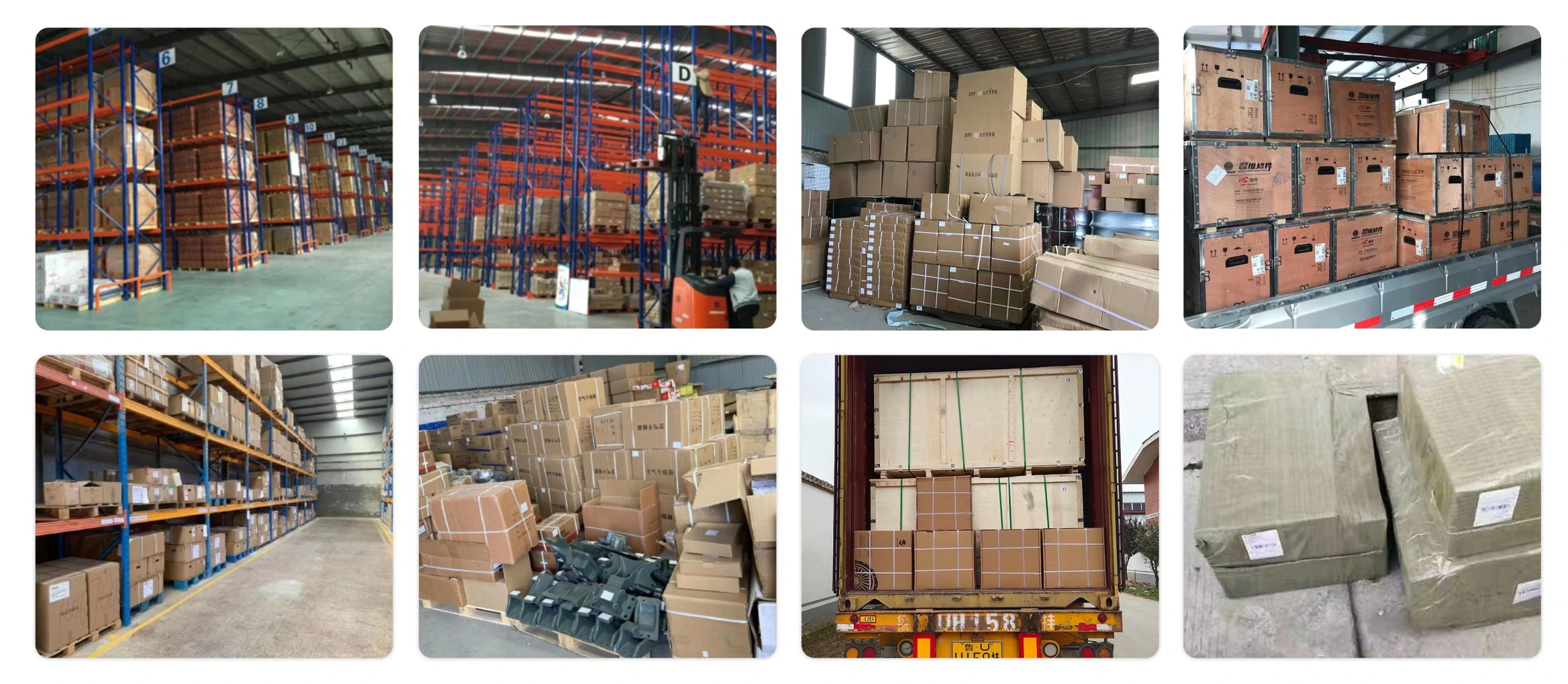
Esta abordagem de embalagem minimiza o risco de corrosão ou danos por impacto, garantindo que peças como o conjunto do bloco de cilindros FAW cheguem em perfeitas condições. Os clientes podem confiar na logística da FAW para obter qualidade e confiabilidade consistentes.