par 


C'est le guide technique essentiel du Ensemble de roue avant FAW (système d'entraînement d'accessoires avant) Pour le FAW Jiefang CA4251P66K24T1A3E5 6×4 tracteur semi-remorque diesel. Ce document fournit un aperçu complet, ventilation détaillée du système de poulies avant, un assemblage critique pour le fonctionnement du moteur.
La fonction de ce système s'étend bien au-delà de la simple rotation. Cet assemblage, désigné ici sous le nom de Ensemble de roue avant FAW, est responsable de la transmission de la puissance du vilebrequin du moteur à tous les accessoires vitaux, y compris l'alternateur, pompe à eau, pompe de direction assistée, et compresseur de climatisation.
Ce guide est conçu pour les techniciens de service, départements de pièces détachées, et les propriétaires de flotte, déconstruire l'ensemble en ses plus petites unités utilisables. Nous analyserons chaque composant, du support principal et de la courroie au tendeur automatique et aux poulies de renvoi, pour garantir des diagnostics précis., entretien, et commande de pièces.
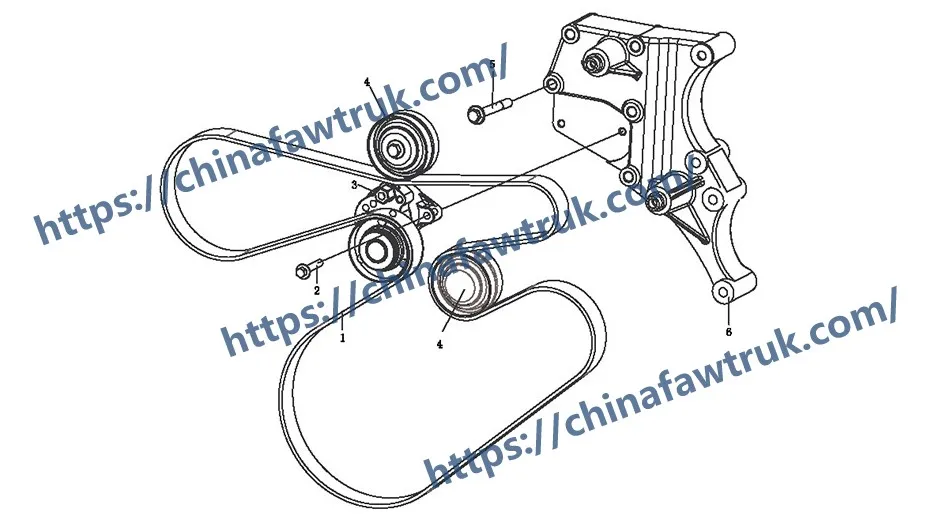
L'ensemble Ensemble de roue avant FAW est construit sur deux éléments fondamentaux: le « Support du système de poulie avant’ (1023011-81D) et la « ceinture Poly-V’ (1023021-81D). Le support sert de châssis pour l'assemblage, boulonnage directement sur le bloc moteur. C'est un moulage à haute résistance, probablement en aluminium ou en fer, qui est usiné avec précision pour fournir des emplacements de montage exacts pour les poulies tendeurs et folles. Sa rigidité est essentielle pour éviter la flexion, ce qui pourrait provoquer un désalignement de la courroie et une usure prématurée.
La «ceinture Poly-V»’ est le composant qui fait le travail. En tant que “poly-v” ou ceinture multi-nervurée, il comporte plusieurs petites nervures en forme de V. Cette conception offre des avantages significatifs par rapport aux anciennes, courroies trapézoïdales simples. Il offre une zone de contact beaucoup plus grande pour l'adhérence, lui permettant de transmettre des charges élevées avec moins de tension et un risque réduit de glissement. Cette conception permet également à la ceinture d'être plus flexible, lui permettant d'être acheminé de manière complexe “serpentin” chemins, entraîner plusieurs accessoires à la fois sur ses côtés nervurés et plats.
Fabriqué en EPDM résistant (Monomère d'éthylène propylène diène) caoutchouc, cette ceinture est conçue pour résister à la chaleur, huile, et craquer sur des dizaines de milliers de kilomètres. Cependant, c'est un article d'usure principal. Inspection régulière des fissures, effilochage, ou le vitrage est un élément essentiel de l'entretien des véhicules. Une défaillance de cette courroie unique entraînera une perte immédiate de production d'électricité. (alternateur) et refroidissement du moteur (pompe à eau), conduisant à une panne.
Le composant le plus sophistiqué du Ensemble de roue avant FAW est l'ensemble de poulie tendeur’ (1023010-36D). Cet appareil est essentiel pour la longévité et les performances du système, car cela résout un problème fondamental: la tension de la courroie doit rester constante, même si la ceinture s'étire avec l'âge et la chaleur, et comme les charges du moteur et les régimes fluctuent rapidement.
Ceci est un tendeur automatique, ce qui signifie qu'il n'est pas réglé manuellement. À l'intérieur du logement principal, un puissant, le ressort hélicoïdal calibré est monté dans une cartouche. Ce ressort exerce une action continue, quantité de force calculée avec précision sur un bras, qui maintient le galet tendeur. Cette force automatiquement “prend le relais” dans la ceinture, en s'assurant qu'il reste parfaitement tendu à tout moment. Cela évite le glissement, ce qui provoque des grincements et de mauvaises performances des accessoires, et cela évite également une tension excessive, ce qui peut détruire les roulements de l'alternateur ou de la pompe à eau.
Les tendeurs modernes comme celui-ci comprennent également un mécanisme d'amortissement interne. Cela fonctionne comme un petit, amortisseur intégré, qui empêche le bras tendeur de “flottant” ou “claques” lors d'une accélération ou d'une décélération rapide (comme changer de vitesse). Cet amortissement est crucial pour réduire le bruit et prolonger considérablement la durée de vie de la courroie et du roulement du tendeur.. Les « boulons combinés’ (CQ1460835) sont spécifiés pour son installation, probablement doté d'une rondelle imperdable pour un montage sécurisé.
L'ensemble de la poulie tendeur’ est considéré comme une seule unité réparable. Les deux principaux points de défaillance sont le ressort interne (qui peut s'affaiblir avec le temps, menant à une ceinture lâche) et le roulement de poulie (qui peut s'user, provoquant un bruit de grincement ou de gémissement). Lorsqu'une panne est diagnostiquée, toute l'assemblée (1023010-36D) est remplacé pour restaurer le Ensemble de roue avant FAW à ses spécifications d'usine d'origine.
Pendant que le tendeur *applique* une pression, les « assemblages de poulies folles »’ (1023015-36D) *guider* la ceinture. La liste des pièces nécessite deux de ces unités. Contrairement au tendeur, ces rouleaux sont fixés en place (boulonné au « support du système de poulie avant ») et ne bouge pas. Leur objectif est purement directionnel.
Les poulies folles sont utilisées pour deux raisons principales. D'abord, ils acheminent la ceinture autour des obstacles. L'avant d'un moteur est un espace encombré de supports de moteur, durites de liquide de refroidissement, et d'autres composants. Les rouleaux sont placés pour créer un espace libre, chemin non gênant pour la ceinture.
Deuxième, ils sont utilisés pour augmenter le “angle d'enroulement” sur d'autres poulies. Par exemple, en plaçant une poulie folle à proximité de l'alternateur, la ceinture peut être forcée de s'enrouler plus de 180 degrés autour de la poulie de l'alternateur. Ce contact de surface accru offre une adhérence supérieure, permettant à l'alternateur d'être entraîné efficacement sans glissement de la courroie, même sous une charge électrique élevée.
Tout comme le tendeur, l'ensemble de poulie de renvoi’ est un appareil simple composé d'une poulie de haute qualité (qui peut être plat ou nervuré, en fonction du côté de la ceinture avec lequel il entre en contact) et un interne, roulement à grande vitesse. Le roulement est le seul élément d'usure. Une panne est généralement indiquée par un gémissement aigu ou un grincement qui monte et descend avec le régime du moteur.. Si un roulement fou se grippe, cela détruira instantanément la ceinture. Donc, ce sont des points d’inspection critiques lors de l’entretien du Ensemble de roue avant FAW.
L'intégrité du Ensemble de roue avant FAW dépend de ses fixations. La liste des pièces identifie deux types. Le « boulon à bride hexagonale », Canne grossière (Modèle standard)’ (Q1841075) est un boulon robuste, et la liste en appelle à cinq. Ce sont presque certainement les boulons principaux qui fixent le « support du système de poulie avant ».’ (1023011-81D) au bloc moteur. La conception de la bride est importante car elle répartit la charge de serrage sur une zone plus large sans avoir besoin d'une rondelle séparée., garantissant que le support reste rigide et parfaitement aligné.
Le « boulon combiné’ (CQ1460835), dont il y en a deux, est spécifié pour « l’ensemble de poulie tendeur ». Un boulon combiné a généralement une rondelle imperdable (soit une rondelle plate, soit une rondelle de blocage à ressort) pré-installé sur le boulon. Cela simplifie l'installation et garantit que la bonne rondelle est toujours utilisée., ce qui est vital pour un composant soumis à une contrainte constante de ressort et de vibration. Utiliser le bon, les boulons spécifiés en usine avec le couple approprié ne sont pas facultatifs; il est obligatoire pour une réparation sûre et fiable du Ensemble de roue avant FAW.
Le tableau suivant fournit l'intégralité, ventilation détaillée de tous les composants identifiés dans le « Système de poulie avant’ schéma du tracteur FAW CA4251P66K24T1A3E5. Utilisez ces numéros de pièces pour une commande et un service précis.
| Marque | Partie no. | Nom de la pièce | Quantité |
|---|---|---|---|
| 1 | 1023021-81D | Courroie Poly-V | 1 |
| 2 | CQ1460835 | Boulon combiné | 2 |
| 3 | 1023010-36D | Ensemble de poulie tendeur | 1 |
| 4 | 1023015-36D | Ensemble de poulie de renvoi | 2 |
| 5 | Q1841075 | Boulon de bride hexadécimal, Canne grossière (Modèle standard) | 5 |
| 6 | 1023011-81D | Support du système de poulie avant | 1 |
Les spécifications pour le Ensemble de roue avant FAW (entraînement d'accessoires) sont définis par ses composants interconnectés. Ce système fonctionne comme une unité unique pour alimenter tous les accessoires entraînés par le moteur..
| Demande de véhicule | FAW Jiefang CA4251P66K24T1A3E5 6×4 Tracteur |
| Groupe de composants | Entraînement d'accessoires avant (Système de poulie) |
| Numéro de pièce du support principal. | 1023011-81D |
| Numéro de pièce de la courroie. & Taper | 1023021-81D (Courroie Poly-V / Ceinture serpentine) |
| Ensemble tendeur | 1x à ressort automatique (1023010-36D) |
| Ensembles de poulies de renvoi | 2x poulies de renvoi fixes (1023015-36D) |
| Attaches clés | Q1841075 (5x), CQ1460835 (2x) |
| Fonction principale | Transmet la puissance de rotation du vilebrequin aux accessoires du moteur (Par exemple, alternateur, pompe à eau, pompe de direction assistée). |
Pièces FAW, y compris l'ensemble bloc-cylindres, sont emballés avec soin pour garantir une livraison en toute sécurité. Chaque composant est sécurisé dans des matériaux de protection pour éviter tout dommage pendant le transport. Le réseau logistique garantit des expéditions ponctuelles dans le monde entier, soutenir des opérations de maintenance efficaces. Vous trouverez ci-dessous une image illustrant l'emballage standard des pièces de camion FAW., mettant en valeur l’attention portée aux détails dans la manipulation et le stockage.
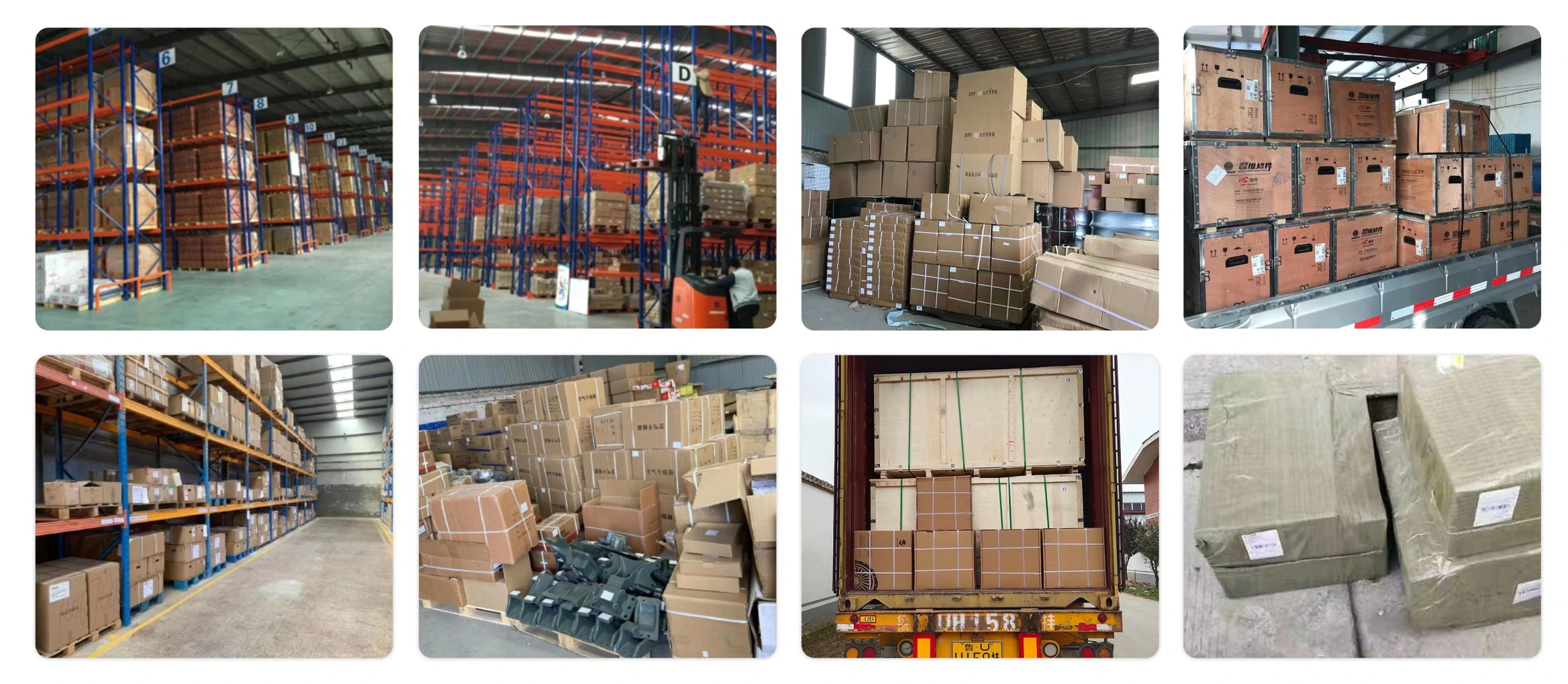
Cette approche d'emballage minimise le risque de corrosion ou de dommages causés par les chocs., s'assurer que les pièces comme l'ensemble bloc-cylindres FAW arrivent en parfait état. Les clients peuvent compter sur la logistique de FAW pour une qualité et une fiabilité constantes.