by 


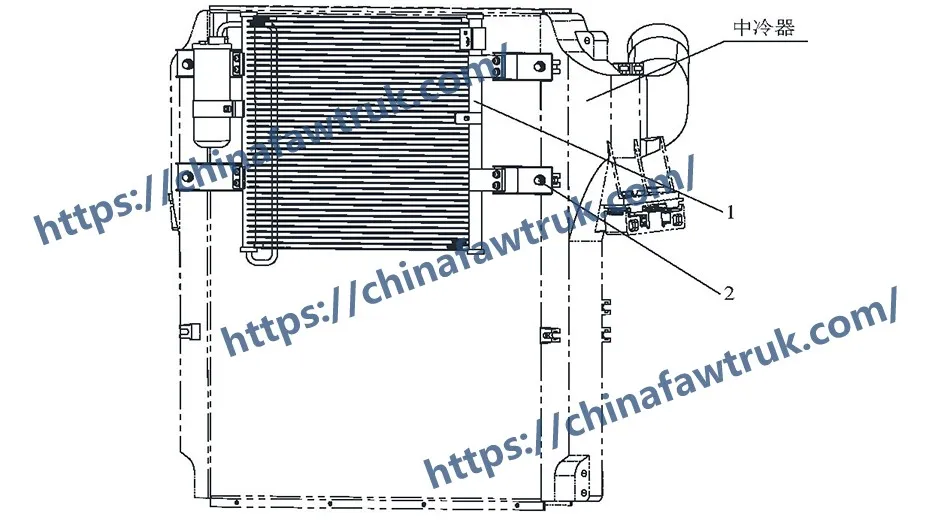
This is a complete technical analysis of the FAW J6P Guard Net (Chapter 39). This component, also known as the ‘Guard net assy’ (Comp 14), is the “Sacrificial Armor” for the entire cooling and charge air system on the FAW Jiefang CA3250P66K2L1T1E 6×4 dump truck. It is not a “cosmetic” part; it is a “Physical Protection Logic” device.
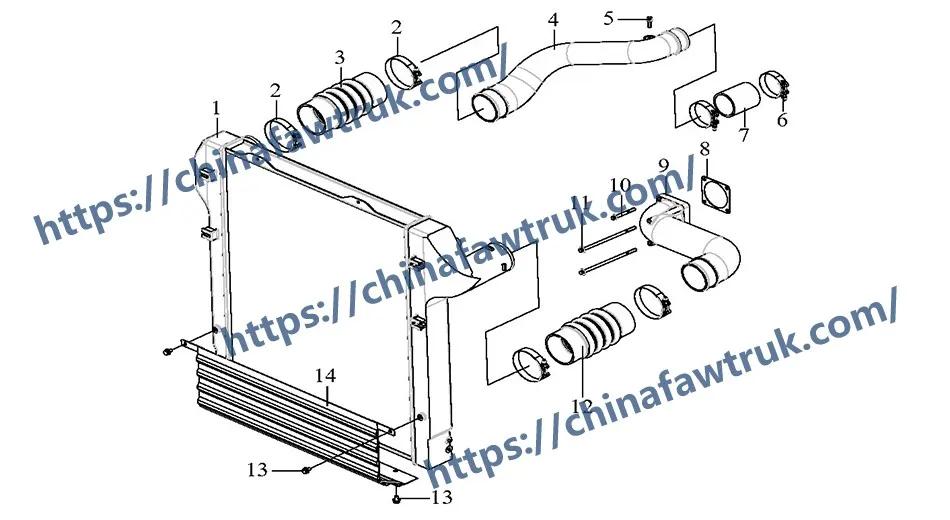
The FAW J6P Guard Net system’s sole purpose is “Impact Absorption Logic.” The ‘Intercooler assy’ (Comp 1) and ‘Radiator assy’ (Chapter 37) are made of “soft” aluminum with “paper-thin” fins. A single “rock” or piece of “road debris” from a construction site can “puncture” the intercooler core, causing an “instant boost leak” (loss of power) or, worse, a “coolant leak” (engine overheating).
This “sacrificial” FAW J6P Guard Net is “suspended” (bolted) in front of these “vulnerable assets.” Its “Open Mesh Logic” is an engineering “compromise”: it must be “open” enough to “allow maximum airflow” but “strong” enough to “deflect or absorb” a “high-velocity impact,” sacrificing itself to protect the expensive cores behind it.
This guide is essential for all technicians and fleet managers, as a “missing” FAW J6P Guard Net is a “high-risk” condition for “intercooler failure.” We will deconstruct all 14 components in this assembly, analyzing the “Armor Logic” (the net itself), the “Mounting Logic” (its bolts), the “Vulnerable Asset” (the intercooler), and the “System Context” (the plumbing it also protects).
This component *is* the FAW J6P Guard Net. It is the “hero” of this assembly, designed for one purpose: “to be destroyed” in place of a more expensive component.
1. Component: ‘Guard net assy’ (1310010A50AJ)
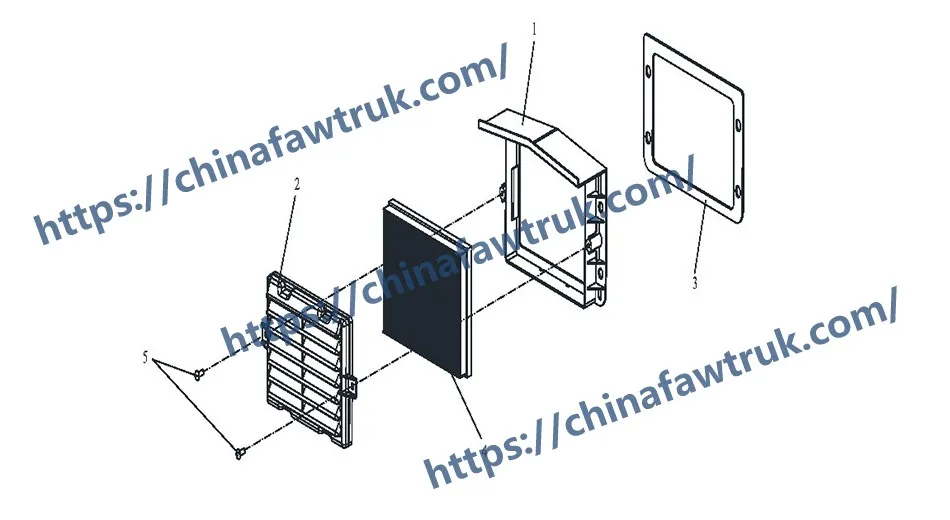
This (Comp 14) is the “Physical Protection Logic.” It is a “high-tensile” steel or “composite” mesh “screen” that is “suspended” directly in front of the ‘Intercooler assy’ (Comp 1).
Its “Impact Absorption Logic” is its primary function. A FAW J6P dump truck, by definition, works “off-road” or in “debris-heavy” construction sites. A “flung rock” from a tire or “road debris” (like a piece of rebar) is an “existential threat” to the cooling system.
The FAW J6P Guard Net is the “sacrificial” “first line of defense.” It is engineered to “absorb” or “deflect” these “high-velocity impacts.” A “dented” or “punctured” FAW J6P Guard Net is a “success,” as it means the ‘Intercooler’ (Comp 1) behind it is “unharmed.”
The “Airflow Logic” is the “engineering compromise.” The “mesh” must be as “open” as possible to “minimize airflow restriction” (which would reduce cooling efficiency), but as “strong” as possible to “stop” debris. This “optimized mesh” is the core of its design.
This is the “Protected Asset.” The FAW J6P Guard Net (Comp 14) exists *only* to protect this single, expensive, and “delicate” component.
1. Component: ‘Intercooler assy’ (1119010-70U)
This (Comp 1) is the “Charge Air Cooler” (CAC). Its “logic” is to “cool” the 150°C+ “hot air” from the turbocharger, creating “dense, oxygen-rich” air for the engine.
Its “Vulnerability Logic” is its “construction.” It is made of “soft” aluminum, with dozens of “paper-thin” “cooling fins” and “thin-walled” “tubes.”
“Failure Mode 1 (Fin Impact)”: A “flung rock” or even “large bugs” can “flatten” these delicate fins. “Flattened” fins “block airflow,” creating a “hot spot” on the core. This “reduces cooling efficiency,” “robbing” the engine of “power” and “increasing emissions.” The FAW J6P Guard Net prevents this “fin-flattening” impact.
“Failure Mode 2 (Puncture)”: A “sharp rock” can “puncture” one of the “thin-walled tubes” that carry the 30+ PSI of “boost pressure.” This is an “instant, catastrophic boost leak.” The “symptom” is a “loud hissing” sound under acceleration, a “severe loss of power,” and “excessive black smoke.” The FAW J6P Guard Net is the “armor” that prevents this “puncture failure.”
This group represents the “Smallest Serviceable Units” (SSU) that “anchor” the FAW J6P Guard Net to the vehicle.
1. Component: ‘Combination bolt’ (CQ1460816) – Qty 4
This (Comp 13) is the “Mounting Logic.” These four (4) “flanged” (self-locking) bolts are the SSUs that “physically attach” the ‘Guard net assy’ (Comp 14) to its mounting points (likely the “FAW J6P Radiator” frame, Chapter 37).
This “Vibration-Proof Logic” is essential. If the FAW J6P Guard Net “rattled” loose, it would (A) “chafe” and “saw” a hole in the “vulnerable asset” (Comp 1) it is supposed to be “protecting,” or (B) “fall off,” leaving the intercooler “exposed.” These “flanged” bolts prevent this “rattle-loose” failure.
2. The “Contextual Fasteners” (Components 5, 10, 11)
This group includes the ‘Hexagon flange bolt’ (Q1840825, Q1840870) and the ‘Connecting bolt’ (1119063-50A). These are the “Hardware Logic” for the “rigid pipes” (Comp 4, 9) that are “in” the assembly.
The FAW J6P Guard Net must be “serviceable.” These bolts (Comp 10, 11) “anchor” the ‘Engine inlet pipe’ (Comp 9), but they must be “accessible” *around* the ‘Guard net’ (Comp 14). This “Serviceability Logic” dictates the “mounting order” for a technician.
This group represents the “rest of the system” (Chapter 39) that the FAW J6P Guard Net is “associated” with and “contextually” protects.
1. The “Plumbing Logic” (Hoses & Pipes)
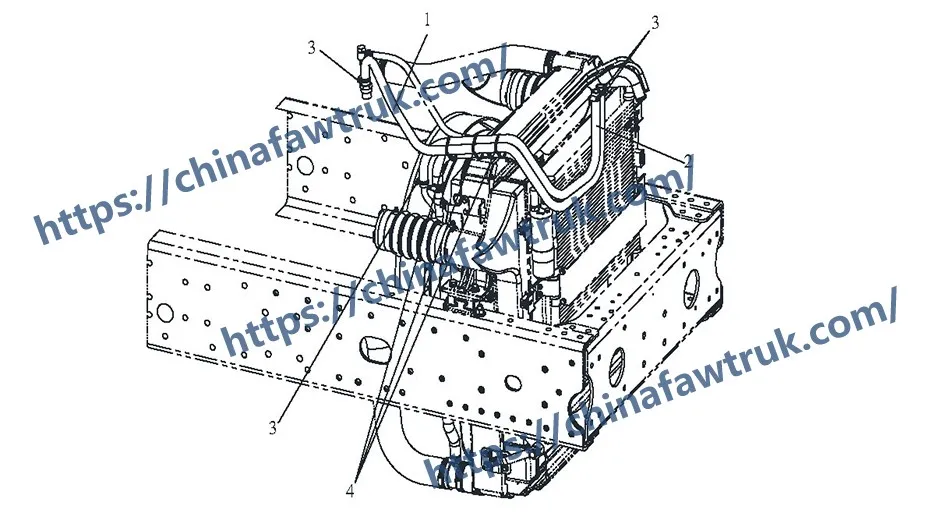
This includes the “Hot Side” plumbing (‘Turbocharger outlet hose’ (1119057A263), ‘Inlet corrugated hose’ (1119050-50A), ‘Intercooler inlet pipe’ (1119031-14B)) and the “Cold Side” plumbing (‘Outlet corrugated hose’ (1119060-50A), ‘Engine inlet pipe’ (1119062-14B)).
While the FAW J6P Guard Net‘s “primary mission” is to protect the ‘Intercooler’ (Comp 1), its “secondary mission” is to “protect” this “exposed” plumbing. A “flung rock” could also “puncture” the ‘Inlet corrugated hose’ (Comp 3), causing a “boost leak.” The “guard net” provides a “first line of defense” for these “vulnerable” hoses as well.
2. The “Sealing Logic” (Clamps & Gaskets)
This includes the six (6) ‘Heavy duty hose clamps’ (T67610006A, T6767606A) and the ‘Inlet pipe gasket’ (1119064-50A). This is the “Boost-Proof Sealing Logic” for the plumbing.
The “Integrity Logic” is that this *entire system* (net, core, pipes, seals) must work “in concert.” The FAW J6P Guard Net (Comp 14) “protects” the “core” (Comp 1) from “impact,” while the “clamps” (Comp 2, 6) “protect” the “hoses” (Comp 3, 7, 12) from “blowing off.” A “failure” in *any* of these 14 parts leads to a “system failure” (a boost leak).
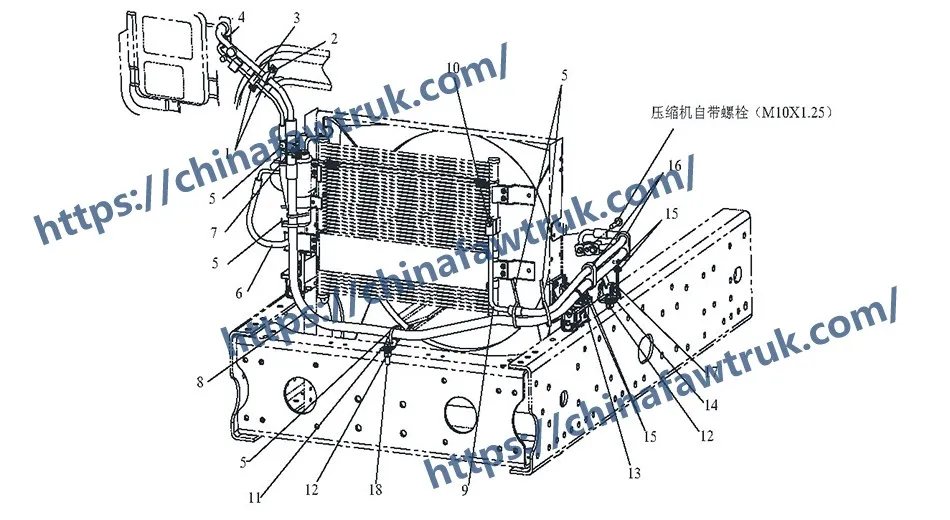
The following table provides the complete, detailed breakdown of all 14 component types in the FAW J6P Guard Net and intercooler assembly (Chapter 39) for the FAW Jiefang CA3250P66K2L1T1E 6×4 dump truck.
| Mark | Part No. | Part Name | Quantity |
|---|---|---|---|
| 1 | 1119010-70U | Intercooler assy | 1 |
| 2 | T67610006A | Heavy duty hose clamp | 4 |
| 3 | 1119050-50A | Inlet corrugated connecting hose assy | 1 |
| 4 | 1119031-14B | Intercooler inlet pipe | 1 |
| 5 | Q1840825 | Hexagon flange bolt | 1 |
| 6 | T6767606A | Heavy duty hose clamp | 2 |
| 7 | 1119057A263 | Turbocharger outlet hose | 1 |
| 8 | 1119064-50A | Inlet pipe gasket | 1 |
| 9 | 1119062-14B | Engine inlet pipe | 1 |
| 10 | Q1840870 | Hexagon flange bolt | 2 |
| 11 | 1119063-50A | Connecting bolt | 2 |
| 12 | 1119060-50A | Outlet corrugated connecting hose assy | 1 |
| 13 | CQ1460816 | Combination bolt | 4 |
| 14 | 1310010A50AJ | Guard net assy | 1 |
The specifications for the FAW J6P Guard Net system are defined by its function as the primary physical armor for the Charge Air Cooler.
| Vehicle Application | FAW Jiefang CA3250P66K2L1T1E 6×4 Dump Truck |
| System Group | FAW J6P Guard Net & Intercooler Assembly |
| Primary Logic | Sacrificial Impact Protection (Debris Deflection) |
| Secondary Logic | Optimized Airflow (Open Mesh Design) |
| Core Component (The “Armor”) | ‘Guard net assy’ (1310010A50AJ) |
| Protected Asset | ‘Intercooler assy’ (1119010-70U) |
| Mounting Hardware (for Net) | ‘Combination bolt’ (CQ1460816) – Qty 4 |
| Associated Plumbing (Context) | ‘Inlet/Outlet corrugated hose’ (1119050-50A, 1119060-50A) |
| Associated Sealing (Context) | ‘Heavy duty hose clamp’ (T67610006A, T6767606A) |
| Associated System | FAW J6P Charge Air Cooler (CAC) System |
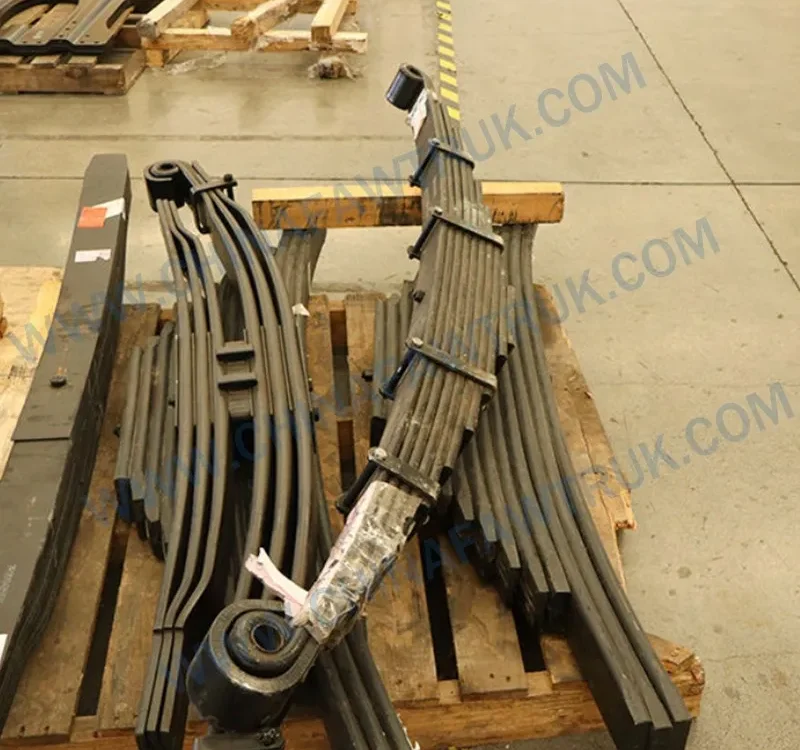
FAW parts, including the Cylinder Block Assembly, are packaged with care to ensure safe delivery. Each component is secured in protective materials to prevent damage during transit. The logistics network guarantees timely shipments worldwide, supporting efficient maintenance operations. Below is an image illustrating the standard packaging for FAW truck parts, showcasing the attention to detail in handling and storage.
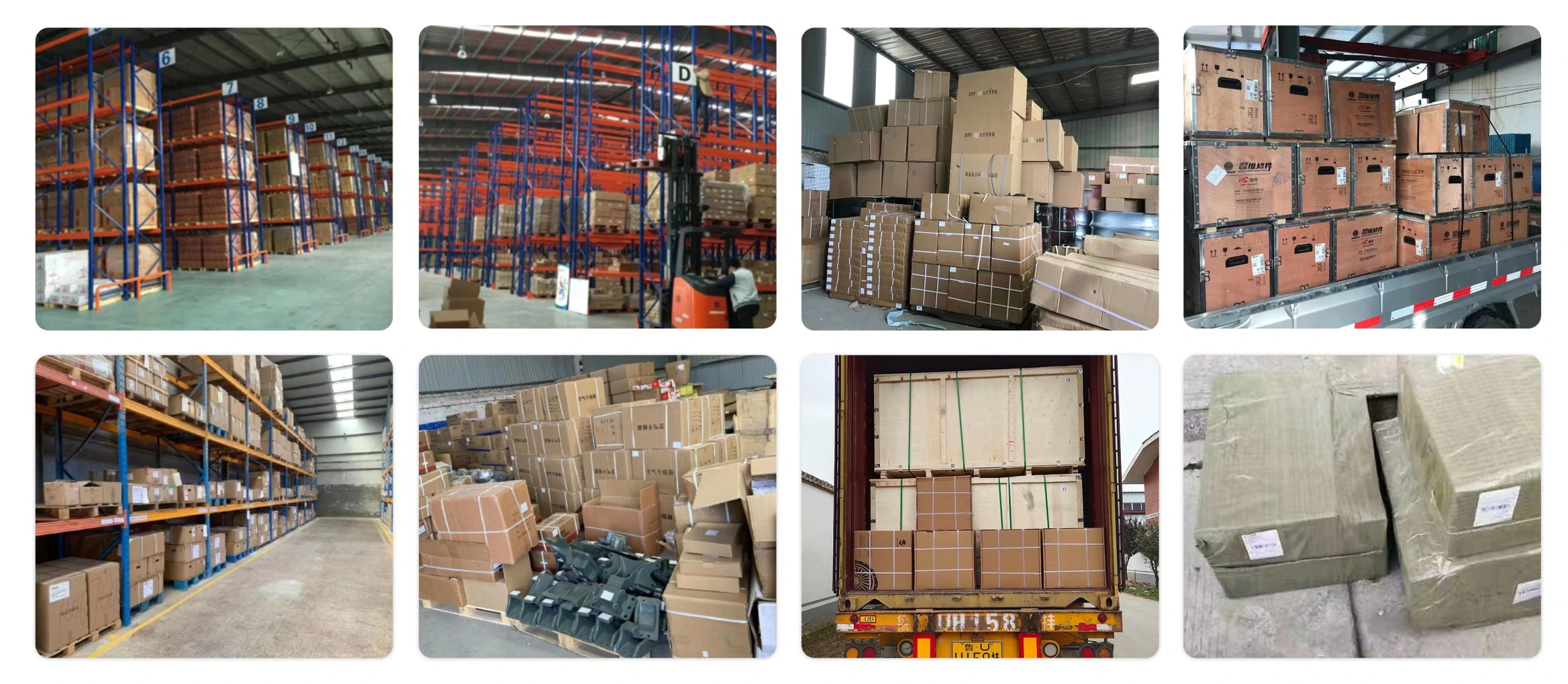
This packaging approach minimizes the risk of corrosion or impact damage, ensuring that parts like the FAW Cylinder Block Assembly arrive in perfect condition. Customers can rely on FAW’s logistics for consistent quality and reliability.