por 


Bienvenido a esta guía técnica crítica sobre la Turbocompresor FAW (Número de pieza. 1118010-91W-C00), el componente sumador de potencia más importante para FAW Jiefang CA4251P66K24T1A3E5 6×4 tractor semirremolque diésel. Este es el corazón del sistema de inducción forzada del motor..
El Turbocompresor FAW Es responsable de forzar un gran volumen de aire comprimido hacia los cilindros del motor., permitiendo un consumo de combustible mucho mayor, lo que aumenta dramáticamente la potencia y el torque. Este componente es una turbina diseñada con precisión que gira a velocidades superiores 150,000 RPM.
Esta guía es un recurso esencial para los técnicos profesionales., especialistas en motores, y gerentes de repuestos. Deconstruiremos todo Turbocompresor FAW ensamblaje y sus sistemas auxiliares críticos, incluyendo el montaje de alta temperatura, la alimentación de aceite a alta presión, y las líneas de retorno de aceite, hasta la unidad reparable más pequeña.
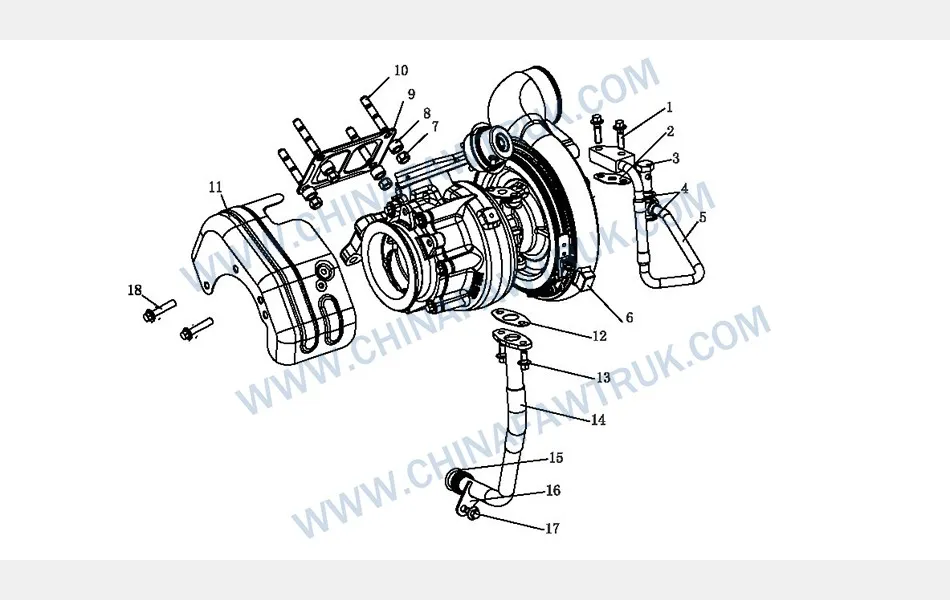
El componente principal es el "Conjunto de turbocompresor de turbina".’ (1118010-91W-C00). Este es el principal Turbocompresor FAW unidad. Es un muy equilibrado, Conjunto de precisión que consta de dos mitades principales.: el “lado caliente” y el “lado frío.”
**La turbina (lado caliente):** Los gases de escape calientes del motor se canalizan directamente a la carcasa de la turbina.. Este gas a alta presión hace girar una rueda de turbina, que está hecho de un exótico, superaleación de alta temperatura como Inconel, capaz de soportar más de 900°C (1650° F). Este es el “motor” que alimenta todo Turbocompresor FAW.
**El compresor (Lado frío):** La rueda de la turbina está conectada a través de un eje de acero templado a un “rueda de compresor” en el lado frio. Esta rueda suele estar fresada a partir de una pieza sólida de aluminio.. mientras gira, se dibuja fresco, aire filtrado y lo comprime (creando “aumentar”), forzándolo hacia el intercooler y el colector de admisión del motor.
**La CHRA (Conjunto giratorio del cubo central):** El eje que conecta estas dos ruedas gira a velocidades increíbles en un “flotante” sistema de cojinetes lisos. este rodamiento, en el corazón de la Turbocompresor FAW, no toca físicamente el eje; Se desplaza sobre una película microscópica de aceite de motor a alta presión., que lo lubrica y lo enfría. La integridad de esta película de aceite es el factor más importante en Turbocompresor FAW longevidad.
Montaje del Turbocompresor FAW es un desafío de calor extremo. Se atornilla directamente al colector de escape., cual es la parte mas caliente del motor. para manejar esto, el sistema se basa en hardware especializado. Los cuatro pernos prisioneros de doble cabeza del turbocompresor’ (1118051-53D) se enroscan primero en el colector de escape. Estos están hechos de alta resistencia, acero resistente al calor.
La 'junta del turbocompresor’ (1118013A81D) se coloca sobre estos montantes. Esta no es una junta de papel.; es un acero multicapa (MLS) empaquetadora, diseñado para ser aplastado entre el colector y el Turbocompresor FAW carcasa de turbina. Debe contener la alta presión., gases de escape sobrecalentados, evitando fugas. Una junta de entrada de turbina con fugas “silbar” y causar una pérdida severa de presión de sobrealimentación.
El Turbocompresor FAW Luego se desliza sobre los montantes., seguido de los cuatro 'Manga – turbocompresor’ (1118014-53D). Estas mangas son críticas; Actúan como espaciadores de precisión y, más importante, aisladores termicos, ayudando a evitar que las tuercas absorban todo el calor de la carcasa de la turbina. Finalmente, las cuatro 'nueces – turbocompresor’ (1118073-29D) están apretados. estos son especiales “tuercas de seguridad,” a menudo hecho de acero con bloqueo de distorsión, Diseñado para resistir el aflojamiento bajo ciclos de calor extremos y vibraciones.. Este conjunto completo de hardware es esencial para una confiabilidad Turbocompresor FAW instalación.
A Turbocompresor FAW girando en 150,000 Las RPM se destruirán en menos de cinco segundos sin aceite.. El 'Conjunto de tubo de entrada de aceite del turbocompresor’ (1118060-91W.) es su salvavidas. Este es un preformado, Tubería de acero rígida diseñada para acceder a una galería de aceite de alta presión en el bloque del motor..
Esta tubería alimenta a los más frescos., más limpio, aceite a la más alta presión directamente al cojinete liso del CHRA. El diseño de este Turbocompresor FAW la alimentación de aceite es crítica; debe estar libre de torceduras, grietas, o cualquier residuo.
Esta conexión de alta presión está sellada mediante accesorios tipo banjo especializados.. El 'perno banjo'’ (Q/XC3451.1 M16X1.5) Es un perno hueco que permite que el aceite fluya a través de él.. Está sellado por las dos 'Juntas’ (Q/WC3403-94(16X22)). Estas son arandelas trituradoras de cobre blando o aluminio.. Se coloca una junta a cada lado del accesorio banjo.. Cuando se aprieta el perno, estas arandelas se deforman, creando un perfecto, sello de alta presión. Estas juntas son de un solo uso.. Reutilizarlos provocará una fuga de aceite a alta presión., matando de hambre a los Turbocompresor FAW y creando un enorme riesgo de incendio cuando el aceite se rocía sobre la carcasa de la turbina al rojo vivo.. Este es un punto de servicio crítico para el Turbocompresor FAW.
Después de que el aceite es forzado a través del Turbocompresor FAW cojinete, ya no está bajo presión. Luego debe drenar *fuera* del CHRA y regresar al cárter de aceite.. Este es el trabajo del 'Conjunto de tubería de retorno de aceite del turbocompresor’ (1118080-2000).
Este es de gran diámetro., tubería de baja presión. Su diseño es fundamental.: debe ser lo más ancho posible y encaminarse con una constante, pendiente descendente (alimentación por gravedad). cualquier torcedura, obstruir, o un punto bajo en esta línea de retorno hará que el aceite se acumule dentro del Turbocompresor FAWcentro de vivienda.
Cuando se produce esta copia de seguridad, La presión de aceite acumulada no tiene adónde ir excepto más allá del Turbocompresor FAWes interno “anillo de pistón” sellos. Esta es una causa primaria de “humo azul” del escape, a medida que el aceite ingresa a la carcasa caliente de la turbina y se quema. También puede forzar la entrada de aceite en el “lado frio,” ensuciando el intercooler. La 'abrazadera – tubo de retorno de aceite del turbocompresor’ (1118083-81D) se utiliza para asegurar esta tubería.
Este tubo de retorno está sellado en el Turbocompresor FAW vivienda por la 'Junta – tubo de retorno de aceite del turbocompresor’ (1118094-29D), y en el bloque del motor por la junta tórica de goma hidráulica neumática’ (Q07343236C). Ambos sellos son fundamentales para evitar fugas externas.. Todo este camino de retorno es una parte clave del Turbocompresor FAW salud del sistema.
El 'escudo térmico del turbocompresor’ (1118031-1509) es una placa de metal estampada. Su función es sentarse entre la carcasa de la turbina al rojo vivo y el “frío” carcasa del compresor, o entre la turbina y el bloque del motor. Bloquea el intenso calor radiante del “lado caliente” del Turbocompresor FAW.
Este escudo evita que este calor extremo “procesión de coca” (incendio) El aceite dentro de la carcasa del cojinete central después de apagar el motor.. Este “remojo en calor” es una causa importante de Turbocompresor FAW falla. este escudo, junto con otros sujetadores diversos como los 'Pernos de brida hexagonal’ (Q1840830, Q1840812, Q1840612, Q1840816), Se utiliza para asegurar las distintas tuberías., abrazaderas, y escudos, asegurando la totalidad Turbocompresor FAW El conjunto está libre de vibraciones y protegido de su propio calor..
La siguiente tabla proporciona la información completa, desglose detallado de todos los componentes identificados en el 'Turbocompresor’ diagrama para el tractor FAW CA4251P66K24T1A3E5. Un servicio completo de Turbocompresor FAW requiere todas las juntas nuevas, juntas tóricas, y montantes.
| Marca | Número de pieza. | Nombre de la pieza | Cantidad |
|---|---|---|---|
| 1 | Q1840830 | Perno de brida hexagonal, varilla gruesa (Tipo estándar) | 2 |
| 2 | 1118063-D6 | Empaquetadora – tubería de entrada | 1 |
| 3 | Q/XC3451.1 M16X1.5 | perno banjo | 1 |
| 4 | Q/WC3403-94(16X22) | Empaquetadora | 2 |
| 5 | 1118060-91W. | Conjunto de tubo de entrada de aceite del turbocompresor (según muestra) | 1 |
| 6 | 1118010-91W-C00 | Conjunto de turbocompresor de turbina | 1 |
| 7 | 1118073-29D | Tuerca – turbocompresor | 4 |
| 8 | 1118014-53D | Manga – turbocompresor | 4 |
| 9 | 1118013A81D | junta del turbocompresor | 1 |
| 10 | 1118051-53D | Perno prisionero de doble cabeza del turbocompresor | 4 |
| 11 | 1118031-1509 | Escudo térmico del turbocompresor | 1 |
| 12 | 1118094-29D | Empaquetadora – tubo de retorno de aceite del turbocompresor | 1 |
| 13 | Q1840812 | Perno de brida hexagonal, varilla gruesa (Tipo estándar) | 1 |
| 14 | 1118080-2000 | Conjunto de tubo de retorno de aceite del turbocompresor | 1 |
| 15 | Q07343236C | Sello de goma con junta tórica neumática hidráulica | 1 |
| 16 | 1118083-81D | Abrazadera – tubo de retorno de aceite del turbocompresor | 1 |
| 17 | Q1840612 | Perno de brida hexagonal, varilla gruesa (Tipo estándar) | 1 |
| 18 | Q1840816 | Perno de brida hexagonal, varilla gruesa (Tipo estándar) | 2 |
Las especificaciones para el Turbocompresor FAW se definen por su alta velocidad, funcionamiento a alta temperatura, Requiere un sistema robusto para el montaje., lubricación, y protección térmica. todo el Turbocompresor FAW El conjunto es una unidad equilibrada con precisión..
| Solicitud de vehículo | FAW Jiefang CA4251P66K24T1A3E5 6×4 Tractor |
| Grupo de componentes | Turbocompresor FAW |
| N/P del conjunto principal | 1118010-91W-C00 |
| Sistema de rodamientos | Cojinete flotante (Lubricado con aceite & Enfriado) |
| Sistema de montaje | 4-Semental (1118051-53D) con nueces (1118073-29D) & Empaquetadora (1118013A81D) |
| Sistema de alimentación de aceite | Tubería de entrada de alta presión (1118060-91W.) con sellos de banjo (Q/WC3403-94) |
| Sistema de retorno de aceite | Tubería de alimentación por gravedad de baja presión (1118080-2000) con junta (1118094-29D) |
| Gestión Térmica | 1x Escudo térmico del turbocompresor (1118031-1509), 4x mangas (1118014-53D) | Manga
| Función primaria | Utiliza la energía de los gases de escape para comprimir el aire de admisión. (inducción forzada), aumentar la potencia y la eficiencia del motor. |
piezas FAW, incluido el conjunto del bloque de cilindros, Se empaquetan con cuidado para garantizar una entrega segura.. Cada componente está asegurado con materiales protectores para evitar daños durante el transporte.. La red logística garantiza envíos puntuales en todo el mundo., apoyando operaciones de mantenimiento eficientes. A continuación se muestra una imagen que ilustra el embalaje estándar de las piezas de camiones FAW., mostrando la atención al detalle en el manejo y almacenamiento.
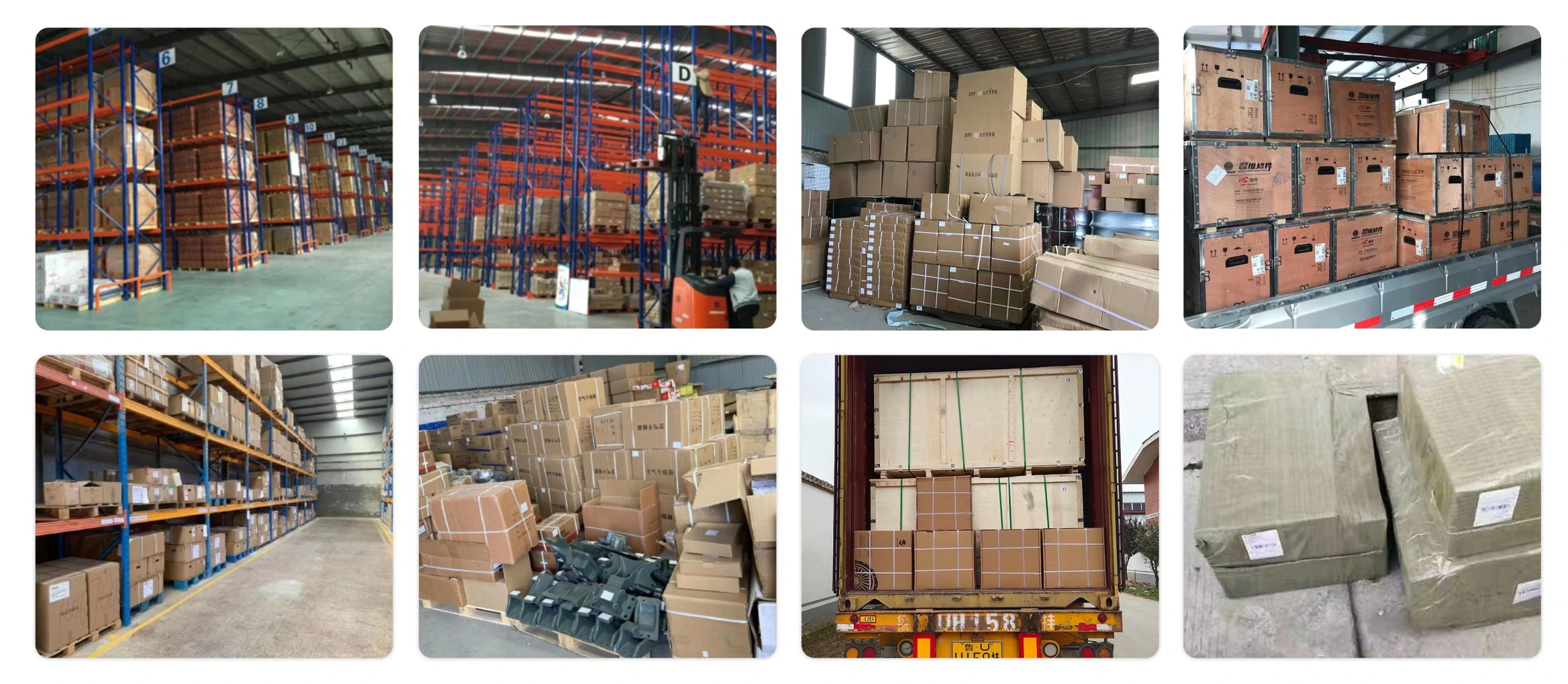
Este enfoque de embalaje minimiza el riesgo de corrosión o daños por impacto., asegurando que piezas como el conjunto de bloque de cilindros FAW lleguen en perfectas condiciones. Los clientes pueden confiar en la logística de FAW para obtener calidad y confiabilidad constantes.