by 


This is a comprehensive technical guide to the Side Panel Toolbox Lock and cable assembly for the FAW Jiefang CA3250P66K2L1T1E 6×4 dump truck. This deconstruction analyzes the 3 serviceable component types that form the complete remote latching system, a critical component for chassis storage security.
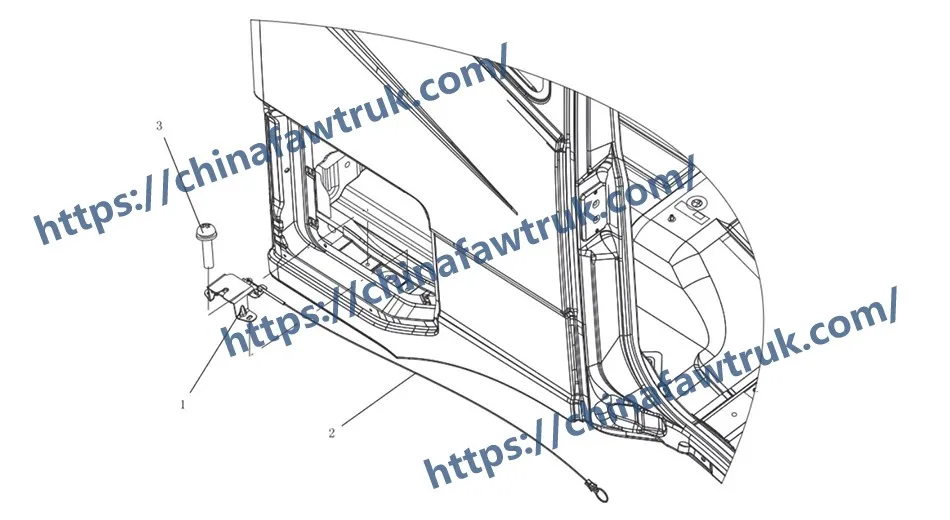
The Side Panel Toolbox Lock is an essential security mechanism for the chassis-mounted storage box. In a heavy-duty dump truck, the external toolboxes house valuable equipment, safety gear, and maintenance items. This system is designed to provide robust protection against theft and environmental contamination. Unlike a simple padlock, this is an integrated, remote-actuated system.
This deconstruction will analyze the key serviceable components of the Side Panel Toolbox Lock. This includes the ‘Lock assy’ (the rotary latch) and the ‘Cable assy’ (the remote pull-wire). This system must be incredibly durable, capable of resisting constant vibration, water ingress, and dust, while still functioning smoothly. A failing Side Panel Toolbox Lock can result in stolen equipment or a box that is seized shut, preventing access to critical tools. The reliability of the Side Panel Toolbox Lock is a key factor in operational security.
This component is the primary security mechanism of the Side Panel Toolbox Lock. This is the mechanical interface that physically secures the toolbox lid to the box body.
1. Component: ‘Lock assy – side toolbox’ (5402670-A01) – Qty 1
This (Comp 2) is the main latch mechanism, which is actuated by the cable. The Rotary Latch Logic is a robust design: when the toolbox lid is closed, a striker pin (U-bolt) forces a rotary pawl (cam) inside this assembly to turn and lock behind it. This pawl is held in place by a heavy-duty spring, ensuring the Side Panel Toolbox Lock cannot be shaken open by vibration. This assembly is mounted inside the toolbox, protecting it from direct weather.
The Durability Logic requires this component to be made from zinc-plated or galvanized steel to resist the corrosion that is inevitable inside a chassis-mounted toolbox. The internal spring must be high-tensile steel to provide a reliable “cinching” force, pulling the lid tight against its weatherproof seal.
2. Component: ‘Cross recessed pan head screw assy’ (Q2360625F6) – Qty 2
This (Comp 3) is the hardware used to secure the ‘Lock assy’ (Comp 2) to the toolbox wall. The Combination Bolt Logic (integrated washer) distributes the clamping load, and the “F6” suffix often indicates a locking patch or specialized coating. A loose lock assembly is a primary failure mode, causing misalignment and preventing the Side Panel Toolbox Lock from engaging.
Maintenance of this part of the Side Panel Toolbox Lock involves periodically cleaning the old grease and debris from the latch and applying a fresh coat of white lithium or similar grease to ensure the pawl moves freely. A seized latch is a common problem in dump truck applications.
This component provides the remote actuation for the Side Panel Toolbox Lock, allowing the driver to unlatch the box from a single, secure key point (the handle, not listed).
1. Component: ‘Cable assy – side toolbox’ (5402680-A01) – Qty 1
This (Comp 1) is the core transmission component. The Tensile Logic is that this cable (a braided steel inner wire inside a low-friction plastic sheath) must transmit a pulling force from the handle to the release lever on the ‘Lock assy’ (Comp 2). The sheath is anchored at both ends, allowing the inner wire to move freely. This is a critical part of the Side Panel Toolbox Lock.
The cable is highly susceptible to two main failure modes. First is stretching, where the inner wire permanently elongates over time, creating “slack” in the system. This prevents the handle from pulling the latch far enough to release. Second, and more common, is seizing. The outer sheath can be chafed, allowing water and grit to enter. This corrodes the inner wire, causing it to bind or seize completely, making the Side Panel Toolbox Lock inoperable.
2. Cable Routing and Maintenance
The routing of this cable is critical. It must be installed without sharp bends or kinks, which would dramatically increase friction. It must also be secured (using clamps, not listed here but part of the larger assembly) to prevent it from rubbing against the chassis frame. A chafed cable sheath is a guaranteed failure.
Maintenance of this Side Panel Toolbox Lock component involves lubricating the entry and exit points of the inner wire. If the pull becomes stiff, it is often a sign of internal corrosion, and the entire ‘Cable assy’ should be replaced. A well-maintained cable is essential for the reliable operation of the Side Panel Toolbox Lock.
The installation and maintenance of the Side Panel Toolbox Lock are straightforward but must be done precisely to ensure both security and reliability. The system’s integrity is entirely dependent on the alignment and condition of these 3 part types.
1. Installation Procedure
When installing a new Side Panel Toolbox Lock, the ‘Lock assy’ (Comp 2) must be perfectly aligned with the striker pin on the lid. The ‘Cross recessed pan head screw assy’ (Comp 3) should be installed with a thread-locking compound to prevent them from vibrating loose. The ‘Cable assy’ (Comp 1) must then be connected and adjusted.
The Cable Adjustment Logic is key. There is typically an adjustment nut at one end of the cable (at the handle or at the latch). This must be set to remove all “slack” from the inner wire, without creating tension. If there is tension, the Side Panel Toolbox Lock will not fully engage. If there is slack, the handle will not be able to pull the latch open.
2. Diagnostics and Troubleshooting
When a Side Panel Toolbox Lock fails, the diagnostic process is simple. First, attempt to actuate the release lever on the ‘Lock assy’ (Comp 2) manually. If it moves freely and unlatches, the problem is in the ‘Cable assy’ (Comp 1). The cable is likely stretched, seized, or snapped.
If the release lever on the lock itself is seized, the problem is the ‘Lock assy’ (Comp 2). This is common in dump truck environments where fine dust and water mix to create a cement-like sludge. The internal spring may be broken, or the pawl is corroded. In this case, the entire Side Panel Toolbox Lock assembly must be replaced.
The following table provides the complete, detailed breakdown of all 3 component types in the Side Panel Toolbox Lock assembly for the FAW Jiefang CA3250P66K2L1T1E 6×4 dump truck. This list is essential for any service of the Side Panel Toolbox Lock.
| Mark | Part No. | Part Name | Quantity |
|---|---|---|---|
| 1 | 5402680-A01 | Cable assy – side toolbox | 1 |
| 2 | 5402670-A01 | Lock assy – side toolbox | 1 |
| 3 | Q2360625F6 | Cross recessed pan head screw assy | 2 |
The specifications for the Side Panel Toolbox Lock are defined by its function as a remote-actuated, cable-driven latching system for the chassis-mounted toolbox.
| Vehicle Application | FAW Jiefang CA3250P66K2L1T1E 6×4 Dump Truck |
| System Group | Side Panel Toolbox Lock |
| Primary Logic | Remote mechanical latching and security |
| Actuation Method | ‘Cable assy’ (5402680-A01) |
| Latching Component | ‘Lock assy’ (5402670-A01) |
| Mounting Hardware | ‘Cross recessed pan head screw assy’ (Q2360625F6) |
| Total Component Types | 3 |
| Associated System | Side Panel Toolbox. The Side Panel Toolbox Lock provides the security. |
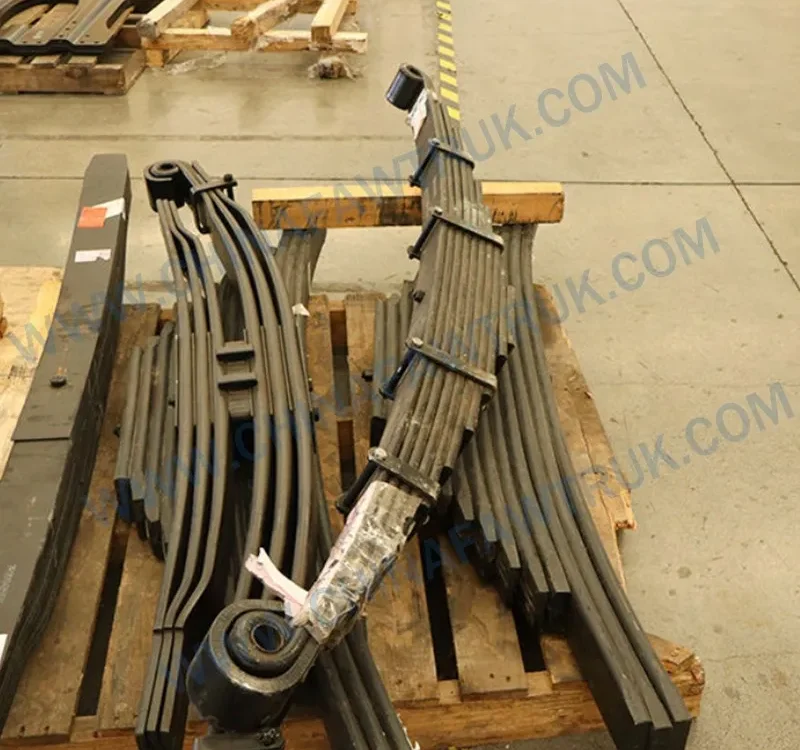
FAW parts, including the Cylinder Block Assembly, are packaged with care to ensure safe delivery. Each component is secured in protective materials to prevent damage during transit. The logistics network guarantees timely shipments worldwide, supporting efficient maintenance operations. Below is an image illustrating the standard packaging for FAW truck parts, showcasing the attention to detail in handling and storage.
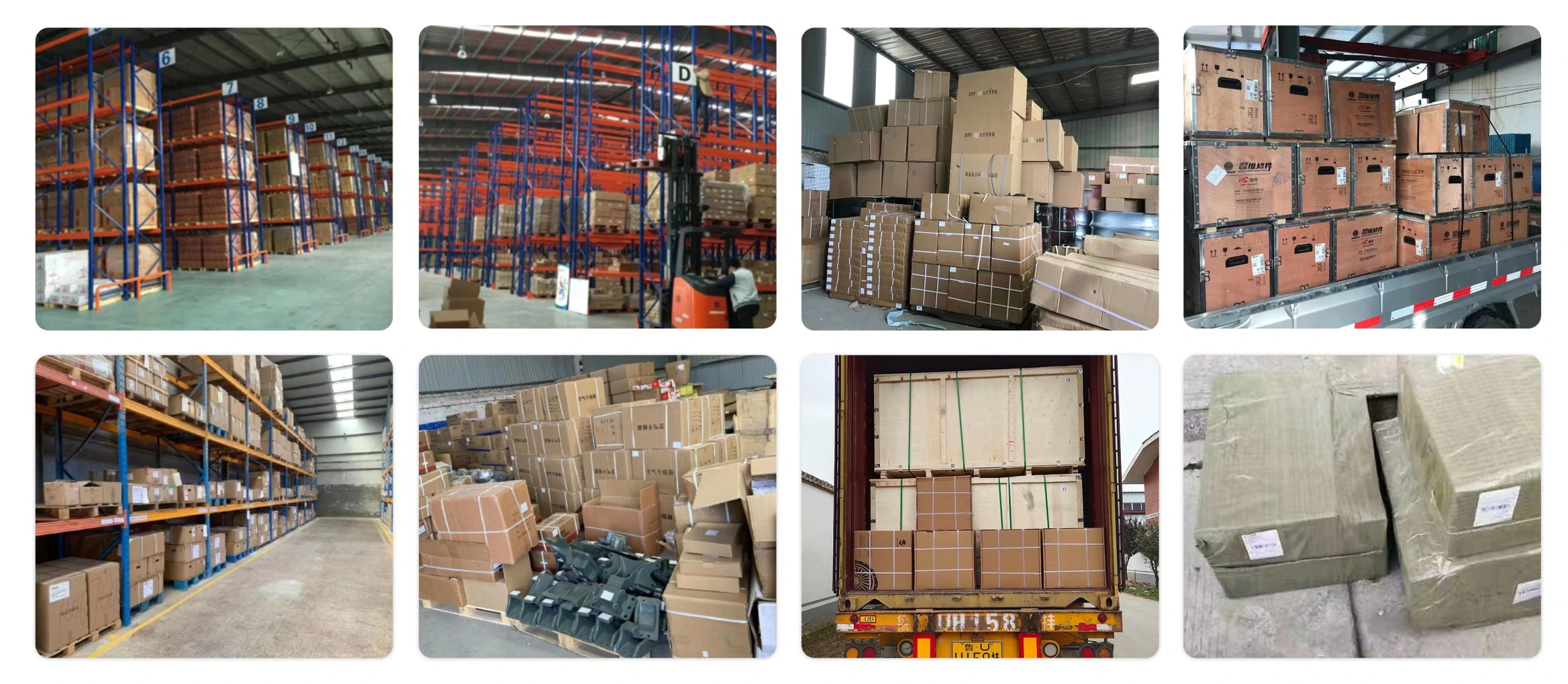
This packaging approach minimizes the risk of corrosion or impact damage, ensuring that parts like the FAW Cylinder Block Assembly arrive in perfect condition. Customers can rely on FAW’s logistics for consistent quality and reliability.