par 


Bienvenue dans cette analyse critique de la sécurité du Arrêt de porte FAW assemblée (Assemblée 690). C'est le complet, 7-type de composant, robuste “contrôle de porte” et “limiteur” système pour la porte d'entrée FAW’ (Assemblée 683) sur le FAW Jiefang CA4251P66K24T1A3E5 6×4 tracteur semi-remorque diesel. Ce n'est pas une simple sangle; c'est un point critique “logique” ensemble à double fonction de sécurité:
1. “Détente” Logique: Il maintient la lourde porte de la cabine *ouverte* à un angle prédéfini, l'empêchant de se fermer brusquement sur le conducteur.
2. “Limiteur” Logique: Il fournit un “arrêt brutal” pour empêcher la porte de “extension excessive,” ce qui est essentiel pour prévenir les dommages catastrophiques causés par le vent.
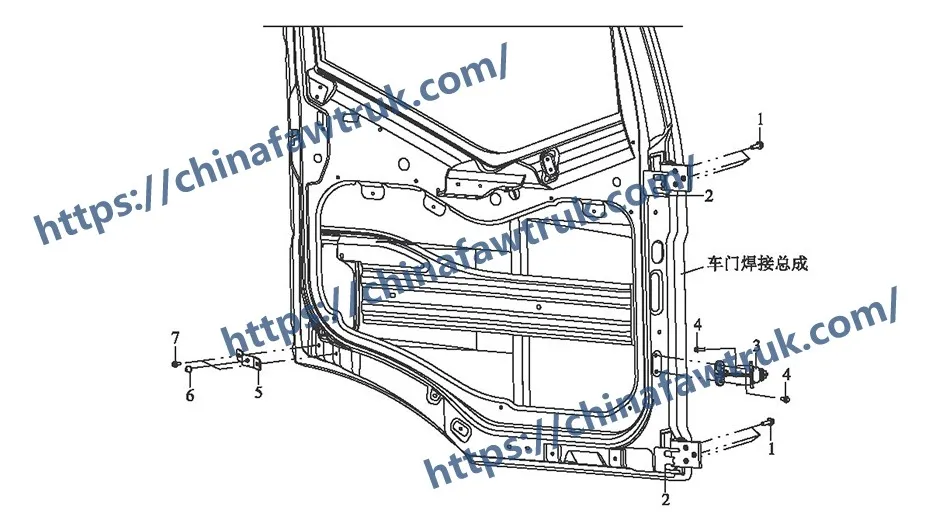
Le Arrêt de porte FAW (ou “contrôle de porte”) est le héros méconnu du taxi. Une défaillance de ce composant peut entraîner un “oscillation libre” porte qui peut être attrapée par le vent, en l'ouvrant avec suffisamment de force pour plier l'ensemble de cabine soudé’ (617) Pilier A, briser la « fenêtre latérale »’ (634), et détruire les charnières de la porte. Ce petit assemblage évite des milliers de dommages par collision.
Ce guide détaillé est essentiel pour les techniciens d'atelier de carrosserie et les gestionnaires de pièces.. Nous déconstruirons l'ensemble Arrêt de porte FAW système dans son 7 Unité minimale utilisable distincte (MSU) genres. Nous analyserons le “détente” logique du principal ‘Stop Assy’ (MSU 3), le “ancre” logique des parenthèses (MSU 5), le “amortissement” logique des blocs de caoutchouc (MSU 6), et la critique “anti-vibration” logique de fixation (MSU 1, 4, 7).
L'ensemble d'arrêt de porte d'entrée’ (6106035-A01) est le cœur du Arrêt de porte FAW système. La liste en appelle à deux (2), un pour chaque porte. Ce MSU est un bras mécanique robuste, et il effectue deux “logique” fonctionne simultanément.
1. Le “Détente” Logique (Maintien-Ouvert):
C'est le “contrôle de porte” ou “maintien en position ouverte” logique. Ce MSU n'est pas seulement une sangle plate. Il s'agit d'un bras en acier épais avec un profil de forme précise (avec “vallées” et “pics” estampillé dedans). À l'intérieur du « support de montage »’ (MSU 5), à travers lequel ce bras glisse, sont un ensemble de puissants rouleaux ou broches à ressort.
Alors que la porte s'ouvre, ces rouleaux “monter” le long du bras. Lorsqu'ils tombent dans l'un des “vallées” (la détente), la pression du ressort “écluses” les en place. C'est le “cliquez” tu ressens. Ce “logique de détente” est assez fort pour supporter le lourd Porte d'entrée FAW (683) ouvrir, l'empêchant de se fermer sur les jambes du conducteur lorsqu'il monte ou descend.
2. Le “Limiteur” Logique (Anti-Hyperextension):
C'est le point critique “anti-dommages” logique. Le Arrêt de porte FAW bras (MSU 3) a un “arrêt brutal” construit à sa fin. Ce “logique” d'une limite fixe *empêche* physiquement la porte de s'ouvrir trop loin.
C'est sans doute la fonction la plus précieuse du Arrêt de porte FAW. Une porte de camion lourd, attrapé par un coup, fort coup de vent, devient un “naviguer.” Sans ce limiteur, le vent claquerait la porte “ouvrir” avec une force incroyable. Cette force entraînerait une hyperextension des charnières de la porte, “peeling” la porte du montant A, plier l'ensemble de cabine soudé’ (617) cadre, et détruire la porte.
Ce MSU est le “sacrificiel” composant. Il est conçu de telle sorte que, lors d'un événement de rafale de vent catastrophique, ce *limiteur* se cassera *avant* le montant A de la cabine. Remplacer un $50 Arrêt de porte FAW est infiniment préférable à un $5,000 réparation structurelle de la cabine.
Facilité d'entretien: Ce MSU est un article très résistant. La détente “vallées” s'user avec le temps, résultant en un “faible” porte qui ne reste pas ouverte. C'est une unité scellée (pré-graissé) et est remplacé comme un seul assemblage.
Ce groupe de MSU forme le “côté châssis” interface pour le Arrêt de porte FAW.
MSU 5: '…Support de montage d'arrêt de porte’ (6101543-A01 / 6101544-A01): C'est le “ancre” logique. Ce sont les poids lourds, supports en acier fabriqués (Gauche & Droite) qui sont solidement boulonnés à l'*intérieur* du montant A de la cabine.
L'ensemble d'arrêt de porte d'entrée’ (MSU 3) passe *à travers* ce support. Ce MSU est ce qui contient le “détente” rouleaux et ressorts mentionnés plus haut. C'est “logique” c'est être l'immeuble “ancre” qui résiste 100% de la force de traction de la porte.
MSU 6: '…Bloc amortisseur d'arrêt de porte’ (6101541-A01) – Quantité 2: C'est le “Nvh” (Bruit, Vibration, Dureté) logique. Ces deux blocs de caoutchouc denses sont les “la bosse s'arrête.”
Leur “logique” est de fournir un “arrêt en douceur.” Quand le Arrêt de porte FAW (MSU 3) atteint son “limite,” il entre en contact avec ce bloc en caoutchouc. Cela évite un dur, fort “CLIQUETIS” d'impact métal sur métal, éliminer le bruit et réduire le “charge de choc” sur le châssis de la cabine. Un bloc amortisseur manquant entraînera une porte bruyante et finira par provoquer la défaillance de la goupille du limiteur..
Ce dernier groupe de MSU est le matériel. Le “logique” de ce kit concerne “alignement” et “anti-vibration,” qui sont essentiels pour un fonctionnement Arrêt de porte FAW.
MSU 2: « Cale-charnière de réglage’ (6106061-A01) – Quantité 1: C'est le “logique d’alignement.” Ce single, mince, La cale découpée avec précision est un MSU essentiel. C'est “logique” doit être placé *entre* le « support de montage »’ (MSU 5) et le montant A de la cabine. Cela permet à un technicien de carrosserie de minutieusement “pousser” ou “tirer” l'alignement du support, changer l'angle du Arrêt de porte FAW. Ceci est essentiel pour garantir que la porte s'ouvre à l'angle *exact* correct et qu'elle se ferme parfaitement..
MSU 1, 4, 7 (Boulons): C'est le “logique de fixation.” Le système utilise 24 boulons à haute résistance totale, de deux types: « Boulons à bride hexagonale’ (12 total) et « Boulons combinés’ (12 total).
Le “logique” est 100% “anti-vibrations.”
Ces deux conceptions fournissent une tension constante sur la tête du boulon. UN “contrôle de porte” est l'un des vibrations les plus élevées, pièces les plus impactantes sur un camion. Un boulon standard se détacherait. Ce “attache verrouillable” la logique est ce qui garantit Arrêt de porte FAW reste rigidement fixé à la cabine, offrant un fonctionnement sûr et silencieux.
Le tableau suivant fournit l'intégralité, ventilation détaillée de tous 7 types de composants identifiés dans le Arrêt de porte FAW ensemble pour tracteur FAW CA4251P66K24T1A3E5.
| Marque | Partie no. | Nom de la pièce | Quantité |
|---|---|---|---|
| 1 | CQ1461035 | Boulon combiné | 12 |
| 2 | 6106061-A01 | Cale-charnière de réglage | 1 |
| 3 | 6106035-A01 | Ensemble d'arrêt de porte avant | 2 |
| 4 | Q1840616F6 | Boulon à bride hexagonale, gros fil (modèle standard) | 8 |
| 5 | 6101543-A01 | Support de montage de butée de porte avant gauche | 1 |
| 6101544-A01 | Support de montage de butée de porte avant droite (ce 6101543-A01) | 1 | |
| 6 | 6101541-A01 | Bloc amortisseur d'arrêt de porte avant | 2 |
| 7 | Q1840612F6 | Boulon à bride hexagonale, gros fil (modèle standard) | 4 |
Les spécifications pour le Arrêt de porte FAW sont définis par sa fonction de sécurité critique, système de contrôle et de limitation de porte à double logique.
| Demande de véhicule | FAW Jiefang CA4251P66K24T1A3E5 6×4 Tracteur |
| Groupe de composants | Arrêt de porte FAW |
| Type de système | Vérification mécanique des portes (Détente) & Limiteur |
| Logique primaire | Prévention des dommages (Anti-Hyperextension / Limiteur) |
| Logique secondaire | Sécurité (Détente de maintien), Nvh (Bloc amortisseur) |
| MSU 3 (Bras) | « Ensemble d'arrêt de porte d'entrée’ (6106035-A01) – Quantité 2 |
| MSU 5 (Ancre) | '…Support de montage’ (6101543-A01 / 6101544-A01) |
| MSU 6 (Amortisseur) | '…Bloc amortisseur’ (6101541-A01) – Quantité 2 |
| MSU 2 (Aligner) | « Cale-charnière de réglage’ (6106061-A01) – Quantité 1 |
| Logique de fixation | Anti-vibrations (Combinaison & Boulons à bride) |
Pièces FAW, y compris l'ensemble bloc-cylindres, sont emballés avec soin pour garantir une livraison en toute sécurité. Chaque composant est sécurisé dans des matériaux de protection pour éviter tout dommage pendant le transport. Le réseau logistique garantit des expéditions ponctuelles dans le monde entier, soutenir des opérations de maintenance efficaces. Vous trouverez ci-dessous une image illustrant l'emballage standard des pièces de camion FAW., mettant en valeur l’attention portée aux détails dans la manipulation et le stockage.
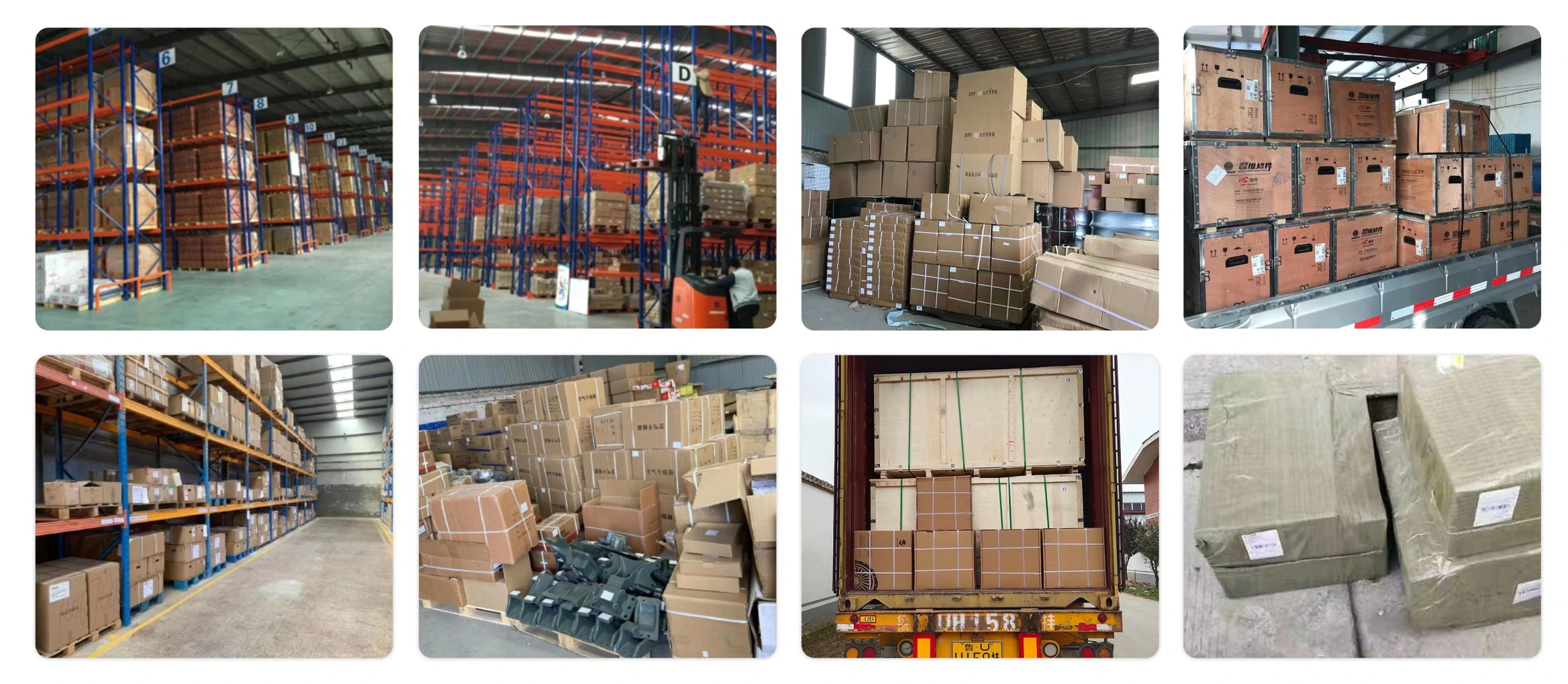
Cette approche d'emballage minimise le risque de corrosion ou de dommages causés par les chocs., s'assurer que les pièces comme l'ensemble bloc-cylindres FAW arrivent en parfait état. Les clients peuvent compter sur la logistique de FAW pour une qualité et une fiabilité constantes.