par 


Bienvenue dans le guide technique complet du FAW Couvre-culasse et bouchon de remplissage d'huile système, un ensemble crucial de composants pour le FAW Jiefang CA4251P66K24T1A3E5 6×4 tracteur semi-remorque diesel. Cet assemblage constitue la première ligne de défense pour le système de soupapes du moteur..
Ce système, le FAW Couvre-culasse et bouchon de remplissage d'huile, remplit plusieurs fonctions critiques: ça scelle le haut du moteur, protégeant les arbres à cames délicats et les engrenages de soupapes de la saleté et de l'humidité. Il contient également l'huile moteur qui lubrifie ces composants, prévenir les fuites. En outre, il abrite le système de ventilation du carter moteur et constitue le point de service pour l'ajout d'huile moteur.
Ce guide est conçu pour les techniciens professionnels et les gestionnaires de pièces, fournir une ventilation détaillée de l'ensemble FAW Couvre-culasse et bouchon de remplissage d'huile assemblée. Nous déconstruirons le système en ses plus petites unités utilisables, du couvercle principal et de son joint aux boulons spécialisés et à l'ensemble de bouchon d'huile, s'assurer que chaque service est effectué avec précision.
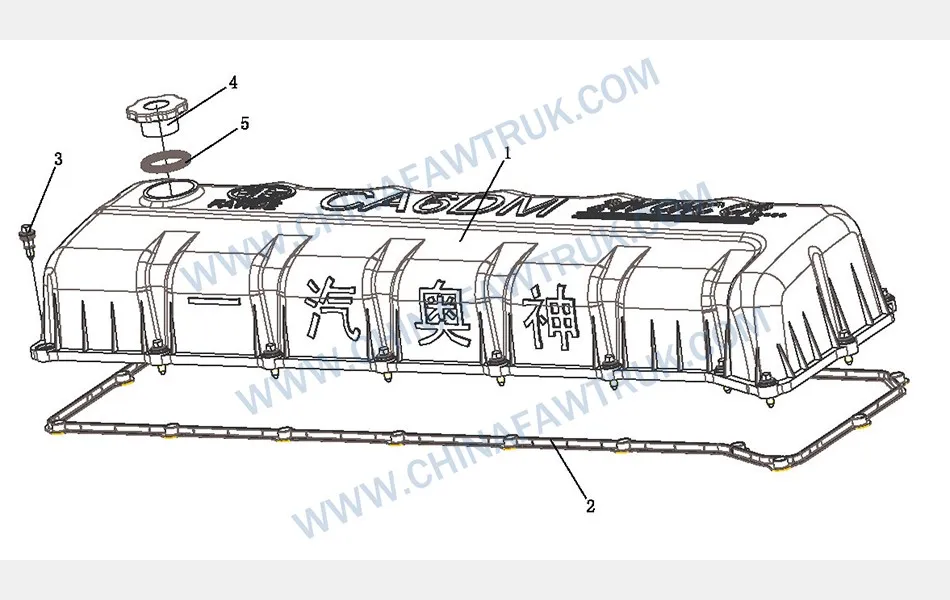
Le composant le plus important de cet assemblage est le « couvre-culasse ».’ (1003031-81D). Sur les moteurs diesel modernes, cette pièce est un composant de haute technologie, souvent fabriqué à partir d'un matériau à haute résistance, composite chargé de verre (plastique) ou une fonte d'aluminium légère. Une conception composite est souvent préférée car elle réduit le poids du moteur et est nettement plus silencieuse., amortir le “cocher” bruit du système de soupapes.
La fonction principale de ce composant est d’agir comme un joint statique, mais sa fonction secondaire est tout aussi critique. Ce couvercle contient la ventilation positive du carter du moteur (PCV) système. Pendant que le moteur tourne, certains gaz de combustion (“soufflé”) inévitablement pousser au-delà des segments de piston et dans le carter. Cela crée de la pression et doit être ventilé.
Cependant, ces gaz sont mélangés à un fin brouillard d'huile moteur chaude. Le FAW Couvre-culasse et bouchon de remplissage d'huile l'assemblage est conçu avec une série complexe de canaux internes, chicanes, et séparateurs huile-air. Lorsque les gaz du carter s'écoulent dans le couvercle, ils sont forcés de traverser ça “labyrinthe.” Les gouttelettes d'huile liquide les plus lourdes entrent en collision avec les parois du déflecteur, condenser, et vidanger dans la culasse, retour au carter d'huile.
L'huile restante *vapeur* (avec les gaz soufflés) est ensuite extrait d'un port sur le couvercle et acheminé vers l'entrée d'air du moteur., juste avant le turbocompresseur. Cela permet de rebrûler les hydrocarbures imbrûlés, qui est une fonction essentielle de contrôle des émissions. Si ce système de déflecteur interne se bouche ou tombe en panne, le moteur aspirera de l'huile liquide dans l'admission, entraînant une consommation élevée d’huile, fumée bleue à l'échappement, et l'encrassement du turbocompresseur et du refroidisseur intermédiaire.
Le « couvre-culasse »’ elle-même est une partie statique; le « Joint de couvre-culasse’ (1003041-81D) est le composant actif qui fait l’étanchéité. Il s’agit du point de défaillance le plus courant dans le FAW Couvre-culasse et bouchon de remplissage d'huile système.
Ce n'est pas un simple joint en papier. C'est un “profil” joint, moulé avec précision à partir d'un, élastomère résistant à l'huile (comme le silicone ou le FKM/Viton). Il est conçu pour s'insérer parfaitement dans une rainure qui s'étend sur tout le périmètre du couvercle en plastique ou en aluminium.. Il comprend également des joints toriques intégrés qui s'enroulent autour des trous de boulons et des tubes de bougies d'allumage. (le cas échéant), créer un complet, solution d'étanchéité monobloc.
Ce joint vit dans un environnement brutal, soumis à des vibrations constantes du moteur, cycles de chaleur (de la température ambiante à plus de 100°C et vice-versa), et exposition continue à l'huile moteur chaude. Pendant plusieurs milliers d'heures, cet élastomère va durcir, devenir fragile, et compresser. Quand cela arrive, il perd sa capacité d'étanchéité, et l'huile commence à pleurer.
Un joint de couvre-culasse qui fuit est un élément d’entretien courant. Le diagnostic est simple: signes visuels de “transpiration” ou de l'huile active coule de la couture entre la tête et le couvercle. Souvent, cette huile va couler sur le collecteur d'échappement chaud, créant une odeur distincte d'huile brûlée. Le remplacement de ce joint est une procédure de service standard, mais cela doit être fait correctement en suivant la séquence précise de serrage des boulons pour éviter d'endommager le nouveau joint.
L’étanchéité du joint est aussi bonne que la force de serrage qui lui est appliquée. C'est le travail du 17 « Ensemble de boulons de couvre-culasse’ unités (1003060-81D). La grande quantité de 17 Les boulons sont nécessaires pour répartir la pression de serrage uniformément sur toute la longueur., périmètre complexe du joint, s'assurer qu'il n'y a pas “taches lâches” où le pétrole pourrait s'échapper.
Ceux-ci sont désignés comme un “ensemble de boulons” parce que ce ne sont pas de simples boulons. Chacun comprend presque certainement une rondelle métallique imperdable et, le plus important, un isolateur en caoutchouc ou “œillet.” Cet œillet est un élément essentiel du FAW Couvre-culasse et bouchon de remplissage d'huile conception.
Cet œillet en caoutchouc remplit deux fonctions. D'abord, ça scelle le trou du boulon, empêchant l'huile de s'écouler par le filetage des boulons et de s'accumuler sur le dessus du couvercle. Deuxième, il agit comme un “couple doux” arrêt. Lors de l'installation d'une couverture composite, un serrage excessif est un risque majeur; cela pourrait fissurer le couvercle ou “diviser” le joint. Ces boulons ne sont pas conçus pour être serrés avec une force élevée. Le technicien les serre jusqu'à ce que la rondelle métallique comprime l'œillet en caoutchouc. Ceci fournit un “intégré” limite de couple et isole le couvercle des vibrations du moteur, empêchant les boulons de reculer.
Les deux derniers composants constituent le principal point d'interaction utilisateur du FAW Couvre-culasse et bouchon de remplissage d'huile système. Le bouchon de remplissage d'huile’ (1003037-29D) est le amovible, bouchon à verrouillage rotatif qui permet à un technicien ou à un opérateur d'ajouter de l'huile moteur.
La partie fonctionnelle, cependant, est le « bouchon de remplissage d'huile à bague d'étanchéité »’ (1003036-29D). Il s'agit d'un simple joint torique ou d'un joint plat en caoutchouc placé dans une rainure sur le capuchon.. Sa fonction est bien plus importante que simplement empêcher le pétrole de “éclaboussures” dehors. Ce joint est un élément essentiel du système de ventilation du carter.
Le système PCV, décrit plus tôt, est conçu pour maintenir un léger *vide* à l’intérieur du carter moteur. Si ce joint de capuchon est manquant, fissuré, ou durci, cela crée un “fuite de vide.” Cela permet de, *air non filtré* à aspirer directement dans la commande des soupapes du moteur. Cet air sale contamine l’huile moteur et contourne les déflecteurs de séparation d’huile du PCV..
Un joint de capuchon défaillant peut perturber l’équilibre délicat du PCV, pouvant conduire à une pression incorrecte dans le carter. Dans le pire des cas, si le système PCV est obstrué, un joint de capuchon défectueux peut devenir une *exutoire* pour la pression du carter, expulser les vapeurs d'huile et salir le compartiment moteur. Ce petit, « Bague d'étanchéité peu coûteuse’ est un élément essentiel pour maintenir la santé de l'ensemble du moteur et le bon fonctionnement du FAW Couvre-culasse et bouchon de remplissage d'huile.
Le tableau suivant fournit l'intégralité, ventilation détaillée de tous les composants identifiés dans la section «Couvre-culasse et bouchon de remplissage d'huile»’ schéma du tracteur FAW CA4251P66K24T1A3E5.
| Marque | Partie no. | Nom de la pièce | Quantité |
|---|---|---|---|
| 1 | 1003031-81D | Couvercle de culasse | 1 |
| 2 | 1003041-81D | Joint de couvre-culasse | 1 |
| 3 | 1003060-81D | Ensemble de boulon de couvercle de culasse | 17 |
| 4 | 1003037-29D | Bouchon de remplissage d'huile | 1 |
| 5 | 1003036-29D | Bague d'étanchéité - Bouchon de remplissage d'huile | 1 |
Les spécifications pour le FAW Couvre-culasse et bouchon de remplissage d'huile sont centrés sur son rôle de système principal d’étanchéité et de ventilation pour la commande des soupapes du moteur.
| Demande de véhicule | FAW Jiefang CA4251P66K24T1A3E5 6×4 Tracteur |
| Groupe de composants | Couvre-culasse et bouchon de remplissage d'huile |
| Numéro de pièce du couvercle principal. | 1003031-81D |
| Numéro de pièce du joint principal. | 1003041-81D (Joint élastomère profilé) |
| Système de fixation | 17x assemblages de boulons (1003060-81D) avec isolateurs |
| Bouchon de service d'huile, numéro de pièce. | 1003037-29D |
| Joint de bouchon d'huile, numéro de pièce. | 1003036-29D (Joint torique / Anneau de phoque) |
| Fonction principale | Joints de commande de soupapes, contient de l'huile, intègre le système PCV, fournit un accès au remplissage d'huile. |
Pièces FAW, y compris l'ensemble bloc-cylindres, sont emballés avec soin pour garantir une livraison en toute sécurité. Chaque composant est sécurisé dans des matériaux de protection pour éviter tout dommage pendant le transport. Le réseau logistique garantit des expéditions ponctuelles dans le monde entier, soutenir des opérations de maintenance efficaces. Vous trouverez ci-dessous une image illustrant l'emballage standard des pièces de camion FAW., mettant en valeur l’attention portée aux détails dans la manipulation et le stockage.
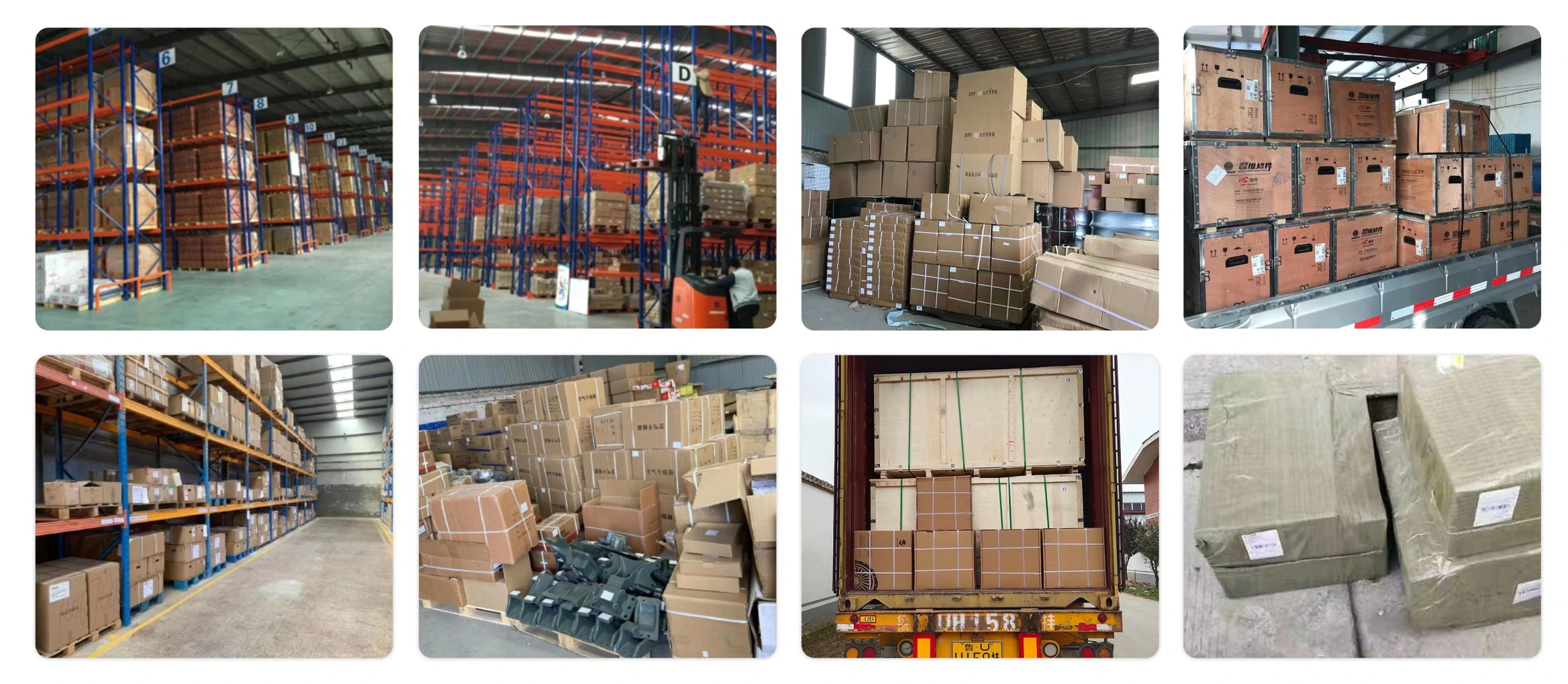
Cette approche d'emballage minimise le risque de corrosion ou de dommages causés par les chocs., s'assurer que les pièces comme l'ensemble bloc-cylindres FAW arrivent en parfait état. Les clients peuvent compter sur la logistique de FAW pour une qualité et une fiabilité constantes.