FAW Russian Radiator Hose: Securing 6 Critical Connections for Uncompromised Coolant Circulation
The FAW Russian Radiator Hose assembly serves as the arterial network for the CA3250P66K24L1TE5Z dump truck’s cooling system. In the unforgiving climate of the Siberian North, these fluid transfer components must withstand extreme thermal cycling, pulsating pressure surges, and sub-zero embrittlement. This guide dissects the engineering behind the inlet and outlet hoses and their specialized clamps, ensuring the engine remains thermally stable in -40°C conditions.

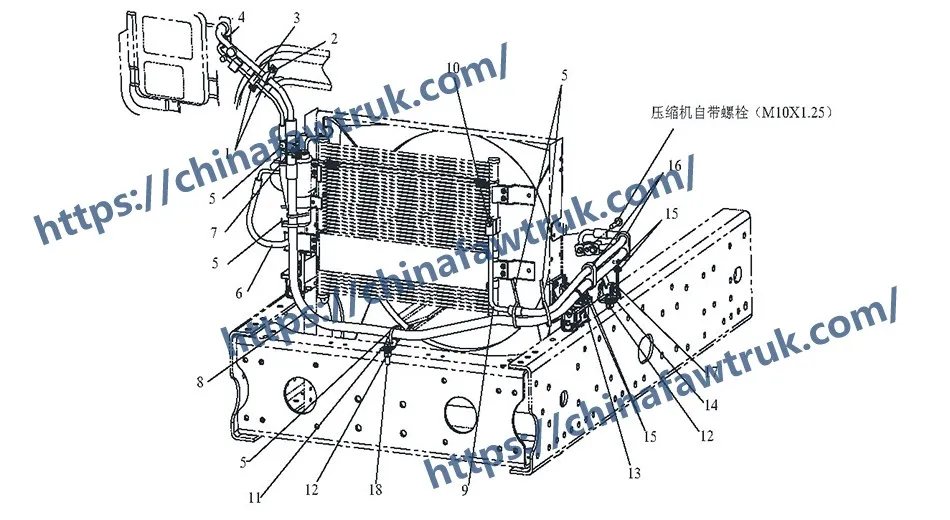
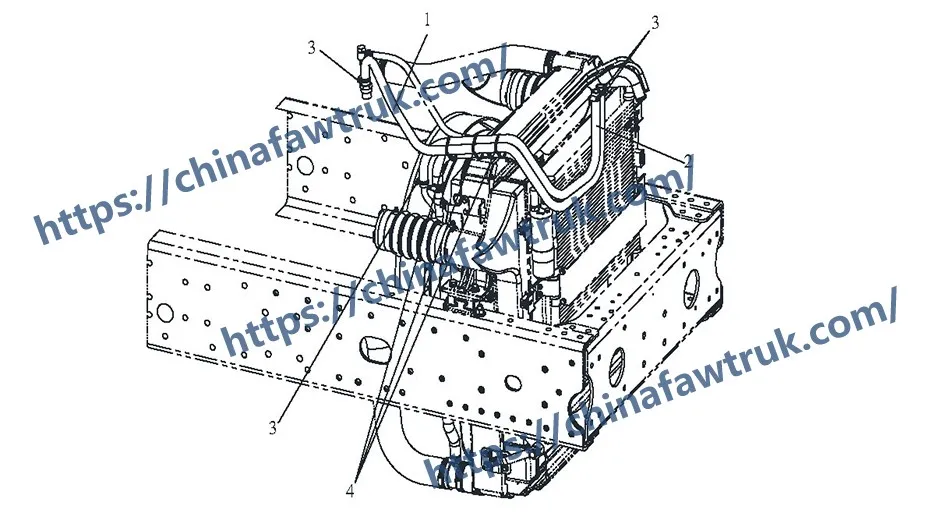
FAW Russian Radiator Hose Logic Assembly
Chemical Engineering: The EPDM Advantage
The primary definition of a high-quality FAW Russian Radiator Hose lies in its chemical composition. Standard automotive rubber hoses are typically made from basic compounds that suffer from a phenomenon known as “glass transition” when temperatures drop below -25°C. At this point, the rubber loses its elasticity and becomes hard and brittle, similar to glass. If the engine vibrates or the chassis twists while the hose is in this state, it will shatter or crack, leading to an immediate and catastrophic loss of coolant.
To combat this, the FAW Russian Radiator Hose is manufactured using a specialized Ethylene Propylene Diene Monomer (EPDM) formulation. This synthetic rubber is engineered with a specific cross-linking structure that maintains molecular flexibility down to -50°C. This ensures that even after a cold soak in a Yakutsk mining pit, the hose remains pliable enough to absorb the initial startup vibration of the heavy-duty diesel engine without fracturing at the connection points.
Furthermore, this specific EPDM blend is highly resistant to electrochemical degradation (ECD). ECD occurs when the hose material and the coolant create a galvanic cell, slowly eating away the rubber from the inside out. By resisting this chemical attack, the FAW Russian Radiator Hose ensures a long service life, preventing “soft spots” or internal delamination that could block the radiator core and cause overheating, proving its value in the long-term maintenance strategy of the fleet.
The Hot Side: Radiator Inlet Hose Dynamics
The Radiator Inlet Hose (Part No. 1303011-55R) handles the most thermally aggressive fluid in the system. It transports coolant directly from the engine thermostat housing to the top tank of the radiator. In the FAW Russian Radiator Hose assembly, this component is subjected to rapid thermal shock. When the thermostat opens, coolant at 90°C or higher surges into the hose, which may be at freezing ambient temperatures.
To withstand this thermal expansion, the FAW Russian Radiator Hose features a multi-ply reinforcement layer. Typically woven from aramid (Kevlar) or high-tenacity polyester fibers, this internal knitting prevents the hose from ballooning under pressure. Ballooning is a common failure mode in inferior hoses, where the diameter expands, thinning the wall and eventually leading to a burst. The reinforcement ensures the hose retains its geometric shape under peak system pressure.
The geometric shape of the Radiator Inlet Hose is also critical. It is molded with specific pre-formed bends to navigate around the alternator, fan shroud, and chassis rails without kinking. A kink in the hose would restrict flow, increasing backpressure on the water pump and reducing cooling efficiency. The precision molding of the genuine FAW Russian Radiator Hose ensures clear routing and optimal flow dynamics, preventing abrasion against vibrating engine components.
The Cold Side: Radiator Outlet Hose Physics
On the return side, the Radiator Outlet Hose (Part No. 1303021-55R) connects the bottom of the radiator to the water pump inlet. While it handles cooler fluid, it faces a different physical challenge: suction collapse. As the water pump spins at high RPMs, it creates a powerful vacuum on the intake side. If the FAW Russian Radiator Hose is structurally weak, atmospheric pressure will crush it flat.
A collapsed lower hose cuts off coolant flow to the engine instantly, causing rapid overheating and potential seizure. To prevent this, the FAW Russian Radiator Hose outlet component is engineered with a spiraled internal wire reinforcement or a thickened wall construction. This rigid structure resists the negative pressure differential, ensuring the hose remains fully open even when the engine is operating at maximum redline RPM during engine braking descents.
Additionally, the outlet hose is often the lowest point in the cooling loop. In the Russian environment, this makes it vulnerable to road debris, ice chunks, and frozen mud. The outer cover of the FAW Russian Radiator Hose is formulated to be abrasion-resistant, acting as a shield against physical damage. This durability is essential for off-road mining trucks where the undercarriage is constantly bombarded by sharp rocks and frozen earth.
Connection Logic: Worm Drive Type B Clamps
The security of the entire FAW Russian Radiator Hose assembly relies on the Worm Drive Hose Clamp Type B (Part No. CQ67690B). While generic hose clamps are ubiquitous, the “Type B” designation in the FAW parts catalog refers to a specific, high-performance design feature: rolled edges. Standard, cheaper clamps often have sharp, square-cut edges on the metal band.
When a sharp-edged clamp is tightened onto a soft EPDM rubber hose, especially one that becomes slightly less pliable in the cold, the metal edge bites into the rubber cover. Over time, vibration and thermal expansion cause this cut to deepen, eventually severing the hose fibers and causing a leak. The FAW Russian Radiator Hose system uses rolled-edge clamps to prevent this. The edges of the band are flared slightly upward, protecting the hose surface from cutting damage.
Furthermore, the worm gear mechanism in the CQ67690B clamp is engineered for high-torque applications. It features a robust housing that prevents the screw from skipping threads when tightened. In the FAW Russian Radiator Hose assembly, maintaining a constant, high clamping force is vital to prevent “cold water leaks”—a phenomenon where coolant seeps out of connections as the metal fittings contract in the extreme cold of the Russian night.
Component Breakdown: 92. Radiator Water Pipe and Hose Logic Assembly
| No. |
Part Number |
Part Name |
Qty |
| 1 |
1303011-55R |
Radiator Inlet Hose |
1 |
| 2 |
1303021-55R |
Radiator Outlet Hose |
1 |
| 3 |
CQ67690B |
Worm Drive Hose Clamp Type B |
4 |
Conclusion: The Arteries of Arctic Performance
The FAW Russian Radiator Hose assembly is a deceptively simple yet critically important system. It connects the engine’s power generation with its thermal management, ensuring that the immense heat of combustion is safely transferred to the atmosphere. In the Russian Arctic, where a failed hose can strand a driver in life-threatening temperatures, the reliability of these components is paramount.
For fleet maintenance, the mandate is clear: use only genuine FAW Russian Radiator Hose replacements. Generic hoses lack the specific cold-weather EPDM formulation, the reinforcement density, and the precise geometric bends required for the J6P chassis. By investing in the authentic parts and utilizing the correct rolled-edge clamps, operators ensure that their trucks remain operational, efficient, and safe, regardless of the severity of the winter conditions.
Packaging and Logistics
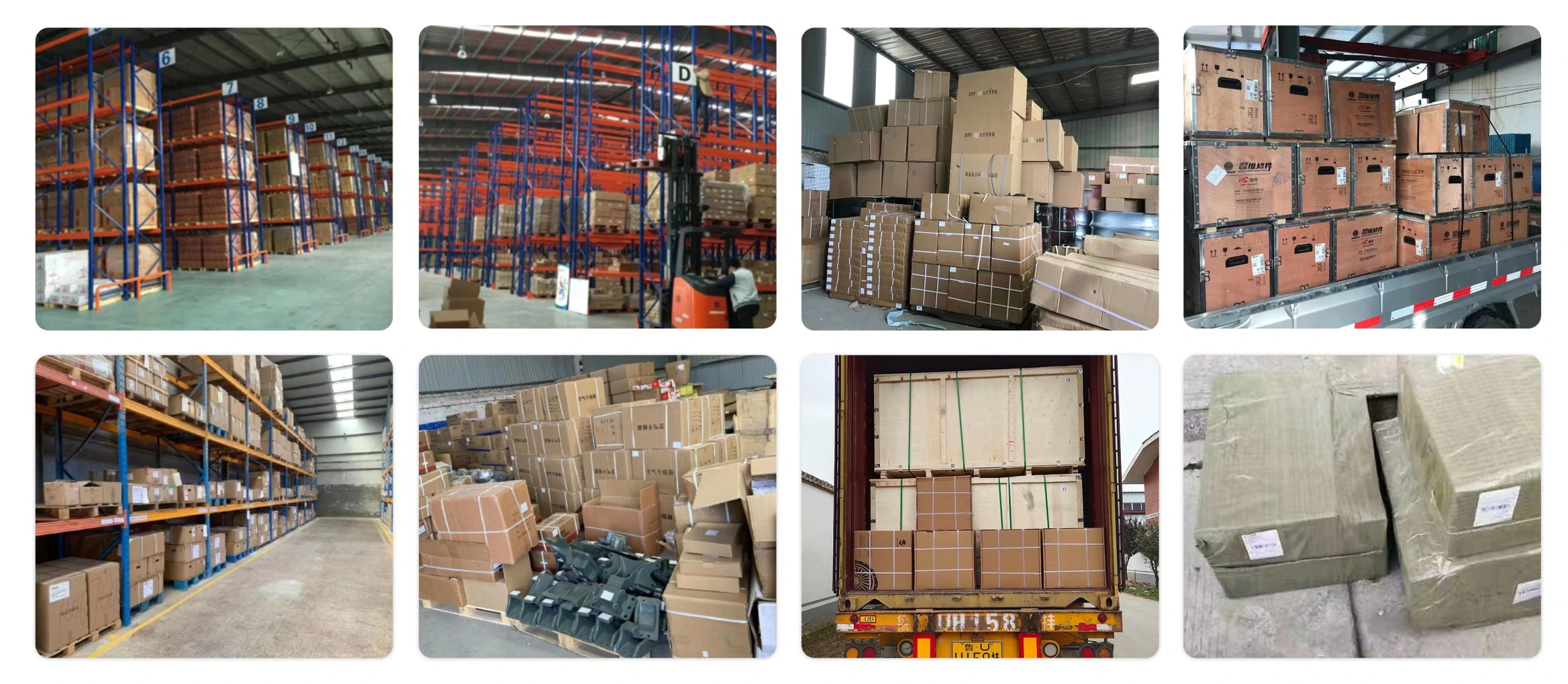
FAW parts, including the Cylinder Block Assembly, are packaged with care to ensure safe delivery. Each component is secured in protective materials to prevent damage during transit. The logistics network guarantees timely shipments worldwide, supporting efficient maintenance operations. Below is an image illustrating the standard packaging for FAW truck parts, showcasing the attention to detail in handling and storage.
This packaging approach minimizes the risk of corrosion or impact damage, ensuring that parts like the FAW Cylinder Block Assembly arrive in perfect condition. Customers can rely on FAW’s logistics for consistent quality and reliability.