FAW Russian Mounting Bracket Assembly: Deconstructing 10 Critical Components for Uncompromised Intake Stability
The FAW Russian Mounting Bracket Assembly forms the structural backbone of the CA3250P66K24L1TE5Z dump truck’s intake system. Engineered specifically for Arctic mining operations, this logic assembly isolates the sensitive filtration unit from violent chassis vibrations. This guide dissects the critical brackets and fasteners ensuring clean air delivery in conditions dropping below -40°C.

FAW Russian Mounting Bracket Assembly
The Core Filtration Logic: Air Filter Assembly
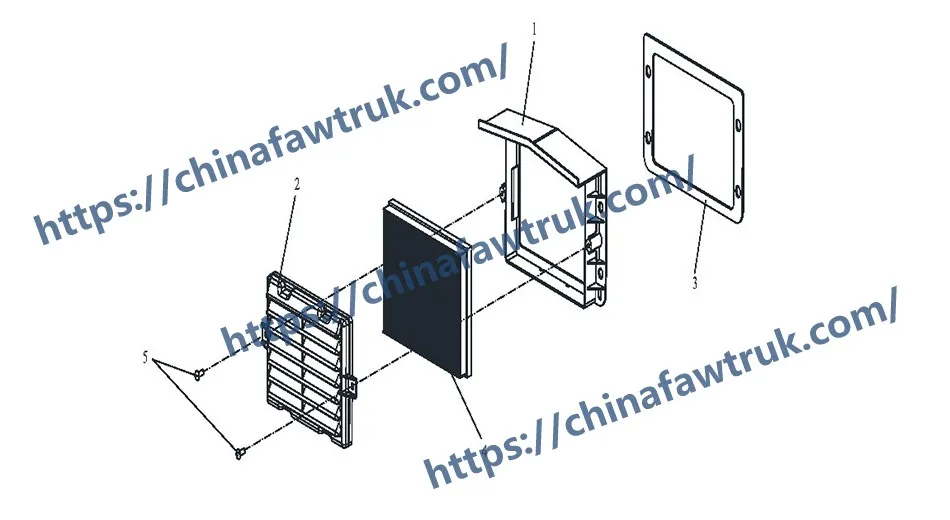
At the heart of the FAW Russian Mounting Bracket Assembly lies the Air Filter Assembly (Pattern) (Part No. 1109010-50V). This component is the primary defense line for the diesel engine, acting as the critical barrier against the external environment. In the Russian Arctic, air filtration is complicated by ice crystals and fine silica dust from mining roads. The assembly uses a multi-stage design to handle these conflicting contaminants efficiently. Beyond blocking particles, it manages airflow velocity to separate heavier debris before it reaches the media. The housing is constructed from high-impact polymers that resist cracking when hit by flying stones at sub-zero temperatures.
Inside the main housing, the filtration logic is split into two distinct stages to maximize engine longevity. First is the Main Filter Element Assembly (Pattern) (Part No. 1109070-76A). This high-capacity element captures 99.9% of airborne contaminants. Its media is pleated to maximize surface area, allowing for extended service intervals even in high-dust environments. The “Pattern” designation confirms standardized geometry for perfect housing compatibility, eliminating air leak risks. Crucially, the FAW Russian Mounting Bracket Assembly design ensures this main element is firmly seated to prevent bypassing caused by vibration.
Acting as a safety net is the Secondary Filter Element Assembly (Pattern) (Part No. 1109060-50V). Often called the “safety element,” this inner filter remains in place during field service. If the main element is damaged during replacement or fails due to saturation, the secondary element protects the engine. For the FAW Jiefang dump truck, this redundancy is non-negotiable. An engine dusting event in a remote Russian mining site can cost thousands of dollars in downtime, making the integrity of these filter elements paramount.
Structural Rigidity: The Bracket Architecture
The filtration units are heavy, and when laden with dust, their mass increases significantly. To support this weight against the G-forces of a moving truck, the FAW Russian Mounting Bracket Assembly employs a dual-bracket architecture. The Air Filter Front Bracket (Part No. 1109371-50V) handles the primary vertical load, securing the forward section of the filter housing. This bracket is stamped from heavy-gauge steel treated for corrosion resistance. In Russia’s saline winter road conditions, untreated steel corrodes rapidly, causing fatigue. FAW’s treatment process ensures the bracket maintains its tensile strength, resisting the embrittlement that often plagues inferior metals in extreme cold.
Complementing the front support is the Air Filter Rear Bracket (Part No. 1109372-50V). This component is critical for preventing rotational torque. As the engine revs and the truck chassis twists over uneven terrain, the air filter housing wants to oscillate. The rear bracket anchors the assembly, triangulating the support structure. This triangulation is a key feature of the FAW Russian Mounting Bracket Assembly, ensuring the connection between the air filter outlet and the turbocharger remains stress-free. Without this rear support, intake hoses would suffer from constant flex, eventually tearing and allowing unfiltered air to enter.
The interplay between the front and rear brackets creates a “floating” yet rigid system. It floats to dampen high-frequency engine harmonics but remains rigid against low-frequency road shocks. This balance is difficult to achieve and represents the engineering precision behind the FAW Jiefang design. Mechanics must align both brackets perfectly before tightening to avoid pre-load stresses. These pre-loads, combined with thermal contraction at -40°C, can lead to premature cracking of the mounting tabs, compromising the entire intake system.
Fastening Dynamics: Bolts and Torque Management
No structural assembly is stronger than its weakest connection. The FAW Russian Mounting Bracket Assembly utilizes fasteners designed to maintain clamping force under thermal cycling. The primary anchor points use the Hexagon Head Bolt (Part No. CQ1501450). These high-tensile bolts withstand the shear forces generated when the 30-ton truck hits a pothole. Four of these bolts are utilized, creating a robust four-point anchor system that distributes the load evenly. The hexagonal head allows for high-torque application, ensuring the initial clamping force is sufficient to bite into the mating surfaces.
The choice of bolt length and grade is not arbitrary. In the context of the FAW Russian Mounting Bracket Assembly, the bolts must possess enough ductility to stretch slightly without snapping under shock loads. This specific part number (CQ1501450) indicates a standardized FAW metric bolt meeting these metallurgical requirements. Using generic hardware store bolts as replacements is a common failure mode. Generic bolts often lack the specific cold-weather impact ratings required for Russian operations, leading to snapped heads and loose brackets.
Proper installation of these bolts requires strict attention to torque specifications. If under-torqued, the brackets will shift, elongating the mounting holes over time. If over-torqued, the bolt threads can yield, losing their ability to hold tension. The design of the FAW Russian Mounting Bracket Assembly allows for easy access to these bolt heads for maintenance checks. In mining environments, it is recommended to retorque these bolts after the first 500 kilometers to account for the initial settling of the bracketry against the chassis.
Locking Mechanisms: Nuts and Spring Washers
Securing the bolts are the corresponding Hexagon Nuts (Part No. CQ34014) and Hexagon Nuts (Part No. CQ34012). The variation in part numbers indicates different thread pitches suited for specific locations. Using the correct nut is vital; a mismatch in thread pitch can strip the bolt, rendering the mounting point useless. In the FAW Russian Mounting Bracket Assembly, these nuts are typically made from a steel grade that matches the bolts to prevent galvanic corrosion, which is accelerated by road salts.
Vibration management is further handled by the washers. The assembly uses Spring Washers (Part No. Q40314 and Q40312) extensively. A spring washer acts as a coil spring, exerting a continuous axial load on the nut. This prevents the nut from rattling loose when the bolt lengthens due to thermal expansion. The split design bites into the nut and bracket, creating a mechanical lock against rotation. This is essential for the FAW Russian Mounting Bracket Assembly given the high-vibration environment of a diesel engine.
Alongside the locking washers are the flat Washers (Part No. Q40114 and Q40112). These flat washers serve to distribute load. They spread the clamping force of the nut over a larger surface area, preventing the fastener from digging into the paint and metal of the bracket. Damaging the surface coating would create a starting point for rust. The quantity of fasteners highlights the complexity of the installation; every single bolt hole must be utilized to maintain the correct resonant frequency and prevent fatigue.
Component Breakdown: 81. Air Filter and Fixed Bracket Logic Assembly
| No. |
Part Number |
Part Name |
Qty |
| 1 |
1109010-50V |
Air Filter Assembly (Pattern) |
1 |
|
1109060-50V |
Secondary Filter Element Assembly (Pattern) |
1 |
|
1109070-76A |
Main Filter Element Assembly (Pattern) |
1 |
| 2 |
1109371-50V |
Air Filter Front Bracket |
1 |
| 3 |
1109372-50V |
Air Filter Rear Bracket |
1 |
| 4 |
CQ1501450 |
Hexagon Head Bolt |
4 |
| 5 |
CQ34014 |
Hexagon Nut |
4 |
| 6 |
Q40314 |
Spring Washer |
4 |
| 7 |
Q40114 |
Washer |
2 |
| 8 |
CQ34012 |
Hexagon Nut |
10 |
| 9 |
Q40312 |
Spring Washer |
10 |
| 10 |
Q40112 |
Washer |
5 |
Conclusion: Securing the Engine’s Lifeline
The FAW Russian Mounting Bracket Assembly is more than just a mounting point; it is a critical system designed to protect the CA3250P66K24L1TE5Z’s engine from the harsh realities of Russian operations. By integrating high-efficiency filtration with a robust, vibration-resistant bracket architecture, FAW ensures that the engine receives clean air without interruption. The careful selection of every bolt, nut, and washer creates a cohesive unit capable of withstanding extreme cold and mechanical stress.
For fleet operators and maintenance technicians, respecting the integrity of this assembly is vital. Substituting genuine FAW parts with inferior generic brackets or fasteners can lead to resonance issues, cracks, and ultimately, dust ingestion. By maintaining the FAW Russian Mounting Bracket Assembly with authentic components, you safeguard the longevity of the entire powertrain, ensuring the truck remains a reliable asset in the most demanding environments on earth.
Packaging and Logistics
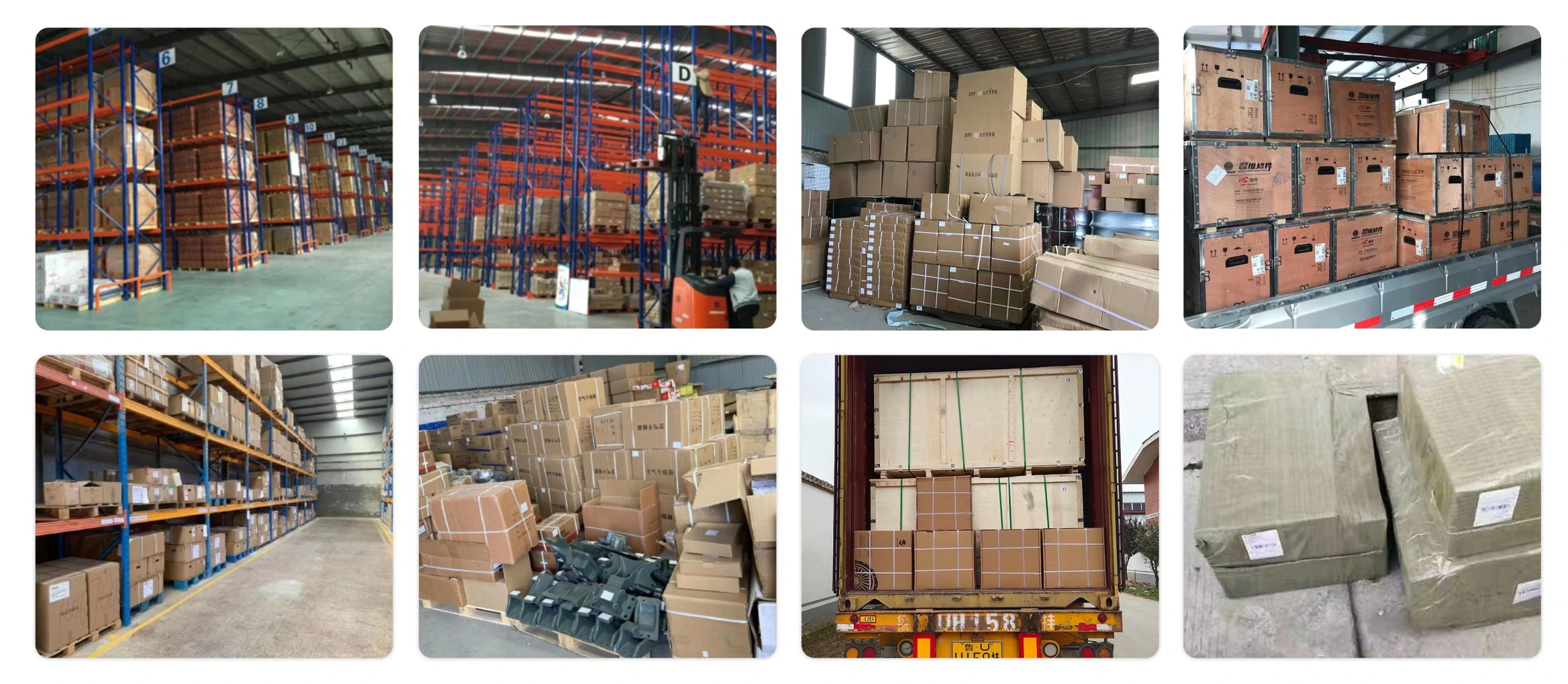
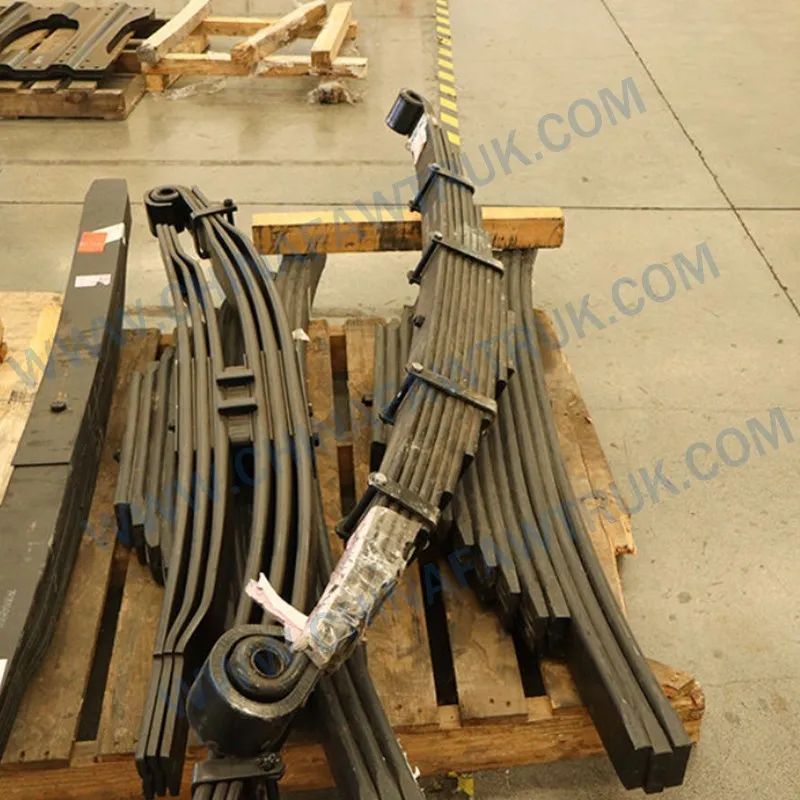
FAW parts, including the Cylinder Block Assembly, are packaged with care to ensure safe delivery. Each component is secured in protective materials to prevent damage during transit. The logistics network guarantees timely shipments worldwide, supporting efficient maintenance operations. Below is an image illustrating the standard packaging for FAW truck parts, showcasing the attention to detail in handling and storage.
This packaging approach minimizes the risk of corrosion or impact damage, ensuring that parts like the FAW Cylinder Block Assembly arrive in perfect condition. Customers can rely on FAW’s logistics for consistent quality and reliability.