por 


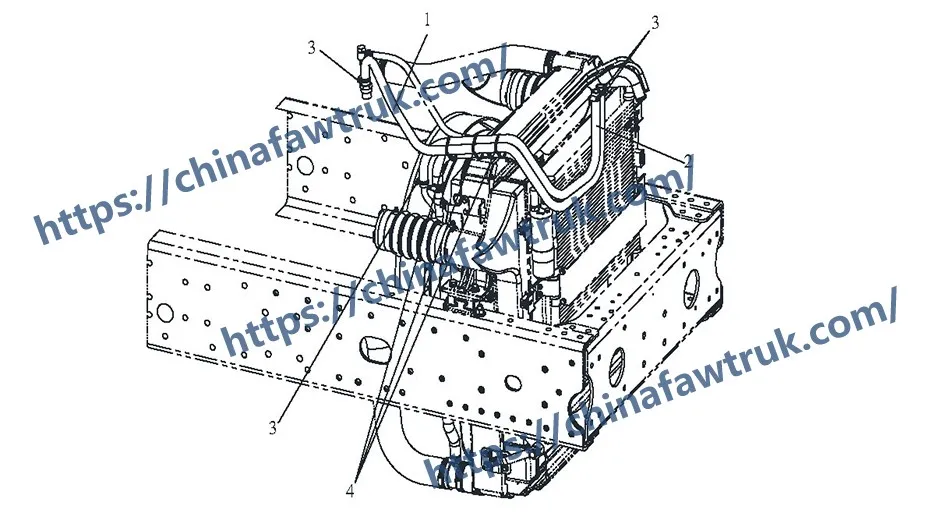
Esta é uma análise técnica completa do Tubulação FAW J6P sistema (Capítulo 37), o “rede arterial” for the thermal management system on the FAW Jiefang CA3250P66K2L1T1E 6×4 caminhão despejando. This 46-component group is not just a set of hoses; é uma engenharia “Fluido & Air Transport Logic” sistema. Its integrity is paramount for preventing coolant leaks, boost leaks, and catastrophic engine overheating.

O Tubulação FAW J6P system must simultaneously manage three “Lógica Fluida” circuitos. O “Primary Coolant Logic” (the main radiator hoses) moves high-temperature engine coolant. O “Carregar Lógica Aérea” (the intercooler hose) transports high-pressure, hot air from the turbo. O “Lógica de Desgaseificação” (a network of small pipes) scavenges and removes destructive air bubbles from the system.
This guide is an essential resource for chassis technicians, gerentes de manutenção de frota, e especialistas em peças. We will deconstruct every component of the Tubulação FAW J6P conjunto. Iremos analisar o “Primary Circulation Logic” (the main coolant hoses and clamps), o “Carregar Lógica Aérea” (the boost hose), o “Lógica de Desgaseificação” (the air bleed network), e o “Lógica de Selagem” (the critical banjo clamps that ensure a leak-proof system).
Este grupo representa o “main arteries” do Tubulação FAW J6P sistema, responsible for moving the bulk of the engine coolant. Uma falha aqui é catastrófica.
1. Componente: ‘Mangueira de entrada do radiador’ (1303011-14B)
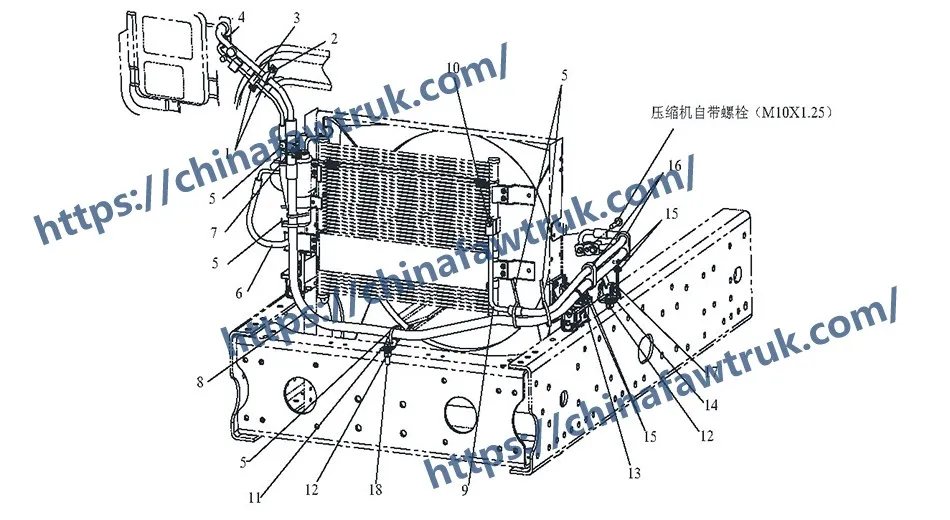
Esse (Comp. 4) é o “Hot Side Logic.” This high-temperature hose carries 90°C+ coolant *from* the engine’s thermostat housing *to* the ‘Radiator assy’ (Comp. 1). It is engineered from reinforced EPDM rubber to withstand high heat, alta pressão, and constant engine vibration.
2. Componente: ‘Mangueira de saída do radiador’ (1303021-14B)
Esse (Comp. 6) é o “Cold Side Logic.” It carries the now-cooled (Por exemplo, 80° c) coolant *from* the bottom of the radiator *back to* the ‘Water Pump’ (Capítulo 19) para entrar novamente no bloco do motor. This hose is under “sucção” from the water pump, so its internal reinforcement must prevent it from “desmoronando” para dentro.
3. Componente: 'Braçadeira de mangueira tipo banjo modelo B’ (CQ67670B, CQ67680B)
Esses (Comp. 3, 5) são os “Lógica de Integridade de Vedação” and are the most critical “Menores unidades utilizáveis” no Tubulação FAW J6P sistema. These are not simple worm-gear clamps. A “Tipo banjo” (ou “Parafuso T”) braçadeira fornece um ângulo de 360 graus, alto torque “Lógica da Força de Aperto.” This ensures a perfect, leak-proof seal on the reinforced hoses, evitando a perda de refrigerante, which would lead to rapid engine overheating.
Esta parte do Tubulação FAW J6P system handles “ar,” não “refrigerante.” It manages the high-pressure “impulsionar” do turbocompressor.
1. Componente: ‘Mangueira de conexão do intercooler’ (1311034-50A)
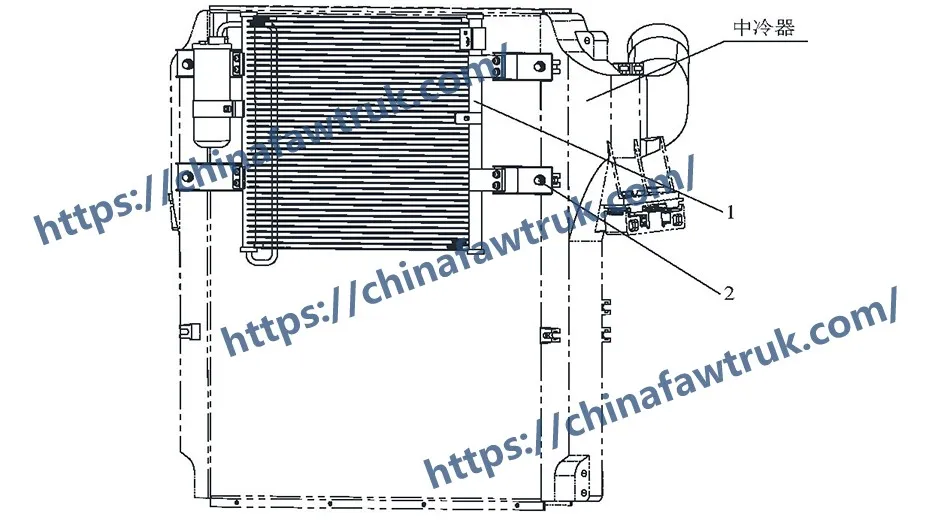
Esse (Comp. 28) é o “Aumentar a lógica” mangueira. The ‘Radiator assy’ (Comp. 1) is a dual-core unit containing the “Refrigerador de ar de carga” (Intercooler). Esta mangueira é “lógica” é conectar o “lado frio” of the intercooler *to* the engine’s intake manifold.
Esse Tubulação FAW J6P component is engineered to handle 20-30+ PSI de pressão de reforço, névoa de óleo (do turbo), and high temperatures. It is likely made of multi-layer reinforced silicone to prevent it from “balonismo” or bursting under boost.
2. Componente: 'Braçadeira de mangueira tipo banjo modelo B’ (CQ67635B)
Esse (Comp. 29) é o “Boost Sealing Logic.” A “aumentar o vazamento” is a common failure point that is catastrophic for performance. These high-torque clamps (Quantidade 3) are essential to “trancar” the ‘Intercooler connecting hose’ (Comp. 28) onto the rigid pipes. A “aumentar o vazamento” from a failed clamp causes an immediate loss of power, excessive black smoke, e um “check engine” luz.
Este é o “System Breathing Logic” network within the Tubulação FAW J6P. Its function is to remove trapped air, o #1 inimigo de um sistema de refrigeração.
1. O “Degassing Network” (Componentes 39, 40, 46, 17)
Isto inclui o ‘Tubo de desgaseificação traseiro do radiador’ (1311069-76A), ‘Tubo de desgaseificação do radiador’ (1311063-61B), e 'Conjunto do tubo de desgaseificação do motor’ (1311025-138). Esse “Lógica de eliminação” uses small-bore pipes to continuously “chupar” air from the highest points of the system (the top of the radiator and the engine head).
Esse “Lógica sem ar” é crítico. Trapped air creates “bolsas de vapor” that don’t transfer heat, causando “pontos quentes” that can warp a cylinder head. Esse Tubulação FAW J6P routes all scavenged air to the 'Reservatório’ (1302052-01) (Comp. 17), também conhecido como “Tanque de expansão,” where the air is safely vented, and the coolant is returned to the system.
2. O “Bypass Network” (Componentes 30, 31, 37, 41)
Este grupo de Tubulação FAW J6P inclui o ‘Tubo de água de retorno’ (1311062-14B), ‘Conjunto de tubo de aço de conexão’ (1311035-61B), ‘Tubo de água de retorno dianteiro’ (1311034-61B), e ‘Conectando o conjunto do tubo’ (1311025-61B). Este é o “Ignorar lógica” that allows hot coolant to flow to the “FAW J6P Cab Heater” (veja o capítulo 52), even when the engine’s main thermostat is closed.
O Tubulação FAW J6P (mangueiras) must be flexible for a specific reason: o “motor” e o “radiador” do not move as one. This group explains the “Lógica de isolamento de vibração” that the pipework must compensate for.
1. O “Isolated Mounting Logic” (Componentes 11, 12, 13)
The ‘Radiator assy’ (Comp. 1) senta-se em um ‘Radiator bottom crossmember’ (1302030-61B) and is held by “isolado” ‘Suporta’ (1302027-70U, 1302028-70U). These mounts (veja o capítulo 38) use rubber to “úmido” vibração.
2. O “Lógica Anti-oscilação” (Componentes 18, 19)
O ‘Conjunto do tirante’ (1302050-01) e ‘Suporte superior do tirante’ (1302041-14B) são estabilizadores diagonais. They prevent the 30kg+ radiator from “balançando” e “tosquia” when the truck’s chassis flexes.
Esse “Lógica de Movimento Diferencial” is the final piece of the puzzle. O Tubulação FAW J6P sistema, specifically the flexible hoses (Comp. 4, 6, 28), são os “Lógica de acoplamento flexível” que “preenche a lacuna” between the vibrating engine and the “sway-damped” radiador. Isto impede o “Lógica Antivibração” de “rasgando” the rigid radiator ports off the engine.
A tabela a seguir fornece o completo, detalhamento de todos 46 tipos de componentes no Tubulação FAW J6P and thermal management assembly (Capítulo 37) para o FAW Jiefang CA3250P66K2L1T1E 6×4 caminhão despejando.
| Marca | Parte não. | Nome da peça | Quantidade |
|---|---|---|---|
| 1 | 1301010-14B | Conjunto do radiador | 1 |
| 2 | 1309010-14B | Cobertura do ventilador | 1 |
| 3 | CQ67670B | Abraçadeira tipo banjo modelo B | 2 |
| 4 | 1303011-14B | Mangueira de entrada do radiador | 1 |
| 5 | CQ67680B | Abraçadeira tipo banjo modelo B | 2 |
| 6 | 1303021-14B | Mangueira de saída do radiador | 1 |
| 7 | CQ1460820 | Parafuso de combinação | 8 |
| 8 | 1301020-61B | Conjunto da placa de conexão do radiador | 2 |
| 9 | Q1840816 | Parafuso de flange hexagonal | 14 |
| 10 | Q1841230 | Parafuso de flange hexagonal | 4 |
| 11 | 1302030-61B | Conjunto da travessa inferior do radiador | 1 |
| 12 | 1302027-70U | Suporte esquerdo do radiador | 1 |
| 13 | 1302028-70U | Suporte direito do radiador | 1 |
| 14 | Q1840825 | Parafuso de flange hexagonal | 8 |
| 15 | CQ1461025 | Parafuso de combinação | 4 |
| 16 | CQ1501050 | Parafuso da cabeça do hexágono | 2 |
| 17 | 1302052-01 | Reservatório | 2 |
| 18 | 1302050-01 | Conjunto do tirante | 2 |
| 19 | 1302041-14B | Suporte superior do tirante | 2 |
| 20 | CQ34010 | Porca hexagonal | 2 |
| 21 | Q40310 | Arruela elástica | 2 |
| 22 | 1302040-14B | Placa de suporte do radiador | 2 |
| 23 | Q1840820 | Parafuso de flange hexagonal | 2 |
| 24 | Q1841230 | Parafuso de flange hexagonal | 4 |
| 25 | CQ34008 | Porca hexagonal | 2 |
| 26 | 1302043-14B | Placa de suporte | 2 |
| 27 | CQ32612 | Porca hexagonal | 4 |
| 28 | 1311034-50A | Mangueira de conexão do intercooler | 1 |
| 29 | CQ67635B | Abraçadeira tipo banjo modelo B | 3 |
| 30 | 1311062-14B | Tubo de água de retorno | 1 |
| 31 | 1311035-61B | Conjunto de tubo de aço de conexão | 1 |
| 32 | CQ1460816 | Parafuso de combinação | 1 |
| 33 | 1311045-61B | Conjunto de suporte | 1 |
| 34 | Q1840816 | Parafuso de flange hexagonal | 4 |
| 35 | 1301023-50A | Placa de conexão superior do radiador | 2 |
| 36 | Q1841020 | Parafuso de flange hexagonal | 2 |
| 37 | 1311034-61B | Tubo de água de retorno frontal | 1 |
| 38 | CQ67640B | Abraçadeira tipo banjo modelo B | 1 |
| 39 | 1311069-76A | Tubo de desgaseificação traseiro do radiador | 1 |
| 40 | 1311063-61B | Tubo de desgaseificação do radiador | 1 |
| 41 | 1311025-61B | Conjunto de tubo de conexão | 1 |
| 42 | Q1840816 | Parafuso de flange hexagonal | 2 |
| 43 | CQ67622B | Abraçadeira tipo banjo modelo B | 4 |
| 44 | CQ72314T5 | Ilhó | 2 |
| 45 | 1311024-249 | Parafuso de sangria de ar de desgaseificação | 1 |
| 46 | 1311025-138 | Conjunto de tubo de desgaseificação do motor | 1 |
As especificações para o Tubulação FAW J6P system are defined by its function as the leak-proof transport network for the engine’s coolant and charge air.
| Aplicação em veículos | FAW Jiefang CA3250P66K2L1T1E 6×4 Caminhão basculante |
| Grupo de sistemas | Tubulação FAW J6P & Thermal Control Assembly |
| Lógica Primária | Leak-Proof Coolant & Charge Air Transport |
| Lógica Secundária | System Degassing, Selando Integridade & Amortecimento de vibração |
| Primary Coolant Hoses | ‘Mangueira de entrada’ (1303011-14B), ‘Mangueira de saída’ (1303021-14B) |
| Primary Charge Air Hose | ‘Mangueira de conexão do intercooler’ (1311034-50A) |
| Degas Pipework Network | 1311069-76A, 1311063-61B, 1311025-138 |
| Sealing Hardware Type | Tipo banjo / T-Bolt Hose Clamps (CQ676 Series) |
| Sistema Associado (Fonte) | Engine Block / Turbocharger Outlet |
| Sistema Associado (Destino) | 'Conjunto do radiador’ / Intercooler (1301010-14B) |
| Total de tipos de componentes | 46 |
Peças FAW, incluindo o conjunto do bloco de cilindros, são embalados com cuidado para garantir uma entrega segura. Cada componente é protegido por materiais de proteção para evitar danos durante o transporte. A rede logística garante envios pontuais em todo o mundo, apoiando operações de manutenção eficientes. Abaixo está uma imagem ilustrando a embalagem padrão para peças de caminhão FAW, mostrando a atenção aos detalhes no manuseio e armazenamento.
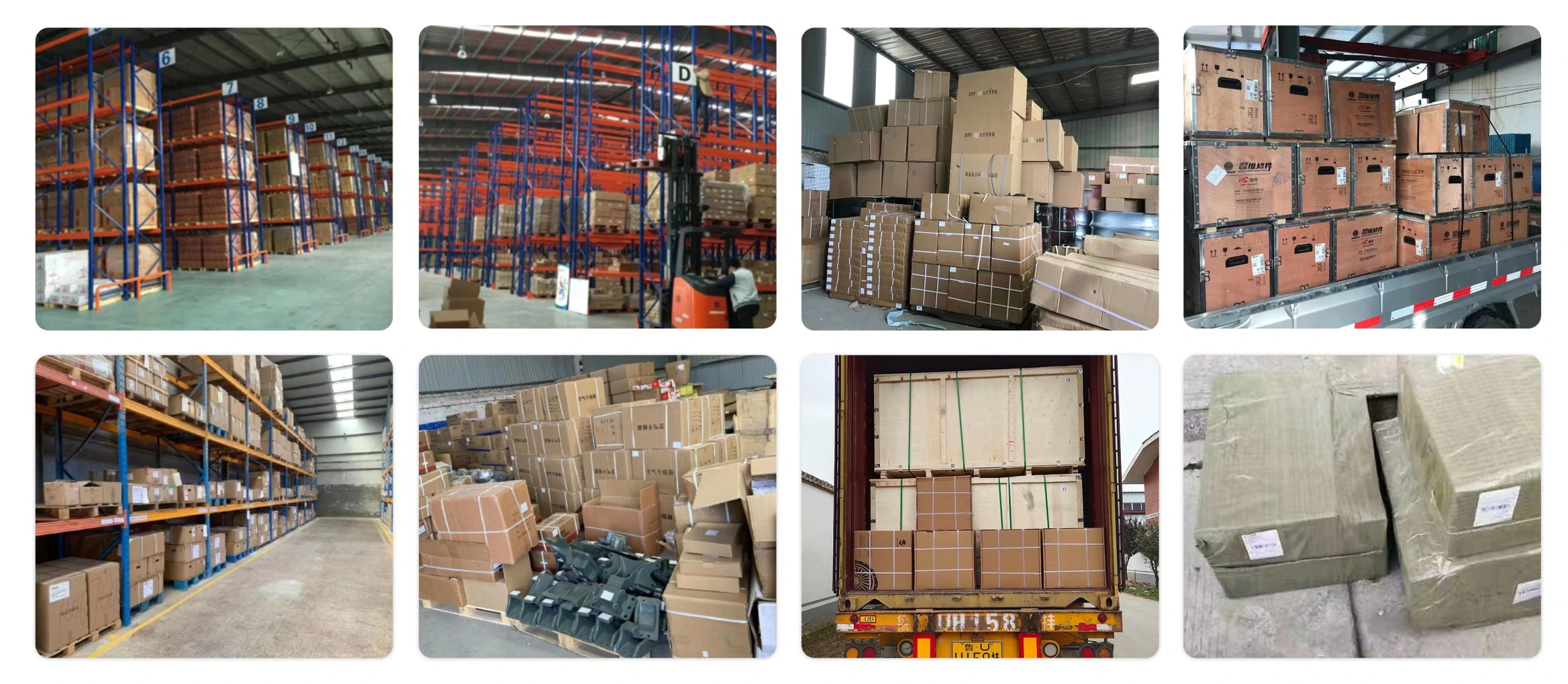
Esta abordagem de embalagem minimiza o risco de corrosão ou danos por impacto, garantindo que peças como o conjunto do bloco de cilindros FAW cheguem em perfeitas condições. Os clientes podem confiar na logística da FAW para obter qualidade e confiabilidade consistentes.