par 


Bienvenue dans ce guide technique essentiel sur le Ensemble logique d'arbre à cames FAW, le composant qui fait office de “cerveau” du système de soupapes pour le FAW Jiefang CA4251P66K24T1A3E5 6×4 tracteur semi-remorque diesel. Cet assemblage dicte la respiration et les performances du moteur.
Le Ensemble logique d'arbre à cames FAW est responsable de la précision, calage non négociable de toutes les soupapes d'admission et d'échappement. C'est “logique” est ancré dans sa conception même, garantissant que chaque cylindre aspire de l'air frais et expulse les gaz d'échappement à la milliseconde exacte requise pour une puissance optimale, efficacité, et contrôle des émissions.
Ce guide est une ressource essentielle pour les techniciens professionnels de moteurs, ateliers d'usinage, et spécialistes des pièces détachées. Nous déconstruirons l'ensemble Ensemble logique d'arbre à cames FAW dans ses deux unités principales utilisables: l'arbre à cames lui-même et sa goupille critique. Comprendre ce système est fondamental pour tout service de moteur haut de gamme.
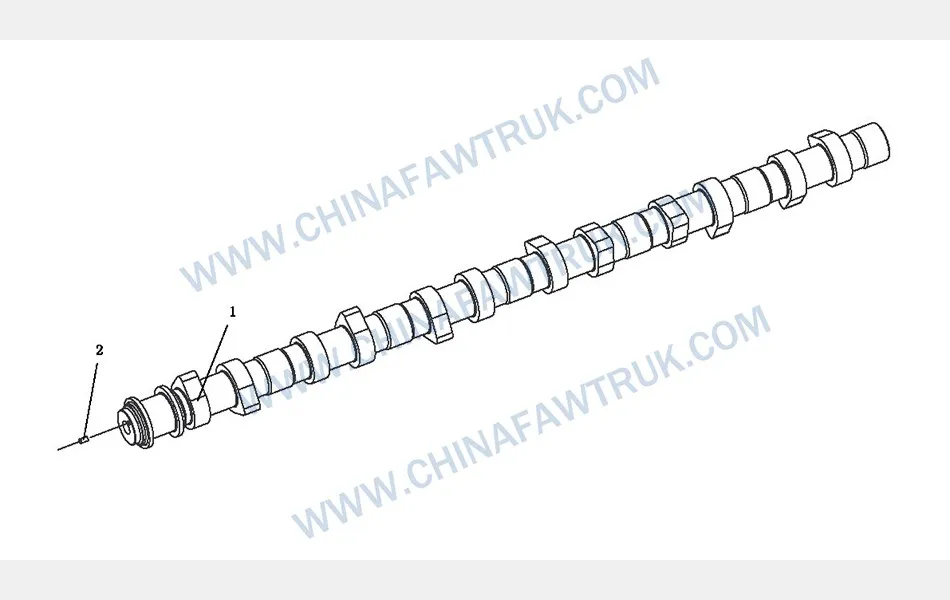
Le noyau du Ensemble logique d'arbre à cames FAW est l'arbre à cames’ (1006016-81D). C'est un seul, composant de haute technologie qui contrôle l'ensemble du système de soupapes. Dans le moteur CA4251P66K24T1A3E5, c'est un arbre à cames en tête (OHC), ce qui signifie qu'il se trouve en haut de la culasse, permettant un actionnement plus direct et plus précis de la vanne. Cet arbre unique est responsable de l'ouverture et de la fermeture de tous 24 vannes (12 admission, 12 échappement) dans le moteur six cylindres.
Le matériau et la fabrication de cet arbre à cames sont critiques. Il est généralement forgé à partir d'une seule billette d'acier à haute teneur en carbone ou moulé à partir d'un matériau à haute résistance. “fer refroidi.” Une fois la forme de base formée, il subit un processus complexe d'usinage et de durcissement. Le “logique” de la Ensemble logique d'arbre à cames FAW est ancré dans la précision, forme excentrique de son 12 l'apport et 12 lobes d'échappement.
Chacun de ces lobes de came est durci par induction pour créer un aspect semblable à celui du verre., surface résistante à l'usure, tandis que le noyau de l'arbre reste plus ductile pour résister à la rupture sous contrainte de torsion. Les lobes eux-mêmes sont conçus avec un “profil” cela dicte deux choses: “ascenseur” (jusqu'où la valve s'ouvre) et “durée” (combien de temps la vanne reste ouverte). Le profil à ce sujet Ensemble logique d'arbre à cames FAW est optimisé pour un moteur diesel robuste, donner la priorité à une portance élevée et à une durée de vie courte pour créer le couple à bas régime caractéristique de ce tracteur.
Cet arbre à cames repose sur les sept selles de roulement de précision qui sont percées dans la culasse et fixées par les capuchons d'arbre à cames. (comme détaillé dans un guide précédent). Les surfaces polies entre les lobes de came sont les tourillons. Ces journaux reposent sur un film hydrodynamique d'huile, juste des millièmes de pouce d'épaisseur. L'intégrité de ce film d'huile est le facteur le plus important pour la longue durée de vie du Ensemble logique d'arbre à cames FAW. Toute pénurie ou contamination de pétrole entraînera une notation sur ces journaux., détruisant à la fois l'arbre à cames et la culasse.
Le deuxième et dernier volet du Ensemble logique d'arbre à cames FAW est la « goujon’ (Q5210614). Cette broche cylindrique unique peut être la plus petite pièce de l'assemblage, mais c'est l'un des composants les plus critiques pour la survie du moteur.
Cette goupille en acier trempé est pressée dans un trou percé avec précision au niveau “museau” (devant) de l'arbre à cames (1006016-81D). Son but est de “clé” ou “indice” le pignon de distribution de l'arbre à cames principal. Le pignon de distribution, qui est entraîné par le vilebrequin via une chaîne ou un train d'engrenages, glisse sur le museau de l'arbre à cames. Cette goupille s'insère dans une fente ou un trou correspondant dans le pignon de distribution..
Cette épingle remplit une fonction non négociable: il verrouille le pignon d'arbre à cames en un seul geste, position exacte par rapport aux lobes de came. Cela garantit que lorsqu'un technicien aligne les marques de synchronisation sur le train d'engrenages (paramètre “temps moteur”), les lobes du Ensemble logique d'arbre à cames FAW sont *également* parfaitement alignés avec les pistons’ postes.
Sans cette épingle, le calage de l'arbre à cames serait une question de conjecture, et le boulon à couple élevé à l'extrémité de la came pourrait glisser, permettant au timing de la came de “marcher.” Si cela arrive, le moteur “logique” est détruit. Les vannes s'ouvriraient au mauvais moment, heurtant le dessus des pistons et provoquant des conséquences catastrophiques, dommages à la fin du moteur. L’intégrité de cette broche unique est la clé de voûte de l’ensemble Ensemble logique d'arbre à cames FAW.
Le Ensemble logique d'arbre à cames FAW ne touche pas directement les valves. Comme caméra aérienne (OHC) conception, il actionne les vannes via un mécanisme intermédiaire, généralement des culbuteurs ou des suiveurs de rouleaux. Pendant que l'arbre à cames tourne, le lobe excentrique tourne et son sommet, ou “nez,” appuie sur le culbuteur. Ce culbuteur pivote alors, pousser vers le bas et ouvrir la soupape contre la pression d'un ressort de soupape lourd.
Toute cette interface est un système à haute friction, zone à forte usure. La surface du lobe de came et la surface du culbuteur (souvent un rouleau) sont deux des surfaces les plus sollicitées de tout le moteur. C'est pourquoi un bon huilage est si essentiel. Les canaux pétroliers au sein du Ensemble logique d'arbre à cames FAW et la culasse sont conçus pour inonder ce point de contact avec un flux constant d'huile à haute pression.
Toute panne d’approvisionnement en pétrole (basse pression, mauvaise viscosité, ou contamination) provoquera la rupture de ce film d'huile. Le résultat est rapide, usure irritante, où les surfaces durcies du lobe de came et du culbuteur sont “essuyé” plat. Ce “came plate” est une panne courante en fin de vie pour de nombreux moteurs. UN “lobe essuyé” sur le Ensemble logique d'arbre à cames FAW ne pourra plus fournir la valve pleine “ascenseur,” ce qui signifie que la vanne ne s'ouvrira pas complètement. Il en résulte un cylindre qui ne peut pas “respirer” correctement, menant à un “mort” cylindre, raté, faible puissance, et beaucoup de fumée.
Donc, le Ensemble logique d'arbre à cames FAW est un composant qui exige une propreté méticuleuse lors de l'installation et l'utilisation d'une huile moteur de haute qualité tout au long de sa durée de vie. Lors de l'installation d'un nouveau Ensemble logique d'arbre à cames FAW, il est obligatoire d'utiliser un spécial, lubrifiant d'assemblage à haute teneur en molybdène sur chaque lobe et tourillon de roulement pour les protéger pendant les premières secondes critiques de fonctionnement avant que la pression d'huile ne monte.
Diagnostiquer une panne dans le Ensemble logique d'arbre à cames FAW commence généralement par des symptômes comme un raté d'allumage persistant sur un ou plusieurs cylindres, un “cocher” ou “tapotement” bruit provenant du haut du moteur, ou une perte de puissance progressive au fil du temps.
Après avoir déposé le couvre-culasse, un technicien peut inspecter visuellement les lobes de came pour détecter toute rayure visible, piqûre, ou décoloration (un “bleui” le lobe indique une chaleur extrême due à un manque d'huile). Une méthode plus précise consiste à utiliser un indicateur à cadran pour mesurer la “ascenseur” de chaque lobe de came lorsque le moteur tourne à la main. La portance mesurée est ensuite comparée aux spécifications d'usine. Tout lobe qui fournit moins de portance que les spécifications est usé, et le Ensemble logique d'arbre à cames FAW doit être remplacé.
Il est essentiel de se rappeler que l'arbre à cames fait partie d'un ensemble apparié.. Si le Ensemble logique d'arbre à cames FAW (1006016-81D) se révèle endommagé, il est presque certain que les composants sur lesquels il repose (les culbuteurs) sont également endommagés. Le simple remplacement de la came sans remplacer les culbuteurs usés entraînera la destruction de la nouvelle came en très peu de temps.. Un travail haut de gamme complet nécessite une inspection complète de l'ensemble de la commande de soupapes associée au Ensemble logique d'arbre à cames FAW.
Le tableau suivant fournit l'intégralité, ventilation détaillée de tous les composants identifiés dans « Ensemble logique d'arbre à cames’ schéma du tracteur FAW CA4251P66K24T1A3E5. Ce Ensemble logique d'arbre à cames FAW est le cœur du système de soupapes du moteur.
| Marque | Partie no. | Nom de la pièce | Quantité |
|---|---|---|---|
| 1 | 1006016-81D | Arbre à cames | 1 |
| 2 | Q5210614 | Goupille de cheville | 1 |
Les spécifications pour le Ensemble logique d'arbre à cames FAW sont définis par sa fonction de contrôleur principal pour la commande des soupapes du moteur dans une configuration OHC à 6 cylindres. L'ensemble Ensemble logique d'arbre à cames FAW doit être installé avec précision.
| Demande de véhicule | FAW Jiefang CA4251P66K24T1A3E5 6×4 Tracteur |
| Groupe de composants | Ensemble logique d'arbre à cames FAW |
| Numéro de pièce d'arbre à cames. | 1006016-81D |
| Goupille de goujon Réf.. | Q5210614 |
| Type de moteur | 6-Cylindre, Caméra aérienne (OHC), 24-Soupape Diesel |
| Nombre de lobes | 24 (12 Admission, 12 Échappement) |
| Matériel (Arbre à cames) | Billet d'acier forgé ou fonte réfrigérée |
| Processus de durcissement | Trempe par induction sur les lobes et les tourillons |
| Fonction principale | Actionne avec précision tout 24 soupapes du moteur (admission et échappement) dans le bon ordre et pendant la bonne durée. |
Pièces FAW, y compris l'ensemble bloc-cylindres, sont emballés avec soin pour garantir une livraison en toute sécurité. Chaque composant est sécurisé dans des matériaux de protection pour éviter tout dommage pendant le transport. Le réseau logistique garantit des expéditions ponctuelles dans le monde entier, soutenir des opérations de maintenance efficaces. Vous trouverez ci-dessous une image illustrant l'emballage standard des pièces de camion FAW., mettant en valeur l’attention portée aux détails dans la manipulation et le stockage.
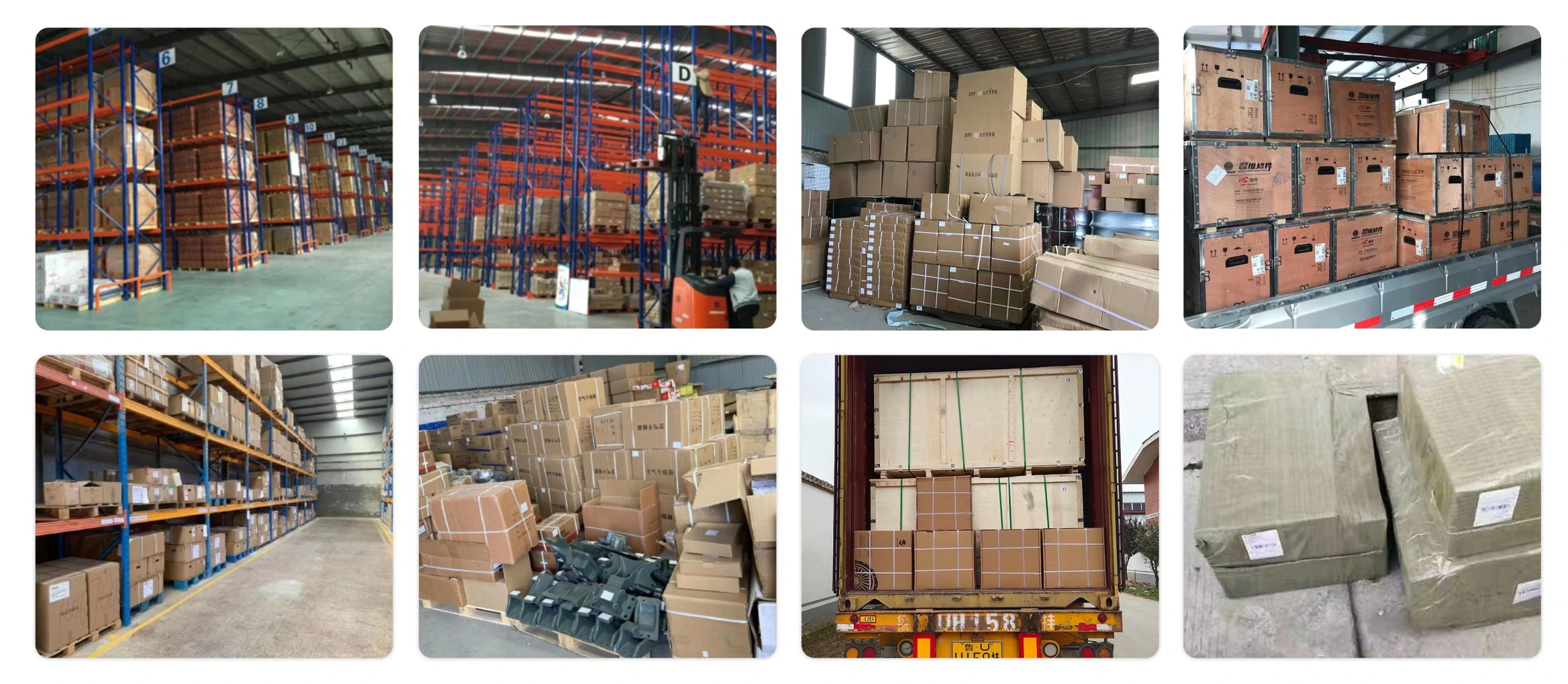
Cette approche d'emballage minimise le risque de corrosion ou de dommages causés par les chocs., s'assurer que les pièces comme l'ensemble bloc-cylindres FAW arrivent en parfait état. Les clients peuvent compter sur la logistique de FAW pour une qualité et une fiabilité constantes.