by 


Welcome to this critical safety breakdown of the FAW Windscreen Wiper assembly. This system is the primary active safety feature for the FAW Jiefang CA4251P66K24T1A3E5 6×4 diesel semi-trailer tractor. Its function is non-negotiable: to provide the driver with a clear, unobstructed field of vision in adverse weather conditions, including rain, snow, and road spray.
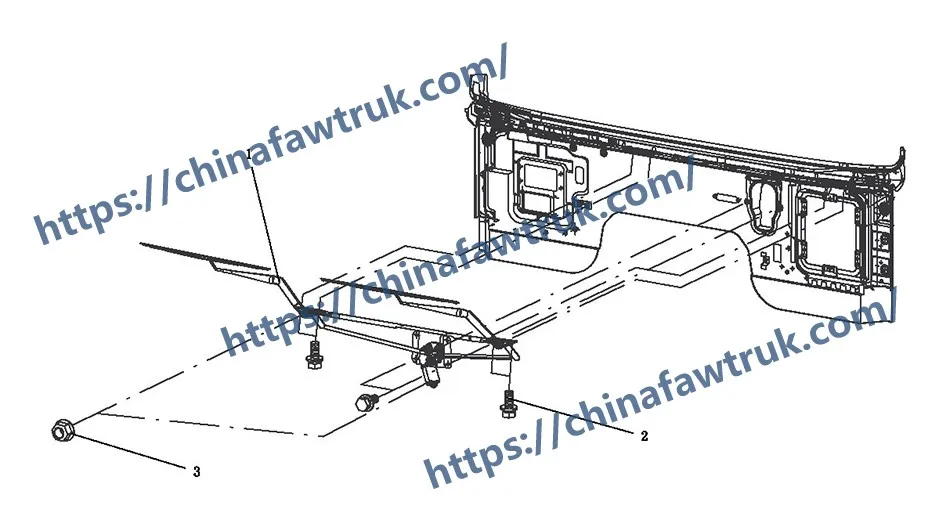
The “Logic Assembly” for the FAW Windscreen Wiper (P/N 5205010-A01 / 5205010AA01) is far more than just the wiper blades. It is a complete, pre-assembled, and timed electro-mechanical system. This “logic” unit includes the wiper motor, a complex pantograph linkage, and the pivot shafts, all as a single part. This design ensures perfect, synchronized wiper geometry and high reliability.
This in-depth guide is essential for technicians and fleet managers. We will deconstruct the entire FAW Windscreen Wiper system into its three primary component types. We will analyze the “black box” logic of the main ‘Wiper assy’ (the primary MSU), and the two sets of critical, anti-vibration fasteners (MSUs 2 & 3) that secure the system to the cab and the arms to the pivots.
To understand the FAW Windscreen Wiper assembly (5205010-A01), you must deconstruct it into its three core “logic” systems, which are all combined into one MSU: the Motor, the Linkage, and the Arms/Blades.
1. The Motor & ECU “Logic” (The “Brain”)
The heart of the FAW Windscreen Wiper is its 24V DC electric motor. This is not a simple “on/off” motor; it is an intelligent “logic” module.
Intermittent & Speed Logic: The motor housing contains a small Electronic Control Unit (ECU) or a set of complex relays. When the driver selects “intermittent,” this module’s “logic” takes over, using a timer to cycle the wipers every few seconds. When “Low” or “High” speed is selected, this module sends power to different “brushes” (windings) in the motor to change its rotational speed.
The “Park” Logic: The most critical logic is the “park” function. Ever wonder how wipers always stop at the bottom? Inside the motor’s gearbox is a cam and a “park switch.” When the driver turns the wipers “Off,” the motor *does not* lose power. The park switch “logic” provides a *second* path for power, keeping the motor running. The motor continues to turn until a “notch” on the cam hits the switch, which physically cuts this second power path. This “notch” is precisely located to stop the motor *exactly* when the wiper arms are at their lowest “parked” position. A failure of this switch is why “bad” wipers stop in the middle of the windscreen.
2. The Pantograph Linkage “Logic” (The “Muscle”)
The motor creates a rotary (spinning) motion. The wipers need a back-and-forth (oscillating) motion. The “logic” that converts this is the linkage.
This FAW Windscreen Wiper uses a “pantograph” linkage. This is a complex system of pre-timed, pre-greased metal arms and pivot joints. The motor spins a short crank arm, which pushes and pulls this “pantograph” system. This “logic” is essential for a large, flat tractor windscreen. A simple “single-pivot” system (like on an old car) would leave a huge, un-wiped “triangle” at the top corners.
The pantograph “logic” ensures the two wiper arms move in a perfect, parallel, or tandem “sweep,” clearing the maximum possible area. This entire linkage is the main component of the 5205010-A01 assembly, as it is sealed and timed at the factory.
3. The Arm & Blade “Logic” (The “Contact Patch”)
Though not in this specific parts list (they are separate MSUs), the “logic” of the FAW Windscreen Wiper is completed by the arms and blades. The wiper *arms* are spring-loaded. This “spring logic” is critical; it applies several pounds of precise, downward pressure, forcing the rubber blade to conform to the curve of the glass. A weak spring is why old wipers “chatter” or “skip” at high speed.
The wiper *blade* is the final MSU. Its “logic” is a flexible, “squeegee” edge. It is designed to “flip” its angle of attack on each direction of the wipe, ensuring a clean, streak-free removal of water.
This is the primary component of the FAW Windscreen Wiper system. The ‘Wiper assy’ is the entire, pre-assembled, “black box” unit containing both the motor and the linkage, as described above. The two part numbers likely refer to a “base” model and an “upgraded” (AA01) model, or a slight design revision.
Service Logic: The “logic” of this part being a single MSU is serviceability. The internal gears of the motor are greased for life. The pantograph linkage is precisely timed and its joints are sealed. It is not designed to be repaired in the field.
A technician does not waste hours trying to diagnose a faulty “park switch” or a stripped plastic gear inside the motor. The “logic” is to treat the entire assembly as one part.
Failure Modes:
In all these cases, the service “logic” is to replace the entire FAW Windscreen Wiper assembly (5205010-A01) as a single MSU.
The FAW Windscreen Wiper is a high-torque system that is constantly starting, stopping, and changing direction. This creates immense vibration. The fastener “logic” is designed *specifically* to combat this.
MSU 2: ‘Combination bolt’ (CQ1460825F6) – Qty 6
The “logic” of these six bolts is to mount the entire ‘Wiper assy’ (MSU 1) to the cab’s firewall/cowl structure. This is a “three-point” mounting system, with two bolts per point, or a six-point system.
The “Combination” (组合) logic is critical. These bolts have a *captive, pre-attached lock washer* (either a spring washer or serrated head). This lock washer provides constant tension, biting into the metal of the wiper bracket and the cab body. This “anti-vibration” logic is essential to prevent the motor and linkage from shaking loose, which would destroy the wiper geometry.
MSU 3: ‘Hexagon head flange lock nut’ (Q032608) – Qty 2
The “logic” of these two nuts is to fasten the *wiper arms* onto the splined shafts of the pivots. A wiper arm *must* be mounted on a cone-shaped, splined (grooved) shaft so it can’t slip.
This nut provides the “clamping force” that “bites” the soft metal of the arm onto the hardened steel spline. But its most important “logic” is that it is a **”flange lock nut”**.
Both fastener types are critical MSUs. The lock nuts (Q032608) are **single-use**. They must be replaced every time the wiper arms are removed.
The following table provides the complete, detailed breakdown of all 3 component types identified in the FAW Windscreen Wiper assembly for the FAW CA4251P66K24T1A3E5 tractor.
| Mark | Part No. | Part Name | Quantity |
|---|---|---|---|
| 1 | 5205010-A01 | Wiper assy | 1 |
| 5205010AA01 | Wiper assy | 1 | |
| 2 | CQ1460825F6 | Combination bolt | 6 |
| 3 | Q032608 | Hexagon head flange lock nut | 2 |
The specifications for the FAW Windscreen Wiper are defined by its function as a safety-critical, electro-mechanical system. All fasteners are high-tensile, anti-vibration components.
| Vehicle Application | FAW Jiefang CA4251P66K24T1A3E5 6×4 Tractor |
| Component Group | FAW Windscreen Wiper |
| System Type | Electro-mechanical Pantograph Wiper System |
| System Voltage | 24V DC (Nominal) |
| MSU 1 (Main) | ‘Wiper assy’ (5205010-A01 / 5205010AA01) |
| MSU 1 Logic | Motor, ECU (Speed/Park Logic), & Pantograph Linkage |
| MSU 2 (Hardware) | ‘Combination bolt’ (CQ1460825F6) – Qty 6 |
| MSU 3 (Hardware) | ‘Hexagon head flange lock nut’ (Q032608) – Qty 2 |
| Fastener Logic | Anti-Vibration (Combination Bolt & Flange Lock Nut) |
| Serviceability | High. Replace main ‘Wiper assy’ as one MSU. Lock nuts are single-use. |
FAW parts, including the Cylinder Block Assembly, are packaged with care to ensure safe delivery. Each component is secured in protective materials to prevent damage during transit. The logistics network guarantees timely shipments worldwide, supporting efficient maintenance operations. Below is an image illustrating the standard packaging for FAW truck parts, showcasing the attention to detail in handling and storage.
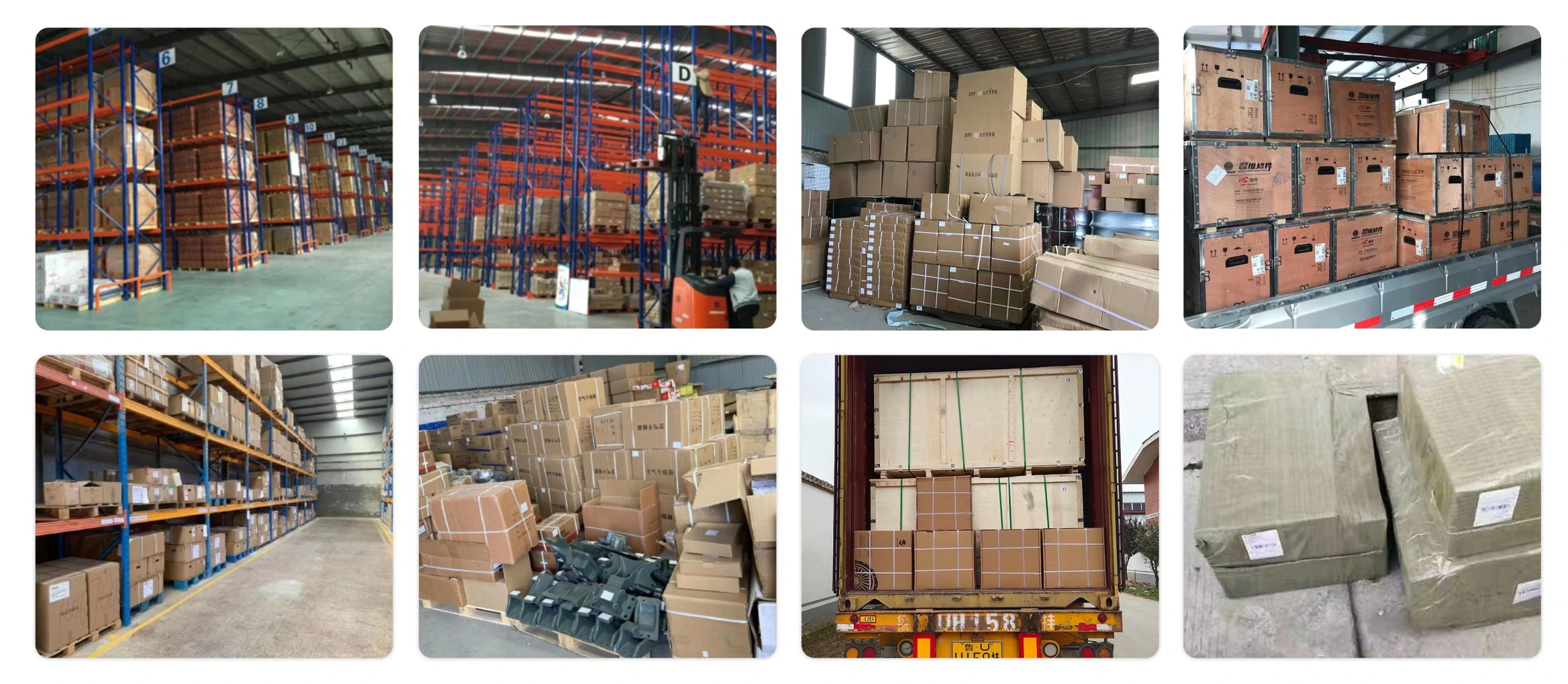
This packaging approach minimizes the risk of corrosion or impact damage, ensuring that parts like the FAW Cylinder Block Assembly arrive in perfect condition. Customers can rely on FAW’s logistics for consistent quality and reliability.