by 


Welcome to this critical safety breakdown of the FAW Scrubber, or windscreen washer, assembly (P/N: 5207010-D03-C00). This system is a primary active-safety feature on the FAW Jiefang CA4251P66K24T1A3E5 6×4 diesel semi-trailer tractor. Its “logic” is to work in perfect synchronization with the ‘FAW Windscreen Wiper’ (Assembly 629) to provide the driver with a clear, unobstructed field of vision. This is essential for safe operation in all weather, especially when dealing with road salt, mud, and insect impacts.
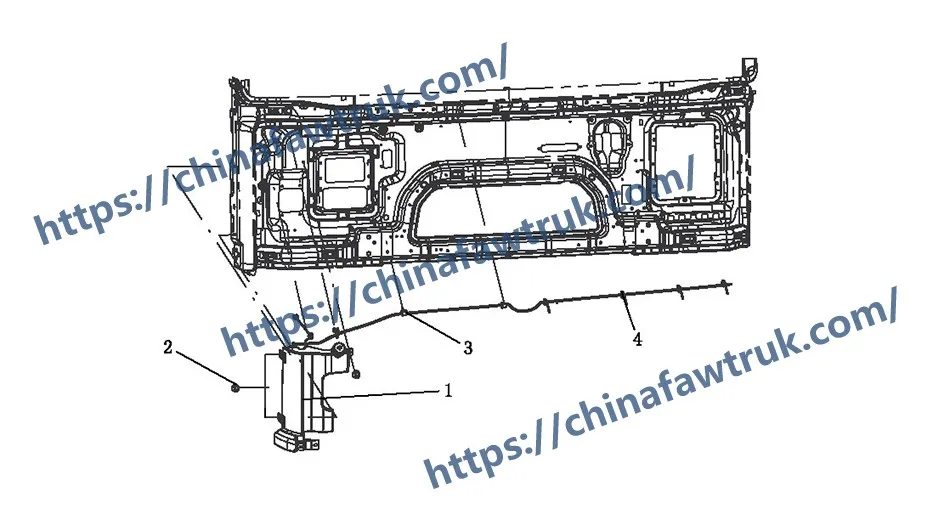
The FAW Scrubber is not just a bottle; it is a “logic assembly” that comprises several key sub-systems: a fluid reservoir, a high-pressure electric pump, fluid lines (hoses), and spray nozzles. The “logic” is to store and deliver cleaning fluid on demand, pressurized and atomized, to the ‘Windscreen’ (Assembly 630). This system is designed for high-vibration, all-weather environments, from sub-zero winters to high-heat summer operation.
This in-depth guide is an essential resource for technicians, fleet managers, and parts specialists. We will deconstruct the entire FAW Scrubber assembly as detailed in the parts diagram. We will analyze the main ‘Washer assy’ (MSU 2) as the primary “black box” component, and just as importantly, the critical “installation logic” of the three other MSUs: the anti-vibration ‘lock nuts’ (MSU 3), and the ‘straps’ (MSUs 1 & 4) that secure the system’s vital arteries.
This component is the “longer” and most complex part of the FAW Scrubber system. The ‘Washer assy’ (5207010-D03-C00) is the primary MSU, a “black box” unit that is replaced as a single part. Its “logic” is to combine three critical functions into one pre-sealed, factory-tested assembly.
1. The Reservoir “Logic” (Storage)
The main body of the ‘Washer assy’ is the fluid reservoir (the “bottle”). This is not a simple container. Its “logic” is based on material science and design.
Material: It is blow-molded from High-Density Polyethylene (HDPE). This material is chosen for its specific “logic”:
Design: The reservoir is molded into a complex, vehicle-specific shape to maximize fluid capacity (often 3-5 liters) while fitting perfectly into the unused, irregular space in the engine bay. It includes a long, ergonomic filler neck and a “breather” cap.
2. The Electric Pump “Logic” (Power)
Integrated into the base of the reservoir is the electric washer pump. This is the “muscle” of the FAW Scrubber. It is a 24V DC motor that drives a small centrifugal impeller.
Its “logic” is to provide high pressure (PSI) to atomize the fluid at the nozzles. It is mounted at the *bottom* of the tank, a “gravity-fed” logic that ensures the pump is always primed and can use every last drop of fluid. The pump is activated by the ‘Combination Switch’ on the steering column, which (via a relay) sends power to this motor.
3. The Fluid Level Sensor “Logic” (Warning)
Also integrated into the ‘Washer assy’ is a low-fluid-level sensor. This is a critical HMI “logic” function. It is typically a “reed switch” with a “float.” When the fluid level drops, a magnetic float sinks, closing an electrical circuit.
This signal is sent to the ‘Combination Instrumentation’ (Assembly 589), illuminating the amber “Low Washer Fluid” warning light. This gives the driver advanced notice to refill, ensuring the FAW Scrubber is always ready.
Because all three of these components are integrated, any failure (a cracked tank, a dead pump, or a faulty sensor) requires the replacement of the single ‘Washer assy’ MSU.
While the ‘Washer assy’ is the heart, the FAW Scrubber system relies on two other (implicit) sets of components to function: hoses and nozzles.
Hose “Logic”: The system uses flexible EPDM rubber or nylon tubing to connect the pump’s output port to the nozzles. The “logic” of this tubing is durability. It must be routed safely through the engine bay, secured by the ‘Harness clips’ (MSU 1) and ‘Plastic straps’ (MSU 4) to prevent it from kinking, chafing, or melting on a hot exhaust manifold. A hole in this hose is a common failure, resulting in a weak or non-existent spray.
Nozzle “Logic”: The fluid is expelled through two or three “nozzles” (or “jets”) located on the cowl panel or on the wiper arms themselves. The “logic” of a modern nozzle is “atomization.” They are not simple “squirters.” They are engineered to break the fluid into a fine, wide “fan” spray that covers the maximum glass area, allowing the ‘Windscreen Wiper’ (629) to clear the glass in a single pass.
The remaining 3 MSUs in the FAW Scrubber parts list form the complete installation and routing kit. Their “logic” is to ensure the system is mounted securely and its “arteries” (hoses and wires) are protected.
MSU 3: ‘Hexagon head flange lock nut’ (Q032606) – Qty 3
This is the “anti-vibration” mounting logic. The ‘Washer assy’ (MSU 2) has three molded-in mounting points that slide over fixed studs on the cab’s inner fender or firewall. These three nuts are what hold the entire 10-pound (when full) assembly in place.
They are not standard nuts. They are “flange lock nuts.”
MSUs 1 & 4: ‘Harness clip’ (3724012-A01) & ‘Plastic strap’ (T67414646) – Qty 7 total
This is the “routing logic” for the FAW Scrubber system. This kit of 7 clips and straps is used to secure the pump’s electrical wire and the fluid hose. Their “logic” is to prevent chafing and heat damage. A technician uses these MSUs to fasten the hose/wire securely to the chassis, far away from the hot engine block, the exhaust manifold, and any moving parts (like the steering shaft or fan belts). A missing clip can lead to a melted hose or a shorted wire, disabling the entire system.
The following table provides the complete, detailed breakdown of all 4 component types identified in the FAW Scrubber (Washer) assembly for the FAW CA4251P66K24T1A3E5 tractor.
| Mark | Part No. | Part Name | Quantity |
|---|---|---|---|
| 1 | 3724012-A01 | Cable tie type harness clip II | 3 |
| 2 | 5207010-D03-C00 | Washer assy | 1 |
| 3 | Q032606 | Hexagon head flange lock nut | 3 |
| 4 | T67414646 | Plastic retaining strap | 4 |
The specifications for the FAW Scrubber are defined by its function as an integrated, electro-mechanical fluid delivery system for the windscreen.
| Vehicle Application | FAW Jiefang CA4251P66K24T1A3E5 6×4 Tractor |
| Component Group | FAW Scrubber (Washer) |
| System Type | Windscreen Washer System (Electric) |
| System Voltage | 24V DC (Nominal) |
| MSU 1 (Main) | ‘Washer assy’ (5207010-D03-C00) – Qty 1 |
| MSU 1 Sub-Parts | HDPE Reservoir, 24V Electric Pump, Fluid Level Sensor |
| MSU 2 (Hardware) | ‘Hexagon head flange lock nut’ (Q032606) – Qty 3 |
| MSUs 3 & 4 (Routing) | ‘Harness clip’ (3724012-A01) / ‘Plastic strap’ (T67414646) – Qty 7 total |
| Fastener Logic | Anti-Vibration (Flange Lock Nut), Secure Routing (Clips/Straps) |
| Serviceability | Main ‘Washer assy’ is a single, sealed MSU. Lock nuts are single-use. |
FAW parts, including the Cylinder Block Assembly, are packaged with care to ensure safe delivery. Each component is secured in protective materials to prevent damage during transit. The logistics network guarantees timely shipments worldwide, supporting efficient maintenance operations. Below is an image illustrating the standard packaging for FAW truck parts, showcasing the attention to detail in handling and storage.

This packaging approach minimizes the risk of corrosion or impact damage, ensuring that parts like the FAW Cylinder Block Assembly arrive in perfect condition. Customers can rely on FAW’s logistics for consistent quality and reliability.